
You have 0 items in your cart

Why Residential Property Disputes Require Expert Legal Guidance
Residential property dispute solicitors are legal professionals who help homeowners, landlords, and tenants resolve conflicts over property rights, boundaries, leases, and ownership. They provide strategic advice, negotiate settlements, and represent clients in court when disputes cannot be resolved amicably.
What Residential Property Dispute Solicitors Can Help With:
- Boundary disputes – disagreements over fence lines, walls, or property limits
- Landlord and tenant conflicts – rent arrears, evictions, disrepair claims, deposit disputes
- Neighbour disputes – nuisance claims, noise complaints, rights of way issues
- Jointly owned property – disagreements between co-owners about sale or use
- Leasehold disputes – service charge issues, lease extensions, breach of covenant
- Title disputes – adverse possession claims, trespass, squatters
Your home is one of your most valuable assets. When a property dispute arises, it can be both financially draining and emotionally exhausting. As one law firm notes, “property disputes can leave you feeling frustrated, fearful and ignored.”
Whether you’re facing a boundary disagreement with a neighbor, dealing with a problem tenant, or navigating a complex ownership dispute with a co-owner, the way you handle the dispute from the start often determines the outcome.
Property law is complicated. The right solicitor will identify issues early, protect your interests, and work toward a resolution that minimizes cost and stress. Sometimes that means negotiating a settlement. Other times it means taking decisive court action to defend your rights.
If you want a neutral overview of how property rights and disputes are typically framed in law, see the general background on property law. This guide then explains the types of residential property disputes, when to seek legal help, and how experienced solicitors approach resolution—from negotiation through litigation.
What Constitutes a Residential Property Dispute?
At its core, a residential property dispute is any legal disagreement between two or more parties concerning a residential property. This can involve homeowners, landlords, tenants, or even third parties like local authorities or developers. These disputes are often emotionally charged because they touch upon a person’s home and personal sanctuary. They can range from seemingly minor squabbles to complex legal battles with significant financial implications. When you find yourself unable to reach a resolution through direct communication, that’s when a dispute officially takes root and professional legal assistance becomes crucial.
Common Types of Residential Property Disputes
Residential property disputes are as varied as the properties themselves. While each case has unique aspects, certain types appear more frequently. Understanding these common disputes helps you identify your situation and know when to call residential property dispute solicitors.

Boundary Disputes
Boundary disputes arise when neighbors cannot agree on where one property ends and another begins. This could involve a misplaced fence, encroaching shed, or differing interpretations of property lines. These disputes escalate quickly because they involve perceived invasions of personal space and property rights. Resolving them requires careful review of title deeds, land surveys, and sometimes historical evidence.
Landlord and Tenant Issues
For both landlords and tenants, residential properties can become a minefield of potential disputes. Landlords might face:
- Rent arrears: When tenants fall behind on payments.
- Evictions: The complex process of removing a tenant from a property.
- Disrepair claims: Tenants alleging failure to maintain the property.
- Deposit disputes: Disagreements over security deposit returns.
Tenants might need protection from unlawful eviction, neglected repairs, or service charge disputes. These cases require thorough understanding of landlord-tenant laws, which vary significantly by jurisdiction.
Neighbour Disputes
Beyond boundaries, neighbors can clash over multiple issues:
- Nuisance claims: Excessive noise, smells, or disturbances interfering with property enjoyment.
- Noise complaints: Common in densely populated areas.
- Rights of way: Disputes over shared driveways or access routes.
- Overhanging trees: When greenery extends onto your property.
These disputes severely impact quality of life and property value, making timely intervention essential.
Jointly Owned Property Disagreements
When multiple individuals own property together, disagreements can arise regarding use, maintenance, or sale. These conflicts are emotionally charged, especially with separating couples or inherited properties. We assist clients navigating these scenarios, often involving legal frameworks like TOLATA in common law jurisdictions. Our goal is finding a fair path forward for all parties. Learn more about resolving conflicts in our guide on Dispute.
Rights of Way and Easements
An easement grants someone the right to use another’s land for specific purposes. Disputes arise when these rights are challenged, obstructed, or unclear in scope. This could involve neighbors blocking established pathways or arguing over access rights. These issues significantly affect property usability and value.
Restrictive Covenants
Restrictive covenants are legal clauses limiting land use. For example, preventing building above certain heights or operating commercial businesses in residential areas. Disputes occur when owners breach covenants, or when someone seeks to enforce, modify, or remove outdated ones. These require careful analysis of historical deeds and planning regulations.
Leasehold Disputes
Leasehold properties involve owning property for fixed periods, subject to freeholder conditions. Disputes include:
- Service charges: Disagreements over maintenance charges.
- Lease extensions: The process and cost of extending lease terms.
- Breach of covenant: Failing to adhere to lease agreements.
- Management disputes: Issues with property management responsibilities.
These disputes are intricate due to layered legal relationships and benefit from early specialist advice.
The Crucial Role of Residential Property Dispute Solicitors
When residential property disputes arise, the involvement of experienced residential property dispute solicitors can be the difference between a protracted, costly battle and an efficient, favorable resolution. At Ironclad Law, we are more than just legal advisors; we are strategic partners, advocates, and when needed, fierce litigators.
Solicitor’s Role Defined
Our role typically includes:
- Legal Advisor: We provide clear, understandable explanations of your rights and obligations under property law, clarifying the complexities of your situation.
- Negotiator: We engage with the opposing party, aiming for amicable settlements that protect your interests and avoid the need for court where possible.
- Litigator: When negotiations fail, we are prepared to represent you in court, deploying our “bulldog” litigation style to fight for your rights.
- Strategic Planning: We develop a custom strategy for your case, identifying potential challenges and opportunities for resolution.
- Evidence Gathering: We help you compile all necessary documentation, from title deeds and leases to correspondence and photographic evidence.
- Risk Assessment: We provide a realistic assessment of your position, outlining potential outcomes, costs, and timelines so you can make informed decisions.
- Protecting Your Interests: Above all, our goal is to safeguard your property rights and achieve the best possible outcome for you.
Here at Ironclad Law, our property dispute solicitors offer a comprehensive suite of services designed to address all aspects of residential property conflicts, including:
- Initial case assessment and strategic advice
- Negotiation and mediation with opposing parties
- Drafting and reviewing legal documents
- Representation in court or tribunals
- Enforcement of judgments
- Guidance on alternative dispute resolution (ADR) options
- Cost-conscious solutions custom to your objectives
For more information on how we handle property-related legal matters, visit our page on Property Transaction Lawyer.
When to Seek Advice from Residential Property Dispute Solicitors
The timing of seeking legal advice can significantly impact the outcome of a dispute. While a direct conversation with a neighbor or a tenant might seem like the first step, there are clear indicators that it is time to bring in professionals.
- Early Intervention Benefits: The sooner you involve us, the better. Early, strategic involvement helps address issues efficiently and reduces the risk of unnecessary escalation.
- Before the Dispute Escalates: If initial attempts at communication have failed, or if the other party is becoming aggressive or uncooperative, it is wise to seek legal counsel so we can impose structure on the dialogue.
- When Communication Breaks Down: If you are no longer able to communicate constructively with the other party, or if they are ignoring your concerns, we can step in to represent your interests.
- Receiving a Legal Notice: If you receive any formal legal document, such as an eviction notice, a letter from a solicitor, or a court summons, contact us immediately. These documents often have strict deadlines and legal implications that require prompt attention.
- When Your Property Rights Are Infringed: If you believe your ownership rights, access rights, or peaceful enjoyment of your property are being violated, we can assess the situation and advise on the best course of action.
- To Understand Your Legal Position: Sometimes, you just need to know where you stand. We can provide a realistic assessment of your legal position, your options, and the potential costs involved.
How a Solicitor Manages Landlord and Tenant Conflicts
Landlord and tenant disputes are a significant portion of residential property litigation. These conflicts can be particularly stressful, affecting someone’s home or a landlord’s investment. Our approach is to provide pragmatic, effective solutions.
- Serving Correct Notices: We ensure all legal notices, such as those required for eviction or rent increases, are drafted and served correctly and within the proper timelines. Incorrect notices can lead to significant delays and legal complications.
- Defending Possession Proceedings: For tenants facing eviction, we can review the landlord’s case, identify any procedural errors, and build a strong defense to protect your right to remain in your home where the law permits.
- Handling Deposit Disputes: We assist both landlords and tenants in resolving disagreements over security deposits, ensuring compliance with applicable deposit protection schemes and fair deductions for damages.
- Pursuing Rent Arrears: For landlords, we pursue unpaid rent through demand letters, negotiation, and if necessary, court action to recover what is owed.
- Addressing Property Disrepair Claims: We represent tenants whose landlords have neglected their maintenance obligations, seeking compensation for damages and compelling landlords to perform necessary repairs. We also defend landlords against unfounded disrepair claims.
- Negotiating Tenancy Surrenders: We facilitate the smooth and legally sound termination of tenancies, whether through mutual agreement or formal surrender, minimizing financial risk for both parties.
Navigating the Path to Resolution
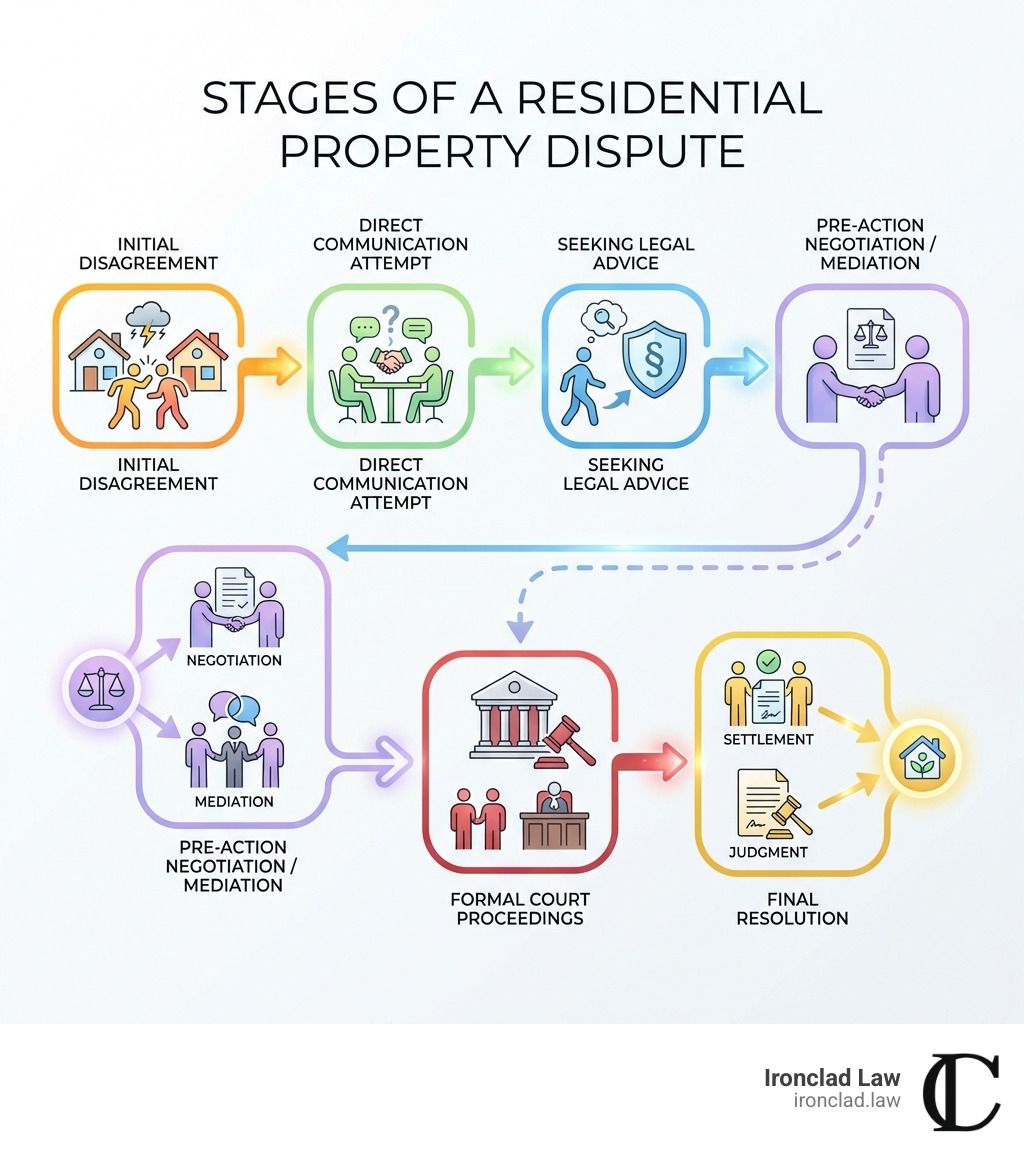
Resolving a residential property dispute requires a clear strategy and a firm hand. Our approach at Ironclad Law is always objective-led: we first understand your goals, then chart the most efficient and effective course to achieve them.
Legal Avenues Overview
When a dispute arises, there are generally two broad paths to resolution: negotiation and alternative dispute resolution (ADR), or formal litigation through the courts. We explore all options, always aiming for the most cost-effective and swift resolution possible, but we are never afraid to go to trial when it is in your best interest.
- Proactive Approach: We believe in identifying and dealing with issues early to minimize disputes or escalation. This means providing immediate, clear advice and taking decisive action.
- Cost-Effective Strategies: We are transparent about costs from the outset and strive to resolve disputes efficiently, often through negotiation or mediation, to avoid the higher costs associated with court proceedings.
- Strategic Action: If court action becomes necessary, we act decisively and strategically, focusing on the desired outcome, proportionality, and strict cost control.
Here is a quick comparison of negotiation and litigation:
| Feature | Negotiation/ADR | Court Litigation |
|---|---|---|
| Control | Parties retain control over the outcome | Judge or jury decides the outcome |
| Cost | Generally lower | Can be significantly higher |
| Time | Often quicker | Can be lengthy and unpredictable |
| Privacy | Confidential | Public record |
| Relationships | Can preserve or repair relationships | Often adversarial, can damage relationships |
| Formality | Informal to semi-formal | Highly formal and structured |
| Outcome | Mutually agreed settlement | Binding judgment or order |
For more insights into resolving various business conflicts, see our guide on Business Dispute Resolution.
The Benefits of Negotiation and Early Settlement
We always explore negotiation and ADR as primary tools for resolving residential property disputes. These methods offer numerous advantages, particularly for residential matters where ongoing relationships (for example, with neighbors) might be important.
- Mediation Process: Mediation involves a neutral third party (the mediator) who helps the disputing parties communicate, understand each other’s positions, and reach a mutually acceptable agreement.
- Cost Savings: ADR methods are typically less expensive than taking a case to court, as they avoid extensive legal fees, court costs, and expert witness expenses.
- Time Efficiency: Disputes resolved through negotiation or mediation often conclude much faster than court cases, which can drag on for months or even years.
- Confidentiality: Unlike court proceedings, which are generally public, ADR processes are confidential.
- Preserving Relationships: When parties have to continue living side-by-side, negotiation and mediation can help preserve or even mend relationships.
- Control Over the Outcome: In ADR, the parties themselves have control over the terms of the settlement, rather than having a decision imposed upon them by a court.
The Litigation Process: When Court Action is Unavoidable
When negotiation and ADR fail, or when the other party is unreasonable or simply unwilling to compromise, we are fully prepared to take your case to court. Litigation is a structured legal process designed to resolve disputes through the judicial system.
- Pre-Action Protocols: Before filing a lawsuit, there are often specific steps (pre-action protocols) that parties must follow, such as exchanging information about the dispute and attempting to resolve it. We guide you through these mandatory steps.
- Filing a Claim: If pre-action efforts are unsuccessful, we will prepare and file a formal claim with the appropriate court, outlining your case and the relief you seek. This officially begins the litigation process.
- Court Proceedings: This phase involves various stages, including exchanging evidence, hearings, and potentially a full trial. We carefully prepare your case, gather all necessary evidence, and present your arguments in court.
- Injunctions: In urgent situations, we can seek injunctions—court orders that compel a party to do something or refrain from doing something (for example, stopping a neighbor from continuing a nuisance).
- Declarations: We can also seek declarations from the court, which are formal statements of legal rights or facts (such as a declaration of a boundary line).
- The Role of a Litigator in Court: Our role as litigators is to be your advocate. We cross-examine witnesses, present arguments, and challenge the opposing side’s case with tenacity and precision.
To understand the typical stages and what to expect when working with us, please review our page on Timeline and what to expect when working with your attorney.
Handling Specific and Complex Property Disputes
Some residential property disputes dig into highly specialized areas of law, requiring particular expertise and often additional professional input. We have the experience and resources to tackle even the most intricate cases.

Our work in complex disputes often includes careful analysis of title deeds, commissioning expert surveyor reports, carrying out Land Registry or county recorder searches, and reviewing relevant legal precedents to build a robust case.
The Process for Resolving Boundary Disputes
Boundary disputes are notoriously contentious. Our process for handling them is thorough and strategic:
- Reviewing Title Plans: We start by examining all relevant title deeds and plans for both properties. These documents are often the primary source of truth, though they can sometimes be ambiguous.
- Instructing a Boundary Surveyor: Often, the legal documents are not enough. We work with independent, expert boundary surveyors who can physically interpret the deeds, examine historical features, and provide an opinion on the true boundary line.
- Negotiation with Neighbors: Armed with legal and surveying evidence, we attempt to negotiate a settlement with your neighbor, aiming for a formal boundary agreement that avoids court.
- Formal Determination of the Boundary Line: If negotiation fails, we can pursue a formal determination through the courts, or specific land tribunals where applicable, to legally define the boundary.
- Adverse Possession Claims: In some cases, a person might claim ownership of land that legally belongs to another, based on continuous, open, and hostile occupation for a statutory period. We handle both defending against and pursuing adverse possession claims, which are complex and highly fact-dependent.
Key Considerations for Jointly Owned and Leasehold Properties
Disputes involving jointly owned properties or leasehold arrangements require a deep understanding of specific legal frameworks.
- Trusts of Land and Appointment of Trustees Act (TOLATA): In jurisdictions with similar common law principles, TOLATA-like provisions govern disputes between co-owners of land, particularly when one party wants to sell and the other does not, or when there are disagreements about financial contributions.
- Disputes Between Co-owners: Whether you are dealing with a former partner, a family member, or a business associate, we can help resolve disagreements over the use, management, or sale of jointly owned property.
- Forcing a Sale: If co-owners cannot agree on selling a property, we can initiate legal proceedings to compel a sale, seeking a fair distribution of proceeds.
- Lease Extensions: For leasehold properties, we advise on your rights and obligations regarding lease extensions, negotiating terms with freeholders and representing you in any tribunal or court proceedings.
- Breach of Lease Covenants: We act for both leaseholders and freeholders in disputes arising from breaches of lease terms, such as unauthorized alterations, sub-letting issues, or failure to maintain the property.
- Right to Manage: In certain leasehold structures, leaseholders may have the right to take over the management of their building from the freeholder. We guide groups of leaseholders through this process.
For expert assistance in navigating property agreements and disagreements, consult our Real Estate Negotiation Lawyer services.
Understanding Restrictive Covenants and Land Ownership
The legal implications of restrictive covenants on land can significantly impact a property’s value and usability.
- What are Restrictive Covenants: These are legally binding conditions tied to the land, dictating what can or cannot be done with it. They are often put in place by previous owners to maintain the character of an area.
- Enforcing a Covenant: If a neighbor or developer breaches a restrictive covenant that benefits your property, we can take legal action to enforce it, potentially seeking an injunction to stop the activity or damages.
- Applying to Modify or Discharge a Covenant: Sometimes, covenants become outdated or impractical. We can assist property owners in applying to the relevant authorities or courts to modify or remove these restrictions, making their land more usable or developable.
- Disputes Over Beneficial Interest: These arise when the legal owner of a property is different from the person who is entitled to its benefits. This often occurs in informal arrangements or family disputes. We work to establish and protect your true beneficial interest in a property.
- Trespass and Squatters’ Rights: We act to address instances of trespass or squatting on your property, initiating legal proceedings to remove unauthorized occupants and reclaim possession.
Frequently Asked Questions about Residential Property Dispute Solicitors
What is the typical timeline for resolving a residential property dispute?
The timeline varies from weeks to years, depending on the case’s complexity, party cooperation, and the resolution method used.
- Factors Influencing Duration: Simple disputes resolved via negotiation may end quickly. Cases needing extensive evidence or expert reports (such as boundary surveys) take longer.
- Simple vs. Complex Cases: A straightforward rent arrears case might take a few months. A complex boundary dispute with uncooperative neighbors could stretch beyond a year if it goes to court.
- Negotiation vs. Court Timeline: Negotiation or mediation can conclude in a few months. Court litigation involves fixed schedules and can take six months to a year or more.
- Importance of Solicitor Efficiency: A proactive approach helps streamline the process and minimize delays.
How do solicitors ensure cost-effectiveness in property litigation?
Legal costs are a major concern in any dispute. Cost-effectiveness should be built into every stage of the service:
- Initial Case Assessment: Providing a realistic assessment of your case, including potential costs and risks, so you can make an informed decision.
- Transparent Fee Structures: Being upfront about fees and providing clear estimates with no hidden surprises.
- Proportionate Costs: Always considering whether the potential costs are proportionate to the likely outcome. A pragmatic settlement is often the most cost-effective solution.
- Exploring Early Settlement: Actively pursuing negotiation and mediation, which are generally cheaper and faster than court.
- Avoiding Court Fees Where Possible: Resolving disputes out of court helps avoid significant court filing fees and trial preparation costs.
What should I bring to my first meeting with a property dispute solicitor?
To make your initial consultation productive, bring all relevant documents and an overview of the situation. This helps your solicitor grasp the details and provide accurate advice.
- All Relevant Documents: Deeds, leases, tenancy agreements, contracts of sale.
- Title Deeds/Plans: Crucial for boundary or ownership disputes.
- Leases/Tenancy Agreements: Essential for landlord-tenant or leasehold disputes.
- Correspondence: Emails, letters, or texts with the other party.
- Photographs/Videos: Visual evidence of damage, encroachment, or nuisance.
- A Timeline of Events: A chronological summary of what has happened.
Conclusion: Secure Your Property Rights with Expert Legal Counsel
Residential property disputes can be overwhelming, impacting your peace of mind and financial well-being. From boundary battles and landlord-tenant clashes to complex leasehold issues and ownership disagreements, these conflicts demand a strategic, informed, and determined legal approach.
This guide has outlined common types of disputes, the crucial role that residential property dispute solicitors play, and the various legal avenues available for resolution—from amicable negotiation to court action. Early intervention, clear communication, and a robust strategy are key to navigating these challenges effectively.
At Ironclad Law, we understand the immense value you place on your home and property rights. We are prepared to take a firm stance when necessary and pursue your case vigorously in court while always weighing whether negotiation, mediation, or litigation best serves your objectives.
Do not let a property dispute compromise your home or your peace. For complex property disputes that may require a strong litigation strategy, the experienced team at Ironclad Law is ready to advise you on your options and represent your interests.