
You have 0 items in your cart

Why Every Business Needs a Dispute Resolution Strategy
Corporate dispute resolution is the process of addressing and settling conflicts that arise in business relationships—whether between shareholders, business partners, employees, or contracting parties. When a dispute emerges, you have three main paths forward:
- Litigation: A formal court process that produces binding, public decisions and allows appeals
- Mediation: A confidential, collaborative process where a neutral third party helps negotiate a settlement
- Arbitration: A private proceeding where an arbitrator makes a binding decision outside of court
Business relationships can break down for numerous reasons. They range from unpaid invoices to interpreting key clauses in a contract to interpersonal conflicts. Disputes can arise at any time—frequently between co-contracting parties, employers and their employees, businesses and their clients, or among shareholders under a Unanimous Shareholders’ Agreement.
The cost of inaction is steep. Unresolved disputes drain resources, distract leadership, damage relationships, and create legal vulnerabilities that compound over time. More and more people are looking outside the courtroom for quicker and potentially less costly alternatives for resolving disputes. Yet most court actions still settle before trial, and when they don’t, the stakes—and costs—escalate dramatically.
Contrary to popular belief, not all disputes need to end up in court. The sooner you address a conflict, the better. As time goes by, it becomes harder to agree on a solution. Using dispute resolution methods early can save both time and money involved in taking a dispute to court.
Effective and proactive management of nascent and actual disputes can significantly contribute to reducing costs, achieving a satisfactory outcome, and preserving business and contractual relationships. It is good business practice to identify issues early and attempt to avoid or de-escalate disputes before they spiral into full-blown litigation. The investment of time in proper drafting of a contract and establishing a rational approach to dispute resolution when negotiating any formal business arrangement can prevent disputes entirely.
This guide will walk you through the three pillars of corporate dispute resolution—litigation, mediation, and arbitration—and help you understand when to deploy each method. You’ll learn how to choose the right path based on your specific goals, financial situation, and the complexity of your dispute. You’ll also find proactive measures to prevent conflicts before they start and strategies for navigating complex, multi-jurisdictional disputes.
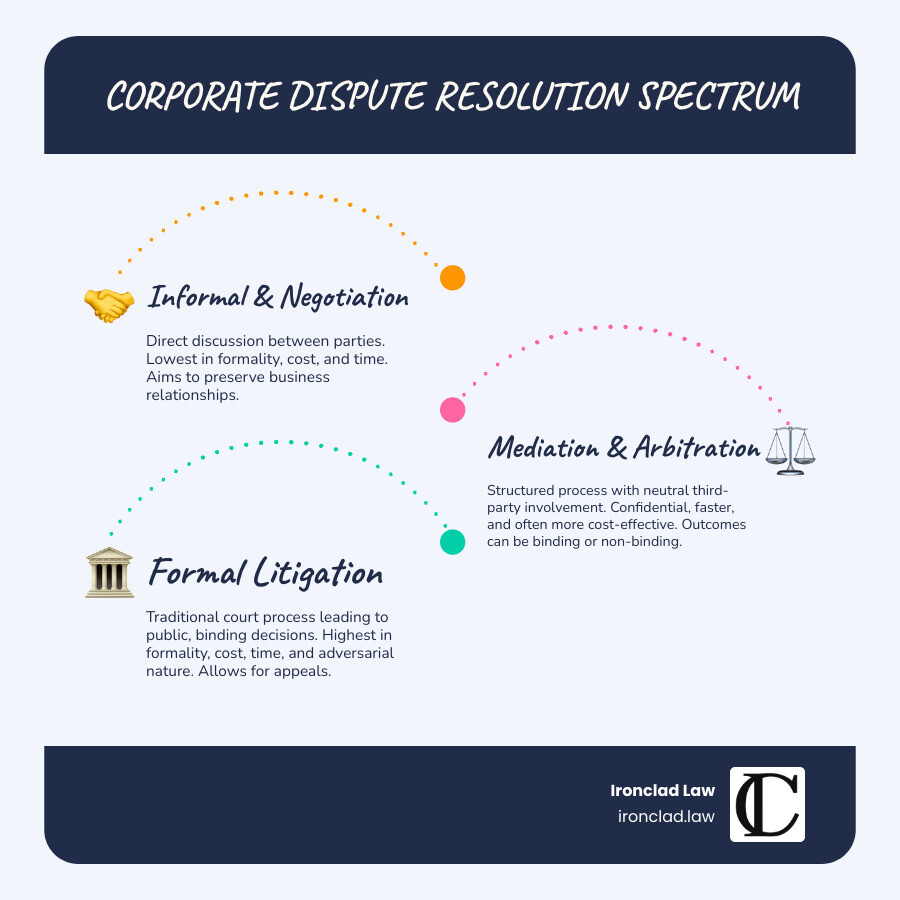
The Three Pillars of Corporate Dispute Resolution: Litigation, Mediation, and Arbitration
When a business dispute arises, understanding your options is the first step toward a resolution. We’ll compare the primary methods for resolving business conflicts, outlining the process, pros, and cons of each.
Litigation: The Formal Court Battle
Litigation is the traditional route for resolving disputes, involving a formal court process. It’s often the most visible and adversarial method, where parties present their cases before a judge or jury, leading to a binding and public decision.
The Process: Litigation typically begins with filing a complaint (or Statement of Claim) and serving it on the opposing party. This is followed by a response (Statement of Defense), then a lengthy “findy” phase where both sides exchange information and evidence. This can involve depositions, interrogatories, and requests for documents. If a settlement isn’t reached, the case proceeds to trial, culminating in a judgment. The losing party may then have the option to appeal the decision to a higher court.
Advantages:
- Binding Decisions and Enforceability: Court judgments are legally binding and enforceable, backed by the power of the state.
- Public Record: The public nature of litigation means that decisions can set legal precedent, offering clarity for future disputes or deterring similar misconduct. This can be desirable if you want to publicize the issue or establish a broadly applicable solution.
- Legal Remedies: Courts can grant a wide range of legal remedies, including injunctions, specific performance, and significant damages awards. In the U.S., punitive damages, though rare, can be substantial, differing significantly from other jurisdictions.
- Appeals Process: If you disagree with the court’s decision, you generally have the right to appeal, ensuring another level of judicial review.
Disadvantages:
- High Costs: Litigation is notoriously expensive, involving substantial legal fees, court costs, and expert witness charges. Unlike many other countries where the losing party might pay a portion of the winner’s legal costs, in the U.S., parties typically pay their own, regardless of the outcome.
- Time-Consuming: The findy phase alone can take months or even years, delaying resolution and diverting significant company resources.
- Adversarial Nature: Litigation is inherently confrontational, often damaging business relationships beyond repair. This can be particularly problematic for ongoing partnerships or collaborations.
- Lack of Confidentiality: Court proceedings and documents are generally public, exposing sensitive business information and potentially harming your company’s reputation.
When to Litigate: Litigation is often reserved for high-stakes disputes where negotiations have failed, or when one party seeks to establish a legal precedent, deter future breaches, or requires a public, binding judgment. It’s also appropriate if there’s a significant power imbalance that cannot be managed by other means, or if violence is involved.
For example, in the UK, the Commercial Court handles complex business disputes, including international trade, commodities, banking, and arbitration awards. This is an example of a specialized court for complex commercial matters. While we have similar specialized courts in the U.S., the specific procedures and names differ.
To learn more about how we approach resolving complex business conflicts, visit our page on More info about Business Dispute Resolution services.
Mediation: The Collaborative Approach
Mediation is a confidential process where a neutral third party, the mediator, helps disputing parties communicate and negotiate to reach a mutually acceptable resolution. It’s often seen as a collaborative, rather than adversarial, approach.

The Process: A mediator doesn’t make decisions or impose solutions. Instead, they facilitate discussion, encourage information exchange, help manage emotions, and guide parties toward common ground. The process is informal and conversational, allowing for creative solutions custom to the parties’ specific needs. While generally voluntary, some jurisdictions in the U.S. may require parties to attempt mediation for certain civil cases. For example, mandatory mediation in civil cases is a requirement in some parts of Ontario, Canada.
Advantages:
- Confidentiality: Mediation proceedings are typically private and confidential, protecting sensitive business information and reputation.
- Preserving Relationships: Its collaborative nature helps maintain or even improve business relationships, which is invaluable for ongoing partnerships, supplier agreements, or shareholder relations.
- Cost-Effective: Generally less expensive than litigation, mediation can save significantly on legal fees and court costs.
- Faster Resolution: Disputes can often be resolved in a matter of days or weeks, rather than months or years.
- Flexibility and Control: Parties retain control over the outcome, as any agreement reached must be mutually acceptable. This leads to agreements that parties are more likely to comply with because they helped design them.
- Focus on Root Causes: Mediators can help parties address the underlying problems contributing to a dispute, not just the surface issues.
Disadvantages:
- Non-Binding Outcomes: Unless formalized into a legally binding contract, agreements reached in mediation are not automatically enforceable.
- No Guaranteed Outcome: There’s no guarantee that parties will reach an agreement, potentially leading to further dispute resolution efforts.
- Power Imbalances: If there’s a significant power imbalance between parties, the weaker party might feel pressured, and the mediator’s role in ensuring fairness becomes crucial. In cases of extreme power imbalance, mediation might not be suitable.
- Requires Good Faith: The success of mediation heavily relies on the commitment and good faith of all parties involved to genuinely seek a resolution.
When to Mediate: Mediation is highly effective for disputes where preserving business relationships is a priority, confidentiality is essential, and parties are willing to openly discuss solutions. It’s particularly useful for contract disputes, partnership disagreements, and issues between businesses and clients. Historically, business disputes submitted to professional mediation services have had a settlement rate of about 80 percent, highlighting its effectiveness.
Arbitration: The Private Adjudication
Arbitration is a private process where disputing parties present their case to a neutral third party (or panel of parties), the arbitrator, who then makes a binding decision. It’s often described as a hybrid between litigation and mediation, offering elements of both.

The Process: Arbitration typically begins with a written agreement to arbitrate, often found within a larger business contract. Parties select an arbitrator, who is often a specialist in a specific legal field relevant to the dispute. The process involves presenting evidence, witness testimony, and legal arguments, similar to a trial, but with more relaxed rules of procedure. The arbitrator then issues an “award,” which is legally binding.
Advantages:
- Binding Award: The arbitrator’s decision is final and legally binding, similar to a court judgment, and generally enforceable globally.
- Confidentiality: Arbitration proceedings are typically private, protecting sensitive business information from public scrutiny.
- Specialized Arbitrators: Parties can choose arbitrators with specific expertise in their industry or the subject matter of the dispute, leading to more informed decisions.
- Efficiency: Arbitration can be faster and more flexible than litigation, as parties can often agree on streamlined procedures and timelines.
- Limited Appeals: While this can be a disadvantage, the limited grounds for appeal mean greater finality and less opportunity for protracted legal battles.
- Flexibility and Control: Parties often have greater control over the procedural framework, including the scope, place, rules, and language of the arbitration.
Disadvantages:
- Limited Appeals: The grounds for appealing an arbitration award are very narrow, meaning there’s little recourse if you believe the arbitrator made a mistake.
- Potential Expense: While often touted as cheaper than litigation, complex arbitration cases, especially international ones, can still be expensive, involving arbitrator fees and administrative costs.
- Risk of Arbitrator Bias: Though arbitrators are expected to be neutral, some critics argue that repeated selection by the same parties could introduce subtle biases.
- Findy Limitations: The findy process in arbitration is typically more limited than in litigation, which could be a disadvantage if extensive fact-finding is crucial to your case.
When to Arbitrate: Arbitration is particularly common in industries like securities, where most new account agreements include an arbitration clause, and formal litigation in court is rarely available to investors. The U.S. Supreme Court’s decision in Shearson/American Express, Inc. v. McMahon, 482 U.S. 220, 107 S.Ct. 2332 (1987), authorized the use of arbitration for securities disputes. International commercial disputes also frequently rely on arbitration, with frameworks like the ICC Arbitration Rules and Procedure providing globally recognized standards. It’s an excellent choice when confidentiality, specialized expertise, and a binding, efficient resolution are paramount.
For comprehensive legal support in navigating arbitration, explore our More info about Arbitration Lawyer services.
Strategic Decision-Making: Choosing Your Path
Choosing the right corporate dispute resolution method is a strategic decision that can significantly impact your business. It’s not a one-size-fits-all choice; the best approach depends on a careful evaluation of various factors.
Analyzing Your Goals and Financial Situation
Your business objectives should be the compass guiding your dispute resolution strategy. We help you consider:
- Business Objectives: What do you truly want to achieve? Is it a quick resolution, maximum financial recovery, preserving a relationship, setting a precedent, or protecting your reputation? For instance, if your goal is to deter future misconduct, litigation might be necessary, but if preserving a long-term supplier relationship is key, mediation could be better.
- Financial Resources: How much are you prepared to invest in resolving this dispute? Litigation can be a black hole for finances, while mediation and arbitration are generally more cost-effective. We help you evaluate the financial resources you are prepared to commit, weighing the potential costs against the potential benefits. Early risk assessment, potentially using decision tree models, can help evaluate legal risks and outcomes.
- Risk Tolerance: Are you comfortable with the uncertainty and public exposure of litigation, or do you prefer the predictability and privacy of arbitration? Do you want to maintain control over the outcome (mediation), or are you willing to cede that control to a third party (arbitration or litigation)?
- Complexity of the Dispute: Simple, clear-cut disputes might be resolved through negotiation or mediation, while highly complex issues involving intricate legal questions or multiple parties might necessitate arbitration or even litigation to ensure a thorough examination.
- Stakeholder Interests: Consider the impact on employees, shareholders, customers, and other stakeholders. Their interests and concerns should play a role in your decision-making.
Effective corporate dispute resolution aligns legal action with your broader More info about Strategic Business Planning services.
The Role of Relationships, Speed, and Confidentiality
Beyond financial considerations, the intangible aspects of a dispute often dictate the most appropriate resolution method:
- Preserving Relationships: For disputes with business partners, key suppliers, or long-term clients, maintaining the relationship might be more valuable than a complete legal victory. Mediation excels here, fostering communication and collaborative problem-solving. Some disputes require a delicate hand to preserve relationships, while others demand tenacity.
- Urgent Resolution Needs: Some business disputes require immediate attention to prevent further financial loss or operational disruption. Mediation and arbitration generally offer faster timelines than litigation, which can drag on for years.
- Protecting Trade Secrets and Sensitive Information: If your dispute involves proprietary information, intellectual property, or other sensitive data, confidentiality is paramount. Mediation and arbitration offer a private forum, shielding your company from public scrutiny. Zero-knowledge proofs, an advanced cryptographic technique, can even allow us to verify claims and authenticate evidence without revealing the underlying sensitive information, which is crucial in protecting trade secrets during litigation.
- Reputation Management: The public nature of litigation can attract negative media attention and damage your brand. Confidential methods like mediation and arbitration help manage your company’s public image by keeping the details of the dispute private.
Long-Term Implications for Your Business
The choice of corporate dispute resolution method reverberates far beyond the immediate outcome, shaping your company’s future:
- Impact on Reputation: A protracted, public legal battle can severely tarnish your company’s image, regardless of the outcome. Conversely, a discreet, amicable resolution can demonstrate your commitment to fair dealings and effective problem-solving.
- Future Operations: The method chosen can affect ongoing business operations. An adversarial court case can divert management attention and resources for extended periods, whereas a swift, private resolution allows you to refocus on your core business.
- Deterring Future Misconduct: While mediation and arbitration offer privacy, a decisive litigation victory can send a strong message, deterring similar issues from arising in the future.
- Establishing Legal Rights: Litigation allows for the establishment of legal precedent, which can be crucial for clarifying rights and obligations in emerging areas of law, such as with cross-chain digital assets where courts have not yet established clear precedents. This can protect your business in the long run.
Understanding these long-term impacts is a critical component of More info about Legal Risk Management services.
Proactive Measures and Advanced Corporate Dispute Resolution Strategies
The best defense against a costly corporate dispute resolution process is often a strong offense—proactive planning and strategic foresight.
Proactive Corporate Dispute Resolution and Strategic Planning
Many disputes can be avoided or significantly mitigated through careful planning and robust internal processes:
- Drafting Clear Contracts: The investment of time in proper drafting of a contract can prevent disputes entirely. Clear, unambiguous contracts with well-defined dispute resolution clauses are your first line of defense. These clauses should outline the preferred method (mediation, arbitration, or litigation) and any multi-tier approaches.
- Shareholder Agreements: Comprehensive shareholder agreements that anticipate potential conflicts—such as deadlocks, valuation disputes, or exit strategies—can provide a roadmap for resolution, often steering parties away from court.
- Internal Policies: Developing and implementing internal company policies and procedures for early dispute management is crucial. This includes fostering a culture of open dialogue and establishing reporting mechanisms for nascent disputes, ensuring issues are addressed before they escalate.
- Early Case Assessment: Systematically undertaking pre-action risk assessment when a dispute arises helps evaluate legal risks and potential outcomes. Engaging legal counsel early can expedite resolution and avoid costly litigation down the line. We believe it’s best to involve a lawyer as soon as a dispute arises.
- Business Contract Management: Effective Business Contract Management ensures that all agreements are consistently managed, reviewed, and updated, minimizing misunderstandings that lead to disputes.
- Outsourced General Corporate Counsel: Many businesses benefit from an Outsourced General Corporate Counsel Service to provide ongoing legal oversight, proactive risk management, and strategic advice, helping to anticipate and prevent disputes before they become critical.
Navigating Complex and Cross-Border Disputes
In today’s interconnected global economy, businesses often face disputes that span multiple jurisdictions and involve complex technologies.
- International Arbitration: For cross-border business relationships, international arbitration is often the preferred method. Arbitration awards are generally enforceable globally, making it a powerful tool for resolving disputes between parties from different countries. Organizations like the ICC International Court of Arbitration have been facilitating international commercial and business disputes since 1923, offering globally accessible and neutral services. The UNCITRAL Arbitration Rules are also designed to be acceptable across different legal and economic systems, promoting harmonious international economic relations.
- Jurisdictional Challenges: When disputes cross borders, determining which country’s laws apply and where the case should be heard can be complex. Carefully drafted “choice of law” and “choice of forum” clauses in contracts are essential.
- Incoterms® Rules: In international trade, Incoterms® rules, published by the International Chamber of Commerce (ICC), provide standardized trade terms that define the responsibilities of buyers and sellers for the delivery of goods. Understanding these rules is crucial to prevent disputes arising from shipping, insurance, and customs.
- Cross-Chain Digital Assets: The rise of blockchain technology and digital assets, especially cross-chain non-fungible tokens (NFTs), introduces novel legal complexities. These innovations challenge traditional property and contract law, creating unprecedented challenges for ownership verification, intellectual property protection, and regulatory compliance across multiple blockchain networks simultaneously. The international nature of most blockchain networks adds complexity to intellectual property coordination and consumer protection enforcement. As regulatory agencies develop more sophisticated approaches to digital asset oversight, the legal framework surrounding cross-chain NFTs represents a dynamic and complex area requiring specialized legal expertise. We can help you steer the intricacies of Securities Dispute Resolution explained and other emerging legal landscapes.
- Corporate Governance: Strong Corporate Governance practices are vital for managing complex, multi-jurisdictional operations and minimizing the risk of internal disputes.
Frequently Asked Questions about Corporate Dispute Resolution
We often get asked about the practicalities of navigating business conflicts. Here are some common questions:
What happens if my contract already has a dispute resolution clause?
If your contract includes a dispute resolution clause, you typically must follow its terms. These clauses often specify whether disputes must first go to negotiation, then mediation, and then arbitration before litigation. It’s crucial to review these clauses carefully with legal counsel as soon as a dispute arises to understand your rights and obligations. A well-drafted clause can streamline the resolution process, but a poorly drafted one can lead to further disputes over the process itself. Even if a clause mandates a specific method, parties are often free to agree to alternative procedures if they mutually choose to do so.
Can I use a combination of methods, like mediation and then arbitration?
Absolutely! This is a common and often effective strategy, known as “Med-Arb” or multi-tier dispute resolution. You might start with mediation, a collaborative process aimed at preserving relationships and reaching a mutually acceptable agreement. If mediation fails to resolve the dispute, the process can then seamlessly transition to arbitration, where an impartial third party will make a binding decision. This approach combines the benefits of both methods: the collaborative, cost-effective nature of mediation with the binding finality of arbitration. Many contracts include multi-tier clauses that outline this sequence, creating a mandatory series of steps.
How does the choice of corporate dispute resolution method affect my company’s reputation?
The choice of corporate dispute resolution method can significantly impact your company’s reputation. Litigation, being public, can expose sensitive information and generate negative publicity, regardless of the outcome. This can damage your brand, deter potential partners, and even affect stock prices. Conversely, confidential methods like mediation and arbitration allow you to resolve disputes discreetly, protecting your reputation and maintaining stakeholder trust. Opting for a collaborative approach like mediation can also signal to the market your commitment to fair dealings and effective problem-solving, potentially preserving valuable business relationships.
Conclusion: Partnering with the Right Legal Team for a Winning Strategy
Navigating the complex world of corporate dispute resolution requires a clear understanding of your options and a strategic approach custom to your specific situation. Whether it’s a disagreement between shareholders, a breach of contract, or a complex international trade dispute, the path you choose can have profound implications for your business’s finances, relationships, and long-term viability.
We’ve explored the three primary methods: the public and adversarial nature of litigation, the collaborative and confidential approach of mediation, and the private and binding process of arbitration. Each has its unique advantages and disadvantages, and the “right” choice depends on your goals, financial situation, and the importance of factors like speed, confidentiality, and relationship preservation.
At Ironclad Law, we believe in aligning legal action with your business goals. We are “bulldog” litigators, fiercely fighting for our clients’ rights and ready to go to trial when necessary. However, we also understand that not every battle needs to be fought in court. Our expertise extends to deploying a balanced approach, knowing when to engage in hard-hitting formal advocacy and when to pursue a negotiated settlement or creative dispute resolution tools. We are expert with many litigation and dispute resolution tools and know when to use each one to drive strategic business results. We’re skilled at achieving balance between these different approaches, always with your best interests at heart.
Our commitment to leveraging advanced cryptographic technologies ensures you receive the most sophisticated protection available, maintaining client confidentiality while building strong legal cases.
Don’t let a corporate dispute derail your business. Partner with a legal team that combines aggressive advocacy with strategic insight. Contact our business dispute resolution team for a consultation today to craft a winning strategy for your business.