
You have 0 items in your cart

Navigating the Financial Licensing Pathway
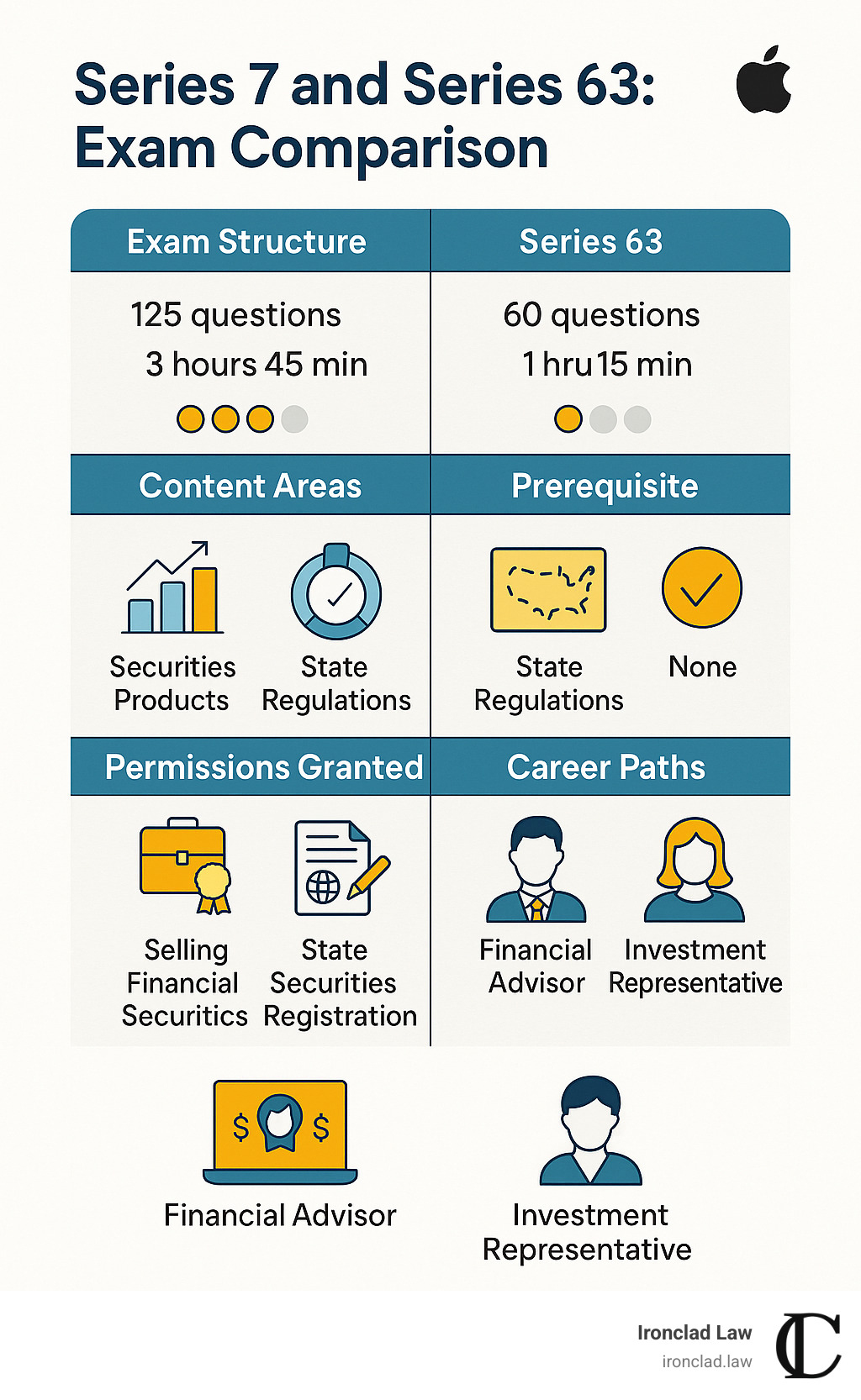
So you’re thinking about taking the series 7 and series 63 exams? Let me break down what you’re getting into:
| License | Purpose | Format | Cost | Pass Score | Prerequisite |
|---|---|---|---|---|---|
| Series 7 | Allows selling of most securities products | 125 questions, 3h 45m | $300 | 72% | SIE exam + firm sponsorship |
| Series 63 | State-level registration for agents | 60 questions, 1h 15m | $147 | 70% | None (but typically paired with Series 7) |
Remember when you had to get both a driver’s license and car insurance before hitting the road? The financial services industry works similarly. The series 7 and series 63 exams are like your driver’s license and registration for the securities highway – you need both to operate fully in most states.
The Series 7 is your “everything ticket” (that’s what we call it in the industry). Pass this exam, and you’ve earned the right to sell most securities: stocks, bonds, options, mutual funds – basically all the essentials a financial professional needs. Think of it as your federal passport to the securities world.
Meanwhile, the Series 63 handles the state side of things. It focuses on those “blue sky laws” (a charming old term referring to state securities regulations that protect investors from fraudsters selling nothing but “pieces of the blue sky”). Without your Series 63, you can’t do business in most states, no matter how well you know your Series 7 material.
I’m Michael Hurckes, and I’ve guided countless professionals through these exams. Trust me when I say that while challenging, these problems are absolutely conquerable with the right preparation. And yes, most financial professionals need both to practice fully – the Series 7 (administered by FINRA) covers federal securities laws, while the Series 63 (developed by NASAA but administered by FINRA) ensures you understand state-level compliance.
If you’re just starting your research, you might find these resources helpful:
– series 7 exam requirements – Everything you need to know before sitting for the exam
– series 63 – A deep dive into the state law examination
– securities license exam – The complete process from registration to test day
Don’t worry if this feels overwhelming at first. Everyone in the industry has stood where you are now, looking up at what seems like a mountain of material. But with the right guidance, you’ll be surprised how manageable these exams become. And that’s exactly what we’re here to help with.
1. License Purpose & Permissions
When you’re stepping into the financial world, understanding what the series 7 and series 63 licenses actually let you do makes all the difference. Think of them as two pieces of a puzzle – one gives you the ability to sell products, while the other ensures you’re following the rules in each state.
Series 7—The “Everything” Ticket
The Series 7 license is lovingly nicknamed the “everything ticket” – and for good reason! Once you’ve conquered this exam, you’ll have the keys to the investment kingdom:
You’ll be able to help clients with stocks when they’re excited about that hot tech company, guide them through bond investments when they need steady income, and explain options contracts when they want to get a bit more sophisticated with their strategy. You can also discuss mutual funds for those who prefer professional management, offer variable annuities for retirement planning, and present direct participation programs (DPPs) for tax advantages.
I remember talking with Jamie, a financial advisor who just passed her Series 7: “It felt like someone finally took the training wheels off my bike. Suddenly I could have meaningful conversations about almost any investment product my clients asked about.”
What makes the Series 7 so valuable is its versatility. Whether you dream of becoming a stockbroker, financial consultant, or working in investment banking, this license lays the groundwork for your career in securities.
More info about FINRA Series 7
Series 63—The State Law Seal
While your Series 7 gives you the federal green light to sell securities, the Series 63 ensures you’re playing by the rules in each state. These state regulations are often called “blue-sky laws” – a colorful name with an interesting origin. A Kansas Supreme Court justice coined the term when warning against investment schemes that had “no more substance than so many feet of blue sky.”
With your Series 63 in hand, you’ll have:
State registration that makes you official in the eyes of state regulators. You’ll understand your ethical standards and fiduciary obligations to clients – essentially, the promises you’re making to put their interests first. The exam ensures you grasp state-specific securities regulations and know which transactions might be exempt from registration requirements.
Here’s a little insider tip: Six jurisdictions don’t actually require the Series 63 by law: Colorado, District of Columbia, Florida, Louisiana, Maryland, and Puerto Rico. That said, if you’ll be working with clients across state lines (which most advisors do these days), you’ll likely need this license regardless of where your office is located.
The Series 63 exam dives deep into the Uniform Securities Act, focusing on registration requirements, anti-fraud provisions, and administrative procedures. It’s all about making sure you understand your legal and ethical responsibilities to clients under state law.
More info about Series 63 License
2. Who Needs Which License and When
The question of which licenses you need depends largely on your career aspirations and the scope of your professional activities. Let’s break down the common scenarios.

When Series 7 & Series 63 Are Both Mandatory
Picture this: You’ve just landed your dream job at a financial firm, excited to help clients build their wealth. But before you can start making recommendations, you need the right credentials. For most securities professionals, especially those working across state lines, both the series 7 and series 63 licenses are non-negotiable requirements.
You’ll definitely need this dynamic duo if you’re planning to work as a stockbroker in most states. I remember talking with Marcus, a financial advisor from Boston who learned this lesson the hard way. “I initially thought I could get by with just my Series 7,” he told me, “but quickly realized that without the Series 63, I couldn’t legally conduct business in neighboring states where many of my clients had relocated.”
The combination becomes particularly important if you’re providing both investment advice and selling securities products. It’s also essential if your compensation includes both commissions and fees, or if you work for a traditional broker-dealer.
Some professionals might consider the Series 6 instead of the Series 7 if they only plan to sell mutual funds and variable annuities. But here’s the thing – it’s a much more limited license, and most firms prefer candidates with the broader capabilities that the Series 7 offers.
For those looking to both sell securities and provide investment advice, there’s another path worth considering. You could obtain the Series 66 (Uniform Combined State Law Examination) along with the Series 7, instead of taking the Series 63 and Series 65 separately. Think of the Series 66 as a two-for-one special – it effectively combines the Series 63 and Series 65 content but requires a valid Series 7 as a corequisite.
Primary Keyword Scenario: series 7 and series 63 for New Hires
If you’re just starting your journey in the financial services industry, don’t worry – there’s a well-trodden path to follow. Most new hires obtain both their series 7 and series 63 licenses within the first few months of employment.
The process typically unfolds like this: First, your new employer sponsors your licensing exams (yes, you need sponsorship for the Series 7). Before diving into the Series 7, you’ll need to pass the Securities Industry Essentials (SIE) exam – think of it as Financial Services 101. With that under your belt and your firm’s sponsorship, you can tackle the Series 7 exam. Finally, you’ll complete the Series 63 to satisfy state requirements.
Many major financial firms have comprehensive training programs designed specifically to help newcomers through this process. Rachelle, a Team Leader in Client Services at a prominent financial firm, puts it beautifully: “Our philosophy is that if you bring your EQ, which is the soft people skills, we will train you for the IQ, which is the knowledge needed to help customers.”
The good news? Your employer will typically cover the costs of these exams and provide study materials. They’ll also usually allocate dedicated time for preparation – they want you to succeed as much as you do! The timeline from your first day to becoming fully licensed typically spans 2-4 months, depending on your firm’s training schedule and your own progress.
Getting both licenses might seem daunting at first, but remember – thousands of professionals successfully steer this process every year. With the right preparation and support, you’ll be fully licensed and ready to help clients before you know it.
3. Prerequisites & Registration Steps
Before you can sit for the series 7 and series 63 exams, you need to meet certain prerequisites and complete specific registration steps.
Registering for the Series 7 and Series 63 Exams
The registration process for these exams differs slightly, primarily because the Series 7 requires firm sponsorship while the Series 63 does not.
For the Series 7:
- Pass the Securities Industry Essentials (SIE) exam, which consists of 75 questions, lasts 1 hour and 45 minutes, and costs $80
- Obtain sponsorship from a FINRA member firm
- The firm will file a Form U4 (Uniform Application for Securities Industry Registration) on your behalf
- Complete fingerprinting and background checks
- Once approved, your firm will open a 120-day testing window
- Schedule your exam through Prometric testing centers
For the Series 63:
- No prerequisite exams are required
- No firm sponsorship is required (though most candidates have one)
- Register directly through FINRA’s Test Enrollment Services System or through your firm
- Pay the $147 examination fee
- Schedule your exam at a Prometric testing center within your 120-day window
One advantage of the Series 63 is that you can take it independently, even before securing industry employment. Some candidates choose to pass the SIE and Series 63 before job hunting to make themselves more attractive to potential employers.
More info about Securities License Exam process
Retake & 30/180-Day Rules for series 7 and series 63
If you don’t pass either exam on your first attempt, there are specific rules governing when you can retake them:
- After the first failure: You must wait 30 calendar days before retaking the exam
- After the second failure: You must wait another 30 calendar days
- After three or more failures: You must wait 180 calendar days (approximately 6 months)
These waiting periods are mandatory and cannot be waived. FINRA implements these cooling-off periods to ensure candidates have adequate time to study and improve their knowledge before reattempting the exams.
If you do fail an exam, we recommend using the waiting period to:
– Review your score breakdown to identify weak areas
– Focus your study on those specific topics
– Take more practice exams
– Consider additional or different study materials
As we often tell our clients at Ironclad Law, “A failed exam isn’t a career-ender—it’s a roadmap showing you exactly what you need to study more.”
4. Exam Structure & Costs of Series 7 and Series 63
Let’s break down what you’ll face when sitting for the series 7 and series 63 exams. Understanding the format, timing, and costs will help you plan your study strategy and budget accordingly.

Series 7 Exam Snapshot
The Series 7 is often called “the monster” by industry insiders—and for good reason. This comprehensive exam will test every corner of your securities knowledge:
- Format: You’ll face 125 scored multiple-choice questions, plus 10 experimental questions that don’t count toward your score (but you won’t know which ones they are, so treat every question as important!)
- Duration: Block off your entire morning or afternoon—you’ll have 3 hours and 45 minutes to complete the exam
- Passing Score: You’ll need to get 72% correct, which means at least 90 questions right
- Cost: The exam fee is $300, which is typically covered by your sponsoring firm
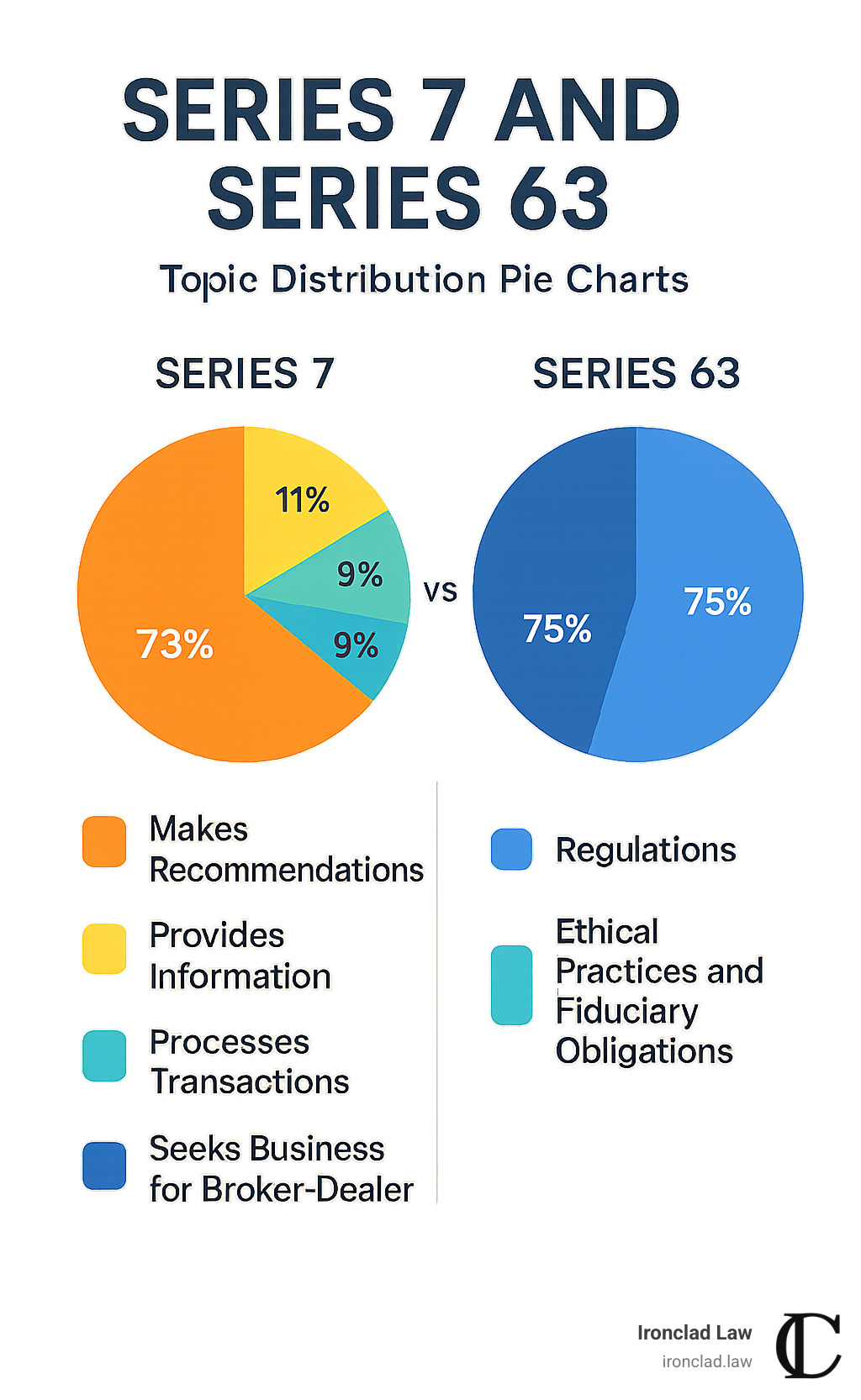
The Series 7 content is organized around four job functions that mirror what you’ll actually do in the field. The heaviest weighting falls on Function 3 (Making Recommendations), which comprises a whopping 91 questions. This makes sense—your primary responsibility will be recommending suitable investments to clients.
One of my clients described the experience: “It felt like running a mental marathon. By question 100, my brain was tired, but I kept pushing through. The practice tests were absolutely essential for building that mental stamina.”
Since 2018, the exam has been restructured. The basic industry knowledge now lives in the SIE exam, allowing the Series 7 to focus more deeply on product knowledge and suitability.
More info about Series 7 Exam Requirements
Series 63 Exam Snapshot
If the Series 7 is a marathon, the Series 63 is more like a focused sprint:
- Format: 60 scored multiple-choice questions, plus 5 unscored pretest questions
- Duration: A relatively brief 1 hour and 15 minutes
- Passing Score: You’ll need 70% to pass, which means 43 correct answers
- Cost: $147, which is often reimbursed by employers
The Series 63 exam focuses primarily on state securities regulations (75% of questions) with the remainder covering ethical practices and fiduciary obligations. While shorter than the Series 7, don’t be fooled—the questions can be tricky, often containing subtle nuances in language that test your understanding of state regulatory frameworks.
A recent development worth noting is NASAA’s Exam Validity Extension Program (EVEP). This program allows you to extend your Series 63 qualification for up to five years through continuing education if you leave the industry. This can be a valuable safety net if your career path takes an unexpected turn.
“The Series 63 questions felt like they were written by lawyers for lawyers,” shared one recent test-taker. “I had to read each question twice to catch all the details. The practice exams were crucial for getting used to their style of questioning.”
Scientific research on test anxiety
Even the most prepared candidates can feel their palms sweating as exam day approaches. This is completely normal! In fact, research from the American Psychological Association suggests that a moderate level of anxiety can actually sharpen your focus and improve performance.
The key is keeping that anxiety from tipping into the overwhelming zone. When I work with clients preparing for their series 7 and series 63 exams, I recommend a few science-backed strategies:
First, thorough preparation is your best defense. When you know the material inside and out, your confidence naturally rises. Second, simulate exam conditions during your practice tests—sit for the full time period without interruptions. This builds mental endurance and reduces surprises on exam day.
Physical preparation matters too. In the days before your exam, prioritize sleep, eat brain-friendly foods, and get some light exercise. Your brain performs best when your body is well-cared for.
Finally, develop a positive pre-exam ritual. Whether it’s visualization, deep breathing, or a quick review of your strongest topics, having a routine can center your thoughts and calm your nerves.
As one client who passed both exams on her first attempt told me: “I was terrified until I reminded myself that I’d already taken and passed six full practice exams. The real thing was just number seven.”
5. Content Breakdown & Topic Weightings
When you’re studying for the series 7 and series 63 exams, knowing where to focus your energy can make all the difference. These two exams test completely different knowledge areas, reflecting their distinct purposes in the regulatory landscape.
High-Weight Topics on Series 7
If you’ve ever heard someone joke that the Series 7 is like drinking from a firehose, they weren’t exaggerating! The exam is heavily weighted toward Function 3: Makes Recommendations, which accounts for a whopping 73% (that’s 91 questions) of the entire test.
Within this critical function, you’ll want to pay special attention to suitability and investment recommendations. This area covers analyzing customer profiles, matching investments to objectives, and understanding tax implications—expect about 25-30 questions here. One of my clients once told me, “I thought I knew suitability until I started studying for the Series 7. Then I realized how deep this rabbit hole goes!”
Trading and settlement procedures is another heavyweight topic (15-20 questions), covering everything from order types to trade corrections. Don’t underestimate margin accounts and calculations either—those 10-15 questions on initial requirements, maintenance calls, and buying power can be surprisingly tricky.
Perhaps the most technically challenging area is options strategies and valuation (15-20 questions). The concepts of spreads, straddles, and intrinsic value trip up many candidates. As one newly-licensed broker told me, “I dreamed about options calculations for weeks!”
Rounding out the major areas is municipal securities (10-15 questions), covering the differences between general obligation and revenue bonds, tax implications, and yield calculations.
The remaining exam portions focus on seeking business (Function 1), evaluating customer profiles (Function 2), and executing transactions (Function 4), but these together account for just 34 questions.
High-Weight Topics on Series 63
The Series 63 exam might be shorter, but it’s laser-focused on state securities laws and regulations.
Uniform Securities Act provisions dominate this exam with 20-25 questions. You’ll need to understand registration requirements for both securities and the professionals who sell them, along with various exemptions and administrative provisions. This material can feel dry, but it forms the backbone of your state-level compliance knowledge.
Prohibited practices and anti-fraud measures account for 15-20 questions, covering everything from insider trading to material misrepresentations. One of my clients described this section as “learning all the ways people have tried to cheat the system, so you don’t accidentally do the same.”
Registration requirements and exemptions (10-15 questions) might sound similar to the first topic, but this area digs deeper into agent, broker-dealer, and investment adviser registration specifics. You’ll need to know which securities are “federal covered” and which transactions are exempt from registration.
The ethical practices and fiduciary obligations section (12-15 questions) is particularly important in today’s regulatory environment. This covers your responsibilities to clients, fair dealing practices, and disclosure requirements. As one securities attorney put it, “This is the part that keeps you out of trouble in the real world.”
Finally, administrative provisions and penalties (5-10 questions) covers what happens when rules are broken, including the powers regulators have and the potential consequences of violations.
Understanding these weightings helps you allocate your precious study time where it matters most. I always tell my clients to spend about 70% of their study time on the heaviest-weighted topics, 20% on the medium-weighted ones, and 10% reviewing the lighter areas. This approach has helped countless professionals pass these challenging exams on their first attempt.
6. Study Strategies & Best Prep Resources
Preparing for the series 7 and series 63 exams doesn’t have to feel like climbing Mount Everest—with the right approach and materials, you can set yourself up for success without losing your mind in the process.

Building a 6-Week Plan for series 7 and series 63 Success
Let’s be honest—these exams aren’t created equal in terms of study time. Most successful candidates I’ve worked with spend about 80-100 hours on the Series 7 (roughly 4-5 weeks) and around 30-50 hours on the Series 63 (about 1-2 weeks). Think of the Series 7 as your main course and the Series 63 as your dessert—still important, but requiring less time to digest.
Here’s a 6-week roadmap that has helped many of our clients cross the finish line with confidence:
During the first two weeks, immerse yourself in Series 7 fundamentals. Start by reading chapters on securities markets and products for the first few days, then tackle practice questions to test your understanding. Days 6-7 are perfect for diving into customer accounts and suitability concepts. By days 8-10, you should be ready for options and complex products (often the trickiest part for many candidates). Wrap up this phase with a midterm practice exam to gauge your progress.
Weeks 3-4 are all about conquering the more advanced Series 7 topics. Spend a few days each on municipal and government securities, trading and margins, and regulatory compliance. The end of week 4 should be dedicated to full-length practice exams—the closest thing to the real experience you’ll get.
“I lived by practice exams,” shares Jamie, a financial advisor who passed both exams on her first attempt. “They showed me exactly where I was weak, which saved me hours of studying topics I already knew well.”
Week 5 is your Series 7 homestretch. After a comprehensive review and one final practice exam, give yourself a day or two of lighter review. Don’t cram the night before—your brain will thank you. Then it’s game day: take the Series 7 exam with a clear, well-rested mind.
In the final week, shift gears to the Series 63. The beauty of this exam is that it’s more focused, allowing you to compress your study timeline. Spend 2-3 days with the textbook and practice questions, then dedicate the next couple of days to practice exams and plugging knowledge gaps. After a final review day, you’ll be ready to tackle the Series 63.
Throughout this journey, track your performance religiously. Create flashcards for concepts that just won’t stick, join study groups to stay motivated, and take plenty of practice exams—at least 3-5 full-length ones for Series 7 and 2-3 for Series 63.
Recommended Courses & Materials
Not all study materials are created equal, and choosing the right ones can make the difference between passing and failing. Based on feedback from hundreds of successful candidates, here are the resources that consistently deliver results:
For your Series 7 preparation, Kaplan Financial Education’s Premium Instruction Package ($389) stands out as a favorite. It includes live online classes for those who benefit from instructor guidance, plus video lessons, their excellent QBank for practice questions, and tools to track your progress. One candidate told me, “The Kaplan QBank was my secret weapon—I did over 2,000 practice questions before my Series 7, and the actual exam felt familiar.”
If you’re looking for something more budget-friendly, Wiley Efficient Learning’s Silver Course ($225) offers solid video content, a comprehensive test bank, and performance analytics to help you identify weak areas. STC (Securities Training Corporation) is another respected option, with their Premier Package ($375) providing on-demand lectures, practice exams, and flashcards.
For the Series 63, you can scale back your investment a bit. Kaplan’s Essential Self-Study Package ($129) includes everything you need: a license exam manual, QBank, and practice exams. Budget-conscious candidates can supplement with NASAA’s Official Content Outline (free on their website) and Investopedia’s Free Study Guide, which covers key concepts and includes practice questions.
Our surveys show that about 81% of recent test-takers used Kaplan’s courses, with an impressive 93% pass rate among those candidates. While preparation materials matter, what’s most important is finding resources that match your learning style and sticking with your study plan consistently.
These exams aren’t testing your ability to memorize obscure facts—they’re testing whether you can apply regulatory knowledge to real-world scenarios. Focus on understanding concepts rather than rote memorization, and you’ll be well on your way to adding those series 7 and series 63 credentials to your professional profile.
More info about How to Be a Broker
7. Career Impact, Continuing Education & Renewal
Congratulations! You’ve put in the hard work to earn your series 7 and series 63 licenses—but this is just the beginning of an exciting journey in financial services. These credentials don’t just open doors; they swing them wide open to a variety of rewarding career paths.

The financial outlook for licensed securities professionals looks particularly sunny these days. According to the U.S. Bureau of Labor Statistics, securities, commodities, and financial services sales agents earn a median annual salary of $62,910, with job growth projected at 10% through 2031—faster than the average for all occupations. If you’re aiming for a career as a personal financial advisor, the numbers look even better, with median earnings of $94,170 and an impressive 15% projected growth rate.
With your series 7 and series 63 tucked under your belt, you might find yourself with job titles like Registered Representative, Financial Advisor, Investment Consultant, or Wealth Manager. I’ve seen many professionals start in client-facing roles and gradually move up to specialized positions as they gain experience and additional credentials.
Maintaining Your Series 7 & 63 Long-Term
Think of your licenses as plants that need regular watering—neglect them, and they’ll wither away. Here’s what you need to know about keeping them healthy:
For your Series 7, you’ll need to complete FINRA’s Regulatory Element CE every three years. This covers regulatory and compliance developments, sales practices, and other essential topics. You’ll also participate in your firm’s Annual Compliance Meeting and complete firm-specific Firm Element CE each year. These requirements ensure you stay current with industry changes and best practices.
The Series 63 maintenance is a bit different—there’s no direct CE requirement for the license itself, but your state registration must be renewed annually. Some states do have their own continuing education requirements, so it’s important to check with your specific state securities regulator.
“Don’t let your licenses lapse if you can help it,” advised Maria, a 15-year industry veteran I recently spoke with. “Retaking these exams years later is much harder than keeping up with your CE requirements. I’ve seen too many colleagues have to start from scratch.”
If you leave a FINRA member firm, your registrations become “inactive” after two years. However, there’s good news—FINRA has introduced the Maintaining Qualifications Program (MQP), which allows you to keep your qualification for up to five years by completing CE requirements, even without firm sponsorship. Similarly, NASAA’s Exam Validity Extension Program (EVEP) for the Series 63 lets eligible individuals extend their exam validity for up to five years through annual CE.
More info about Broker Dealer Compliance
Upgrading Beyond series 7 and series 63
As your career evolves, you might find yourself ready to climb higher up the ladder. Adding specialized licenses can open new doors and boost your earning potential.
Many professionals start with the series 7 and series 63 foundation, then build upward. If management is calling your name, the Series 24 (General Securities Principal) license becomes essential, allowing you to supervise and manage broker-dealer activities. I’ve worked with numerous clients who made this transition after about 3-5 years in the industry.
Perhaps you’re interested in shifting from commission-based sales to fee-based advisory services? The Series 65 (Investment Adviser Representative) would be your next logical step. Or you might consider the Series 66 (Combined State Law), which efficiently combines Series 63 and 65 content for those who already hold the Series 7.
For those drawn to leadership roles, the Series 9/10 (General Securities Sales Supervisor) qualifies you to supervise sales activities. And if the investment banking world intrigues you, the Series 79 (Investment Banking Representative) would be your ticket in.
I remember talking with Jake, a financial advisor who started with the basics—series 7 and series 63—then added his Series 65 and Series 24 over the next five years. “Each new license was like adding another tool to my belt,” he told me. “Now I can help clients in ways I couldn’t before, and my compensation has grown alongside my capabilities.”
The beauty of starting with series 7 and series 63 is that you’ve built a solid foundation. Where you go from there depends on your interests, strengths, and career goals—but the possibilities are virtually endless in this dynamic industry.
More info about securities licensing services
Frequently Asked Questions about Series 7 and Series 63
What happens if I fail either exam?
The journey to becoming licensed isn’t always smooth sailing, and many professionals don’t pass on their first attempt. If you find yourself in this situation, don’t panic – there’s a clear path forward.
After failing either the series 7 or series 63 exam, you’ll need to wait 30 calendar days before retaking it. If lightning strikes twice and you fail a second time, it’s another 30-day waiting period. Should you need a third attempt, the waiting period extends to 180 days (about 6 months) – a rule designed to ensure you have adequate time to truly master the material.
The silver lining? When you receive your results, you’ll get a detailed score report showing how you performed in each topic area. This personalized roadmap highlights exactly where you need to focus your energy.
As Maria, one of our clients at Ironclad Law, shared: “My first Series 7 attempt was humbling, but that score report was a gift. I realized I’d completely underestimated the options section. Six weeks later, I passed with room to spare.”
While there’s technically no limit to how many times you can attempt these exams, your sponsoring firm might have its own policies about multiple failures. It’s always best to check with your compliance department about their expectations.
Can I take Series 63 before Series 7?
Absolutely! Unlike some licensing combinations, the series 7 and series 63 can be tackled in either order. The Series 63 has no prerequisites, making it accessible even before you take the Series 7 (unlike the Series 66, which requires a valid Series 7 license).
Some candidates prefer starting with the Series 63 because:
- It’s significantly shorter and generally considered less challenging
- Success builds confidence before tackling the more comprehensive Series 7
- It allows you to “bank” one license while focusing fully on the more demanding exam
That said, most firms prefer their new hires to focus on the Series 7 first since it’s more directly related to their day-to-day responsibilities. The typical sequence we see most often is: SIE Exam → Series 7 → Series 63.
As one of our financial advisor clients put it: “I knocked out the Series 63 first because it felt manageable while I was still getting comfortable in my new role. Having that win under my belt made me more confident when I tackled the Series 7.”
Are there states that don’t require Series 63?
Yes! While most states require the Series 63, six jurisdictions have chosen a different path:
Colorado, District of Columbia, Florida, Louisiana, Maryland, and Puerto Rico don’t require the Series 63 for securities agents operating solely within their borders.
But here’s the catch – if you plan to work with clients in any other states, you’ll still need the series 7 and series 63 combination, regardless of where your office is located. A broker based in Florida who has clients in Georgia, for example, would need the Series 63 to comply with Georgia’s registration requirements.
I’ve seen this scenario play out countless times with our clients. James, a broker in Miami, initially skipped the Series 63 since Florida doesn’t require it. Six months later, when a major client moved to North Carolina, he had to scramble to get licensed rather than risk losing the relationship.
It’s worth noting that many firms require all their representatives to obtain the Series 63 as standard policy, even in exempt states. This ensures their team can seamlessly serve clients regardless of where they might move in the future – a practical approach in our increasingly mobile society.
Conclusion
Obtaining your series 7 and series 63 licenses is truly a game-changer for your financial services career. I’ve seen how these exams transform nervous candidates into confident professionals ready to guide clients through complex investment decisions.
While each exam has its own personality—the Series 7 testing your broad product knowledge and the Series 63 focusing on state securities laws—together they form the foundation of your professional toolkit. Yes, the study process can feel overwhelming at times, but thousands of people pass these exams every year. With the right preparation strategy and quality materials, you’ll join their ranks.
What I love about these licenses is that they’re not just regulatory checkboxes—they represent practical knowledge you’ll use daily throughout your career. When you explain a municipal bond’s tax advantages or help a client understand why a particular investment aligns with their goals, you’re drawing directly from your exam preparation.
At Ironclad Law, we’ve guided many financial professionals through this licensing journey. Some clients come to us nervous about the process, others worried about compliance after licensing, and some simply wanting guidance on which exams make sense for their career path. Whatever your situation, having an experienced legal team in your corner makes navigating the regulatory landscape much smoother.
The financial world is always evolving, and your series 7 and series 63 licenses are just the beginning. As your career progresses, you might add specialized credentials or move into supervisory roles requiring additional licenses. The good news? The study habits and knowledge foundation you’re building now will serve you well with any future licensing challenges.
These licenses aren’t just about clearing regulatory problems—they’re about becoming the knowledgeable, ethical professional your clients need. When you understand both product details and your legal obligations to clients, you provide a level of service that builds lasting trust.
For more information about our securities licensing services and how we can support your career in the financial industry, please visit our securities licensing services page or contact our New York office for a consultation.