You have 0 items in your cart

Understanding the Series 63 Exam: Your Gateway to Securities Sales
The series 63 is a securities licensing exam that qualifies professionals to sell securities products within most U.S. states. This uniform examination is developed by the North American Securities Administrators Association (NASAA) and administered by the Financial Industry Regulatory Authority (FINRA).
Quick Series 63 Facts:
– Purpose: Allows securities professionals to transact business in most states
– Format: 65 multiple-choice questions (60 scored, 5 unscored pretest questions)
– Time Limit: 75 minutes
– Passing Score: 72% (43 out of 60 correct answers)
– Cost: $147
– Prerequisites: None (can be taken without sponsorship)
– Not Required In: Colorado, Florida, Louisiana, Maryland, Ohio, DC, Puerto Rico
The Series 63 exam, formally known as the Uniform Securities Agent State Law Examination, tests your knowledge of state securities regulations and ethical practices. Unlike other securities exams that focus on product knowledge, the Series 63 specifically covers state “blue sky” laws and regulatory requirements.
Most candidates spend between 30-40 hours studying for this exam. While not considered the most difficult financial licensing test, its focus on legal terminology and regulatory nuances requires dedicated preparation.
I’m Michael Hurckes, an attorney with experience in broker-dealer regulations and FINRA compliance who has guided numerous professionals through the series 63 licensing process at Ironclad Law. My background includes helping financial professionals steer securities regulations while ensuring they meet all licensing requirements across multiple jurisdictions.
Must-know series 63 terms:
– securities license exam
– series 65 exam
– series 7 exam requirements
Understanding the Series 63: Purpose, Scope & Eligibility

When you’re looking to build a career in the securities industry, navigating the licensing landscape can feel like solving a puzzle. The series 63 exam is an essential piece of that puzzle for most securities professionals across the United States.
What Is the Series 63 License?
The series 63 license is your state‑level permission slip to sell securities. Created in 1979, this uniform examination ensures you understand the state securities regulations (often called “blue sky laws”) that protect investors.
Unlike federal exams that test product knowledge, the series 63 focuses specifically on state regulations derived from the Uniform Securities Act. It’s officially called the Uniform Securities Agent State Law Examinationquite a mouthful, which is why everyone in the industry simply calls it the “series 63.”
I remember working with a client who had aced his Series 7 exam and couldn’t understand why he couldn’t start working with clients immediately. “Think of your Series 7 as knowing how to drive,” I explained, “but the series 63 is your driver’s license that makes it legal to do so in most states.”
Who Must Take It & Where Is It Not Required?
If you’ll be selling securities to the public as a registered representative, investment company representative, or variable annuity salesperson, you’ll almost certainly need the series 63 license.
However, not every jurisdiction requires it. You can skip the series 63 if you’re only doing business in:
- Colorado
- Florida
- Louisiana
- Maryland
- Ohio (in most circumstances)
- District of Columbia
- Puerto Rico
That said, many broker‑dealers still require all their representatives to obtain the series 63 regardless of location. This creates consistency across their organization and prevents headaches if clients move to states where the license is required.
As one compliance director told me, “Having all our reps series 63 licensed is like having insuranceit’s better to have it and not need it than need it and not have it.”
Eligibility & Prerequisites
One of the most refreshing aspects of the series 63 is its accessibility. Unlike many professional exams that require specific degrees or years of experience, the series 63 has no formal education requirements and no professional experience prerequisites.
Even better? You don’t need firm sponsorship to take the exam. This means you can get a head start on your licensing journey even before landing your first industry positiona significant advantage in a competitive job market.
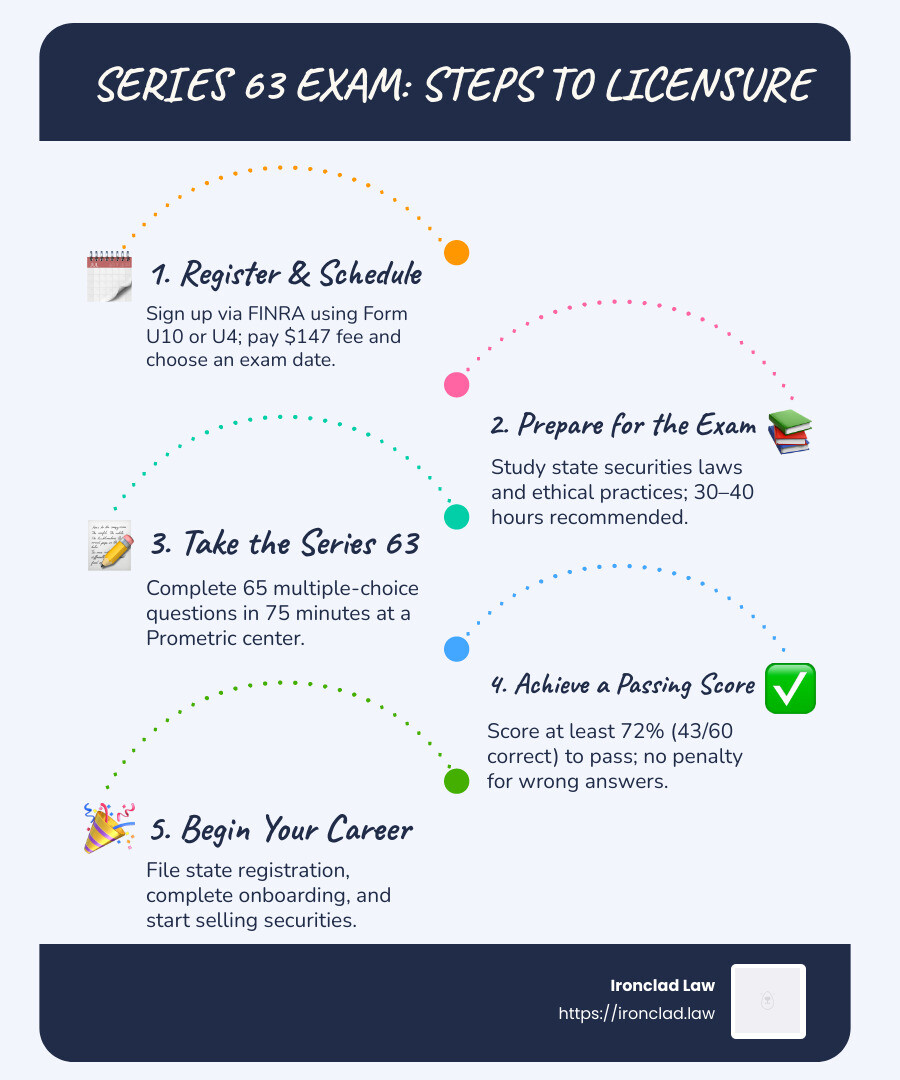
To register for the exam without sponsorship, you’ll complete Form U‑10 and pay the $147 examination fee. If you’re already working with a firm, they’ll handle registration through Form U‑4.
While the series 63 has no formal prerequisites, it’s important to understand that it doesn’t stand alone. You’ll still need to pass the Securities Industry Essentials (SIE) exam plus either the Series 6 (for limited investment products) or Series 7 (for general securities) to actually conduct securities business.
At Ironclad Law, we typically recommend clients take the series 63 after passing their primary qualification exam. This strategy lets you focus on mastering one regulatory framework at a time, improving your chances of success on both exams.
The Series 63 License opens doors throughout the securities industry. While it might seem like just another hurdle in your licensing journey, it’s actually your ticket to doing business across most of Americamaking it well worth the effort.
For more information about state securities regulations, you can visit the North American Securities Administrators Association (NASAA) website, which provides official resources for the Series 63 exam.
Exam Blueprint & Logistics: Format, Content, Registration & Costs

When I sat for my series 63 exam years ago, I remember wishing someone had given me a clear roadmap of what to expect. Let me walk you through exactly what you’ll face on exam day and how to steer the registration process without any surprises.
Series 63 Exam Structure
The series 63 isn’t trying to trick you with its format, but it does demand focused attention. You’ll tackle 65 multiple-choice questions, each with four possible answers. Here’s the interesting part – only 60 of these questions actually count toward your score. The other 5 are “pretest” questions that FINRA is testing for future exams.
The catch? You won’t know which questions are which, so approach every question as if it matters. Each person receives a unique set of questions pulled from a larger bank, though all exams follow the same content blueprint and difficulty level.
You’ll have 75 minutes to complete the exam – that’s about a minute and some change per question. The good news is there’s no penalty for wrong answers, so always guess rather than leave something blank. The computer interface lets you flag tricky questions to revisit later if time allows.
One of my clients who recently passed shared: “I found the interface straightforward, but don’t underestimate how quickly 75 minutes goes by. I made a quick first pass answering what I knew confidently, then circled back to the head-scratchers.”
Content Areas & Weightings
The series 63 focuses on two main domains, and understanding their weightings can help you prioritize your study time:
The first domain, covering State Securities Acts and Related Rules, makes up 60% of your exam. This includes how broker-dealers and their agents are regulated, securities and issuers regulation, investment adviser rules, and various administrative provisions.
The second domain, focusing on Ethical Practices and Fiduciary Obligations, accounts for 40% of the test. This covers professional ethics and proper communication with customers.
Don’t be surprised to see questions based on the Uniform Securities Act of 1956 (with amendments), various NASAA Model Rules, and even aspects of major federal securities laws like the Securities Act of 1933 and the Investment Advisers Act of 1940.
“Applicants must attain scores of 72% in order to pass.”
This means correctly answering at least 43 of those 60 scored questions. After finishing, you’ll immediately see your pass/fail result on screen.
Registration & Scheduling Steps
Registering for the series 63 follows one of two paths, depending on your employment situation:
If you’re sponsored by a firm, your employer will file a Form U-4 through FINRA’s Web CRD system. Once approved, you’ll receive a 120-day window to take the exam, and you can schedule your test at a Prometric center during this period.
If you’re going it alone (unsponsored), you’ll create an account on FINRA’s Test Enrollment Services System (TESS), complete Form U-10, pay the $147 exam fee, and then receive your 120-day testing window.
I always recommend scheduling your exam as soon as your enrollment window opens to get your preferred date and location. Prometric centers can be found throughout the country, typically in business districts.
For those with disabilities or special needs, accommodations are available but must be requested during registration with supporting documentation.
At Ironclad Law, we’ve guided many professionals through the FINRA License process and can help explain the registration steps.
Fees, Passing Score & Retake Policy
The series 63 exam costs $147, which you’ll pay when registering. This fee isn’t refundable, even if you need to reschedule or miss your exam. You can reschedule through Prometric if needed, though last-minute changes may incur additional fees.
As mentioned earlier, you’ll need to correctly answer at least 43 of the 60 scored questions (72%) to pass. You’ll know immediately if you’ve passed or failed, and you’ll receive a printed report showing your score and performance by topic.
If you don’t pass on your first try, don’t worry – but do be aware of the waiting periods:
– After first failure: Wait 30 days before retaking
– After second failure: Another 30-day waiting period
– After third failure: 180-day waiting period (6 months)
There’s no limit to how many attempts you can make, but you’ll pay the $147 fee each time.
One compliance officer I work with at Ironclad Law always tells candidates: “Use any waiting period productively. Your score report will show which areas tripped you up – focus your studying there. Most people pass on their second attempt with this targeted approach.”
For the most current exam details, I recommend reviewing the Official NASAA Series 63 Content Outline, which gets updated periodically as securities regulations evolve.
From Prep to Renewal: Study Strategies, Retakes, CE & Comparing Exams

So you’ve decided to tackle the Series 63 exam—smart move! Let’s talk about how to prepare effectively, what happens if you need a retake, and how to maintain your license once you’ve conquered this challenge.
Building Your Series 63 Study Plan
Most people who pass the Series 63 spend about 30-40 hours studying. That’s significantly less time than you’d need for the Series 7, but don’t let that fool you into thinking it’s a cakewalk. The exam’s focus on legal terminology and regulatory concepts can trip up even seasoned financial professionals.
I’ve found that successful candidates typically start with a comprehensive study guide that follows the NASAA content outline. Begin by getting comfortable with the Uniform Securities Act—this creates the foundation everything else builds upon. Regular practice with exam-style questions is absolutely essential; aim for at least 500 practice questions before your exam day to identify any knowledge gaps.
Flashcards are particularly helpful for the Series 63 since you’ll need to memorize specific definitions from the Uniform Securities Act. And rather than cramming (which rarely works for regulatory content), try spreading your study sessions over 2-3 weeks, revisiting difficult concepts multiple times.
“I created a schedule with specific topics for different days,” shared one of our recently successful clients. “Studying for 1-2 hours daily over three weeks worked much better than marathon sessions crammed into a few days.”
If you’re taking multiple securities exams, we typically recommend this sequence: SIE first, then Series 6 or 7, and finally the Series 63. This progression builds your knowledge logically, letting you master industry fundamentals before tackling state-specific regulations. For more details on the overall licensing journey, check out our Securities License Exam guide.
Common Mistakes & How to Avoid Them
After helping dozens of professionals prepare for the Series 63, I’ve noticed several recurring pitfalls that you’ll want to avoid.
The most common mistake? Underestimating the exam. Many candidates, especially those who’ve already passed the more comprehensive Series 7, assume the Series 63 will be a breeze. This overconfidence often leads to insufficient preparation. The exam’s focus on state securities laws requires specific and detailed knowledge.
Another major stumbling block is neglecting the ethics questions. Ethical practices and fiduciary obligations make up 40% of the exam—that’s nearly half! These questions often involve scenarios requiring judgment calls rather than simple fact recall, making them trickier than they first appear.
Poor time management trips up many test-takers too. With just over a minute per question, running out of time is a real concern. Practice working through questions efficiently, and during the actual exam, don’t get stuck on difficult items—mark them and return if time permits.
Many candidates focus on memorization over understanding. While you do need to know specific definitions, understanding the principles behind the rules leads to better retention and more accurate answers on scenario-based questions.
And don’t forget about those pretest questions—5 of the 65 questions don’t count toward your score, but you won’t know which ones. Answer every question as if it counts!
“I’ve seen many capable professionals fail because they approached the Series 63 as an afterthought,” notes a compliance director we work with. “The content is different enough from the Series 7 that it demands dedicated preparation.”
Retake Strategy & Accommodations
If you don’t pass on your first attempt, don’t beat yourself up—many successful professionals needed multiple tries. The key is using your experience and score report to refine your approach.
Start by analyzing your performance. Your score report will show how you did in each topic area, helping you identify your weakest areas for focused review. If your current study method didn’t yield success, consider alternative materials or approaches—some candidates find study groups or tutoring helpful after an initial failure.
Create a detailed timeline working backward from your next available test date (remembering the 30-day waiting period). Your revised study plan should emphasize weak areas while maintaining familiarity with stronger topics. Taking full-length practice exams under timed conditions helps build stamina and improves time management.
For candidates with disabilities or special needs, FINRA provides reasonable accommodations under the Americans with Disabilities Act. These might include extended testing time, reader assistance, sign language interpreters, or accessible testing stations. You’ll need to submit accommodation requests during registration with supporting documentation from healthcare providers.
FINRA also offers limited accommodations for English Language Learners, though all exams are administered in English only.
Continuing Education & License Validity
Once you’ve passed the Series 63, your license remains valid as long as you maintain registration with a FINRA member firm or self-regulatory organization and comply with any state-specific continuing education requirements.
If you leave your firm or the industry, most states follow the “two-year rule”—your Series 63 qualification remains valid for two years after your registration terminates. Return to the industry within this period, and you typically won’t need to retake the exam.
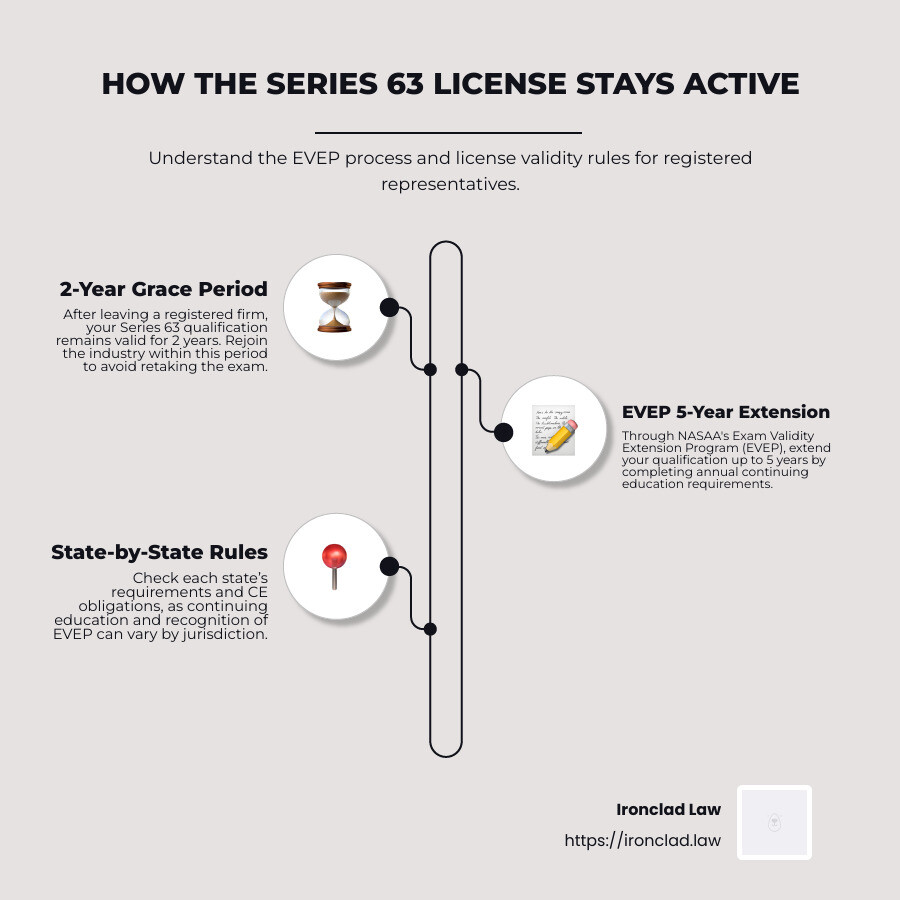
For those who remain unregistered beyond two years, there’s good news—NASAA has implemented the Exam Validity Extension Program (EVEP), which allows you to maintain your qualification for up to five years by completing annual continuing education. This program resembles FINRA’s Maintaining Qualifications Program and has been adopted by many states.
Additionally, some states have implemented Investment Adviser Representative Continuing Education requirements that may apply to Series 63 license holders who act as investment adviser representatives.
“Always check with each specific state regulator about their continuing education requirements,” advises one of our regulatory attorneys. “Requirements can vary by jurisdiction, and staying compliant across multiple states requires diligent tracking.”
Career Paths & Series 63 vs 65/66
The Series 63 opens doors to various client-facing roles in the securities industry. With this license, you might work as a Registered Representative at a broker-dealer, a Financial Advisor (when combined with appropriate product licenses), an Investment Company Representative, or a Variable Annuity Salesperson.
It’s important to understand how the Series 63 compares to related licenses:
| Exam | Focus | Questions | Time | Cost | Who Needs It |
|---|---|---|---|---|---|
| Series 63 | State securities laws for broker-dealer agents | 65 (60 scored) | 75 min | $147 | Broker-dealer agents selling securities |
| Series 65 | State investment adviser laws | 130 (100 scored) | 180 min | $187 | Investment adviser representatives charging fees for advice |
| Series 66 | Combined 63 & 65 content | 100 (80 scored) | 150 min | $177 | Professionals serving as both BD agents and IARs (requires Series 7) |
Your ideal license depends on your career goals. If you’ll only sell securities through a broker-dealer, the Series 63 (plus SIE and Series 6 or 7) is your path. Planning to provide fee-based investment advice only? Go for the Series 65. If you’ll both sell securities and provide fee-based advice, you’ll need the Series 66 plus Series 7.
At Ironclad Law, we help professionals steer these choices based on their career goals and business models. Our Broker-Dealer Compliance services include advising on optimal licensing pathways for various business activities.
Frequently Asked Questions about the Series 63
Do I need a sponsor to sit for the Series 63?
One of the most refreshing aspects of the Series 63 is that you don’t need a sponsoring firm to take the exam. Unlike many other securities exams, you can register as an unsponsored candidate through FINRA’s Test Enrollment Services System by simply completing Form U-10 and paying the examination fee.
This accessibility makes the Series 63 a great option if you’re changing careers, still in school, between jobs, or self-employed and looking to expand your professional toolkit. I’ve worked with many clients at Ironclad Law who appreciated being able to take this step independently.
That said, I always remind candidates that passing the exam is just one piece of the puzzle. To actually use your license and conduct securities business, you’ll eventually need employment with a FINRA member firm, appropriate product licenses like the Series 6 or 7, and registration with the states where you plan to work.
As one career-switcher I advised told me after passing: “Taking the Series 63 before I had a job offer gave me confidence in interviews. When firms asked about my commitment to the industry, I could point to the license I’d already earned on my own initiative.”
How long is the Series 63 license valid if I leave the industry?
If your career path takes you away from the securities industry, your Series 63 qualification doesn’t immediately disappear. Most states follow what we call the “two-year rule,” which means your qualification remains valid for two years after your registration ends. If you rejoin a FINRA member firm during this window, you typically won’t need to retake the exam.
But what if two years isn’t enough time? That’s where NASAA’s Exam Validity Extension Program (EVEP) comes in. This program allows you to extend your qualification for up to five additional years beyond the standard two-year period by completing annual continuing education requirements.
The EVEP program works similarly to FINRA’s Maintaining Qualifications Program and provides valuable flexibility for professionals taking extended breaks – whether for family care, pursuing other opportunities, or any personal reason.
I recently helped a financial advisor who took three years off to care for an aging parent. Because she enrolled in EVEP and kept up with the continuing education requirements, she was able to seamlessly return to the industry without retaking her exams, saving considerable time and stress during an already challenging life transition.
Just remember that states must adopt the EVEP model rule for it to apply in their jurisdiction, so check with your specific state regulators about their policies.
What happens after I pass—can I start selling immediately?
Passing your Series 63 is definitely cause for celebration, but you’ll need to clear a few more problems before you can start working with clients. The post-exam process typically includes:
First, you’ll need proper state registration in each jurisdiction where you plan to conduct business. This process involves filing Form U-4 through your employing firm, paying state registration fees (which vary by state), completing background checks, and meeting any additional state-specific requirements.
Second, your broker-dealer will have its own onboarding procedures. These typically include compliance training, product education, review of firm policies, and setting up your systems access. This orientation period is actually quite valuable – it helps you get comfortable with your firm’s approach before you’re facing clients.
Third, the Series 63 alone isn’t enough – you’ll need product-specific licenses like the Series 6 or Series 7 to actually conduct securities business.
The timeline from passing your exam to being fully authorized typically ranges from a few days to several weeks, depending on state processing times and your firm’s efficiency.
One of my clients at Ironclad Law – now a successful advisor – shared some wisdom I often pass along: “Use this waiting period productively. Shadow experienced colleagues, learn the firm’s systems inside and out, and deepen your product knowledge. This made my eventual transition to client work much smoother once all my registrations came through.”
At Ironclad Law, we regularly guide individuals through these post-exam requirements, helping ensure compliance while minimizing delays in becoming operational. The waiting period can feel frustrating, but proper preparation during this time sets the foundation for a successful career.
Conclusion

The journey to becoming a licensed securities professional isn’t always straightforward, but understanding the Series 63 exam is a crucial milestone along the way. Throughout this guide, we’ve walked through everything you need to know about this important state securities law examination.
Think of the Series 63 as your passport to conducting securities business across state lines. While it might seem like just another hurdle to clear, this exam ensures you understand the state-level regulations that protect investors—knowledge that will serve you throughout your entire career.
Most states require this license (with the exceptions of Colorado, Florida, Louisiana, Maryland, Ohio, DC, and Puerto Rico), making it an essential credential for nearly everyone in the industry. The 75-minute, 65-question format may seem manageable, but don’t underestimate the specific knowledge of state securities laws and ethical obligations you’ll need to master.
I’ve guided many professionals through this process at Ironclad Law, and I’ve found that the most successful candidates approach the exam with respect for its content. Those 30-40 hours of focused study on the Uniform Securities Act and NASAA model rules truly make the difference between passing and failing.
What happens after you pass? That’s when the real work begins. You’ll need to complete state registration processes before you can start working with clients. And remember—the Series 63 is just one piece of your licensing puzzle. You’ll need to pair it with appropriate product licenses like the Series 6 or 7 to actually sell securities products.
At Ironclad Law, we understand that navigating securities regulation can feel overwhelming. The rules are complex, requirements vary by state, and the consequences of non-compliance can be severe. That’s why our securities team specializes in guiding professionals through every step of the licensing and compliance process.
Whether you’re just starting your securities career, changing firms, or expanding your practice into new jurisdictions, having experienced legal counsel can make all the difference. We provide practical, business-focused advice that helps you stay compliant while achieving your professional goals.
Your success in the securities industry depends on building a solid foundation of regulatory knowledge and compliance practices. The Series 63 isn’t just a test to pass—it represents the beginning of your commitment to operating with integrity and in accordance with the law.
For personalized guidance on your securities licensing journey, I encourage you to explore our Securities Licensing hub and connect with our experienced team. We’re here to help you move forward with confidence, knowing your licensing and compliance needs are in capable hands.