
You have 0 items in your cart

Preparing for the Securities Industry Gateway
FINRA SIE practice exams are essential tools for anyone preparing to enter the securities industry. Here’s what you need to know:
| FINRA SIE Exam Quick Facts | |
|---|---|
| Questions: | 85 multiple-choice (75 scored, 10 unscored) |
| Time Limit: | 1 hour and 45 minutes |
| Passing Score: | 70 (scaled) |
| Cost: | $80 |
| Eligibility: | Anyone 18+ (no sponsorship required) |
| Validity: | Results valid for 4 years |
| Best Practice Resources: | FINRA official practice test, Achievable SIE Prep, Mometrix |
The FINRA Securities Industry Essentials (SIE) exam represents your first step toward a career in the financial services industry. Unlike other FINRA exams, the SIE is open to anyone 18 or older, regardless of firm affiliation, making it an accessible entry point for students, career-changers, and professionals alike.
Effective preparation is crucial for success, and quality FINRA SIE practice exams help you:
- Familiarize yourself with question formats and exam structure
- Identify knowledge gaps in the four content domains
- Build test-taking stamina and confidence
- Develop time management strategies
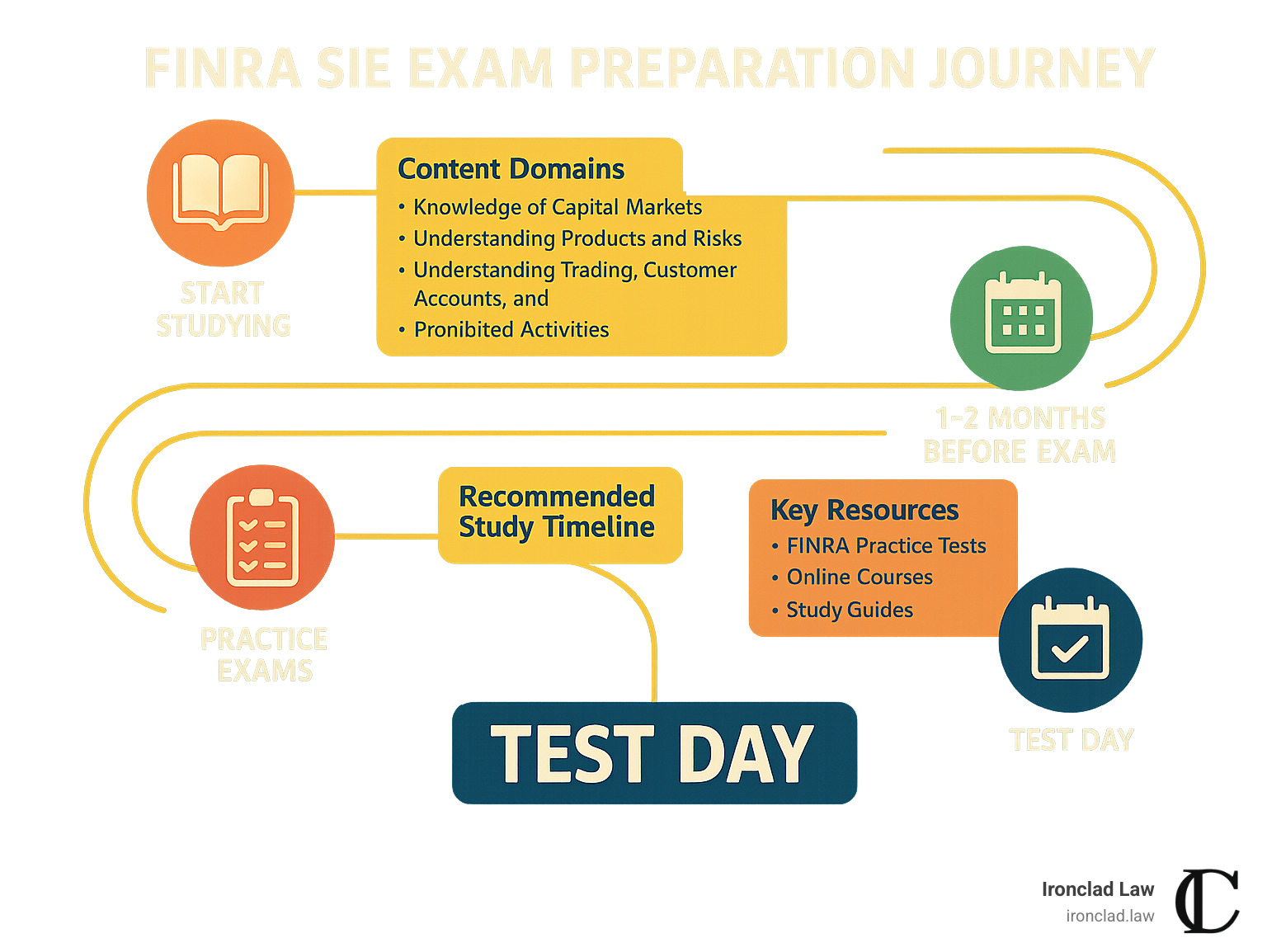
Most candidates spend 1-2 months studying before taking the exam, with practice tests forming the cornerstone of their preparation strategy.
I’m Michael Hurckes, a securities attorney with experience in FINRA broker-dealer regulations who has helped numerous professionals steer the securities licensing process, including preparing for the FINRA SIE practice exam.
Finra sie practice exam terms to remember:
– securities license exam
– series 7 exam requirements
– series 6 financial exam
What Is the FINRA SIE Exam?
Think of the Securities Industry Essentials (SIE) exam as your golden ticket to the financial services world. Created in 2018, this foundational test opens doors without requiring company sponsorship—a game-changer for anyone looking to break into the industry.
The exam itself is straightforward but comprehensive. You’ll face 85 multiple-choice questions (75 scored and 10 unscored pilot questions) during a 1 hour and 45 minute session. The magic number to pass? A scaled score of 70. And once you pass, your results stay valid for a full four years, giving you plenty of time to land that dream position.
What makes the SIE truly special is its accessibility. Anyone 18 or older can take this exam without needing a firm to sponsor them. This means college students, career-changers, and curious minds can all demonstrate their securities knowledge to potential employers before even applying for jobs.
At just $80, the exam is relatively affordable compared to many professional certifications. Remember though, the SIE alone won’t fully license you—you’ll eventually need to pass additional “top-off” exams and secure firm sponsorship to become registered.
Eligibility & Registration Steps
Getting registered for the finra sie practice exam couldn’t be simpler:
- Create your personal account through FINRA’s Web CRD
- Follow the self-enrollment process (it’s designed to be user-friendly)
- Pay the $80 fee using credit card, ACH, or a voucher
- Pick your exam date with Prometric
FINRA recommends using a Windows computer for the smoothest enrollment experience. If you hit any snags during registration, the self-enrollment FAQ page has answers to common questions.
You can take the exam in-person at a Prometric center or remotely from home. For remote testing, ensure you have a reliable webcam, microphone, internet connection, and a private, distraction-free space.
Exam Structure & Scoring
The SIE exam covers four key domains:
Knowledge of Capital Markets (16% – about 12 questions) covers regulatory bodies, market structures, and economic factors.
Understanding Products and Their Risks (44% – roughly 33 questions) explores equities, bonds, options, and investment risks.
Understanding Trading, Customer Accounts, and Prohibited Activities (31% – around 23 questions) covers trading mechanics, account management, and prohibited activities.
Overview of Regulatory Framework (9% – approximately 7 questions) focuses on SRO requirements and professional conduct standards.
The scoring uses the modified-Angoff method, where industry experts determine the passing threshold. Your score of 70 isn’t a percentage—it’s a scaled score representing that you’ve met the required competency level.
You’ll know if you passed immediately after finishing. If successful, congratulations! If not, you’ll receive a detailed breakdown of your performance by content area, showing exactly where to focus your studies for next time.
Mastering the Content Domains
Success on the FINRA SIE practice exam requires a strategic approach to tackle all four content domains.
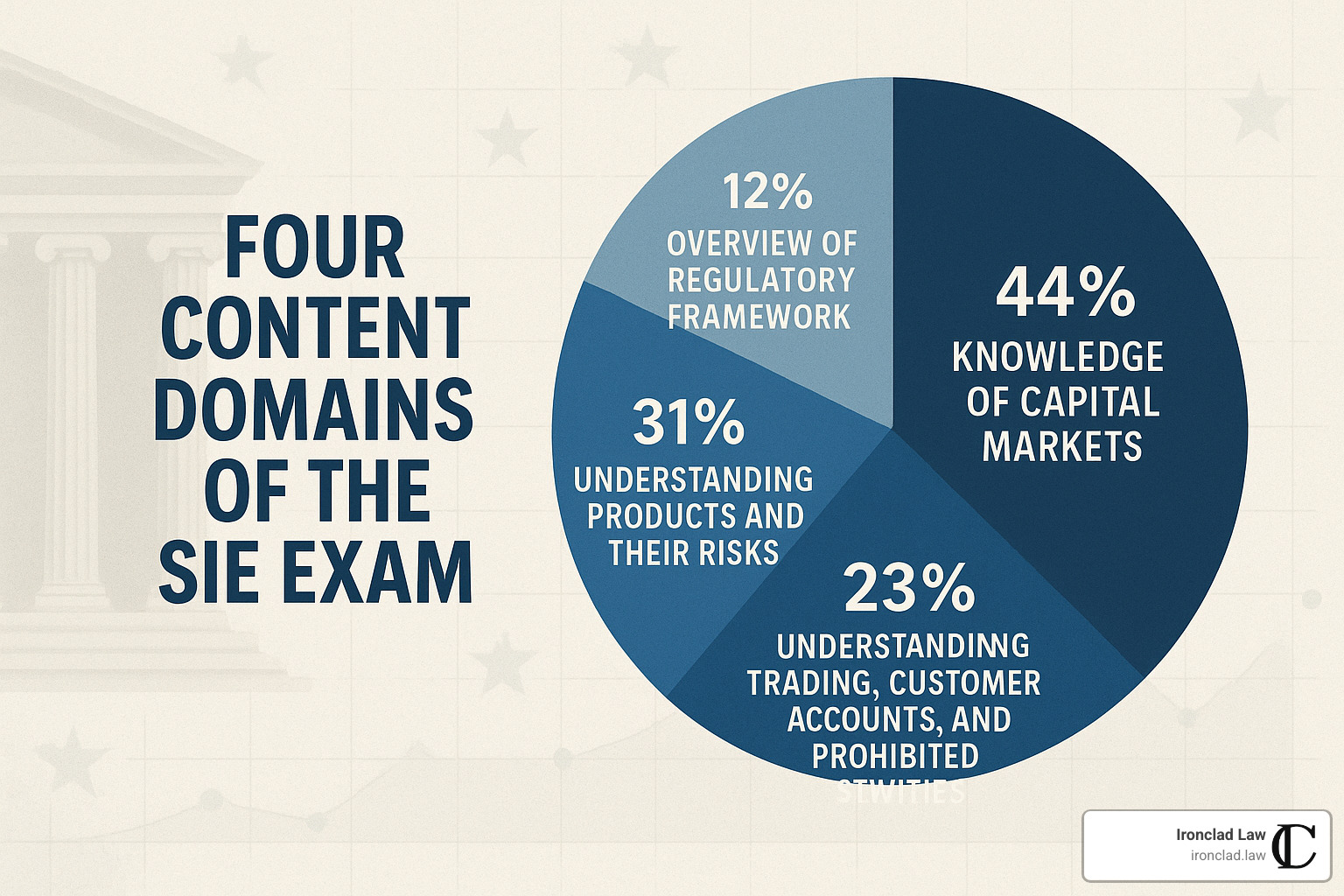
Think of your study time as an investment portfolio—allocate it wisely across domains based on their exam weight. Most successful candidates spend 1-2 months preparing, using a mix of reading, practice questions, and flashcards.
Here’s how the exam content breaks down:
| Content Domain | Weight | Approximate Questions | Recommended Study Time |
|---|---|---|---|
| Knowledge of Capital Markets | 16% | 12 | 15-20% |
| Understanding Products and Their Risks | 44% | 33 | 40-45% |
| Trading, Customer Accounts & Prohibited Activities | 31% | 23 | 25-30% |
| Overview of Regulatory Framework | 9% | 7 | 10-15% |
Spaced repetition works wonders for this exam—revisit material at increasing intervals rather than cramming.
Knowledge of Capital Markets Tips
This domain is like learning the cast of characters in a play:
Market participants form the backbone of the industry. Picture the relationships between broker-dealers, investment advisers, and market makers as an ecosystem.
Regulatory bodies like the SEC, FINRA, and MSRB are the referees. Understanding their jurisdictions helps make sense of the regulatory landscape.
Economic factors can seem abstract, but try connecting them to real-world examples. When the Fed raises interest rates, how do bond prices typically respond?
Types of offerings have distinct characteristics. Create a simple chart comparing IPOs, secondary offerings, and private placements.
Understanding Products & Their Risks Tips
At 44% of the exam, this domain deserves the lion’s share of your attention:
Equity securities go beyond just stocks. Understand the rights that come with preferred shares versus common stock, and how warrants and rights offerings work.
Debt securities often trip up test-takers. Focus on bond pricing, the relationship between interest rates and bond values, and the different risk profiles of corporate versus municipal bonds.
Packaged products like mutual funds and ETFs have nuanced differences. ETFs trade throughout the day at market prices, while mutual funds price once daily at NAV.
Options concepts become clearer when you visualize them. Draw simple payoff diagrams for basic strategies like long calls, long puts, and covered calls.
Risk types should be connected to specific securities. For example, zero-coupon Treasury bonds have minimal reinvestment risk since there are no periodic interest payments to reinvest.
Trading, Customer Accounts & Prohibited Activities Tips
This domain covers day-to-day operations and ethical boundaries:
Order types have specific execution parameters. Market orders guarantee execution but not price, while limit orders guarantee price but not execution.
Trading practices like short selling and margin trading involve specific rules and risks. Focus on the mechanics and restrictions, especially Regulation T requirements.
Account types come with different rules and tax implications. Know the contribution limits and distribution rules for retirement accounts, and the fiduciary responsibilities for UTMA/UGMA accounts.
Customer suitability requirements ensure investors receive appropriate recommendations. The “Know Your Customer” rule requires gathering information about a client’s financial situation, investment objectives, and risk tolerance.
Prohibited activities represent ethical boundaries. Understanding front-running, insider trading, and market manipulation isn’t just for the exam—it’s essential for your career integrity.
Overview of Regulatory Framework Tips
Though this is the smallest domain at 9%, these questions often involve important regulatory details:
Registration requirements determine who needs to be licensed and how. Know which activities trigger registration requirements and the consequences of acting without proper registration.
Continuing education keeps professionals current on regulations and best practices. The Regulatory Element applies to all registered persons, while the Firm Element is custom to a firm’s specific business.
Disciplinary process questions test your understanding of how FINRA enforces rules. Know the progression from investigation to potential sanctions.
Disclosure requirements ensure transparency. Pay special attention to the FINRA U5 Form requirements, which document the termination of a registered representative’s employment.
FINRA SIE Practice Exam: Building Exam-Day Confidence
Let’s face it—there’s no better way to prepare for the SIE exam than diving into practice tests. Think of finra sie practice exams as your rehearsal before the big performance. They’re essential because they:
- Help you get comfortable with how questions are phrased
- Point out exactly where you’re strong and where you need more work
- Build confidence by proving you can answer questions correctly under timed conditions
- Develop your test-taking stamina

FINRA offers an official practice test with 75 questions that mirror what you’ll see on exam day. While it’s untimed (unlike the real thing), it provides valuable feedback on your performance.
Take your first finra sie practice exam early in your study journey as a diagnostic tool. Then take additional practice tests as you progress, with your final practice exam conducted under strict exam-like conditions—timed, without notes, and in a quiet space.
Choosing the Right FINRA SIE Practice Exam Resources
Not all practice resources are created equal. Here are some top options:
-
FINRA Official Practice Test: Free and gives you 75 questions that authentically represent the actual exam.
-
Achievable SIE Prep: Offers over 1,800 practice questions with adaptive learning technology and detailed explanations.
-
Mometrix: Provides multiple full-length practice tests along with flashcards and video lessons.
Look for resources that explain both correct and incorrect answers thoroughly, cover all four content domains, and include performance analytics to track your progress.
The goal isn’t to memorize answers but to deepen your understanding of concepts when you get questions wrong.
Crafting a 4-Week Study Plan
Most successful candidates follow a structured 4-week study plan:
Week 1: Assessment and Foundations
Begin with a diagnostic practice exam. Then review all four content domains broadly, with special focus on Capital Markets concepts. Complete 100-200 practice questions.
Week 2: Products and Risks Deep Dive
Dig into equity, debt, packaged products, and derivatives. Learn the risk characteristics for each product type. Take a domain-specific practice test and complete 200-300 practice questions.
Week 3: Trading, Accounts, and Regulations
Study trading mechanics, prohibited activities, account types, and regulatory framework basics. Complete another 200-300 practice questions.
Week 4: Integration and Final Preparation
Take 2-3 full-length practice exams under timed conditions. Review any weak areas and create quick-reference sheets for challenging concepts. Rest the day before your exam!
Include at least one rest day per week—your brain needs time to process and consolidate what you’re learning.
Common Mistakes on the FINRA SIE Practice Exam
Avoid these common pitfalls:
-
Cramming: The SIE covers too much material for last-minute studying to be effective.
-
Ignoring the regulatory framework: Even though it’s only 9% of the exam, these questions often separate passing candidates from failing ones.
-
Skipping calculation practice: Questions involving yield calculations, break-even points, or option payoffs require practice.
-
Mismanaging time: Don’t spend too long on difficult questions, leaving insufficient time for questions you could easily answer.
-
Using outdated materials: Regulations change; make sure your study resources reflect current rules.
Pro tip: When taking practice exams, use a two-pass approach. First, answer all questions you’re confident about, marking uncertain ones for review. Then return to the marked questions with your remaining time.
Special Considerations & Next Steps After Passing
Congratulations! You’ve passed the SIE exam – but this is just the beginning of your securities industry journey. Let’s talk about what comes next and some special considerations that might apply to your situation.

After passing the SIE, you’ll need to tackle three important steps:
- Find employment with a FINRA member firm (they’ll sponsor your registration)
- Pass a “top-off” qualification exam specific to your desired role
- Complete the registration process through your sponsoring firm
Are you a military veteran? Good news! Your $80 SIE exam fee may be reimbursable through the GI Bill. The Department of Veterans Affairs offers this benefit through their test fee reimbursement program.
College students, your SIE certification can be a powerful differentiator when applying for internships or entry-level positions. It shows potential employers that you’re serious about a securities career and already have foundational knowledge.
Once you’ve passed your finra sie practice exam, networking becomes crucial. Connect with securities professionals through LinkedIn, industry associations, and career fairs.
Bridging to Series 6, Series 7 & Beyond
Your next exam depends entirely on your career goals. Think of the SIE as the trunk of a tree, with various specialized branches extending from it:
-
Series 6 (Investment Company and Variable Contracts Products Representative) is perfect if you plan to sell mutual funds, variable annuities, and insurance products.
-
Series 7 (General Securities Representative) is the most versatile qualification. It allows you to sell virtually all securities products except commodities futures and real estate. Check out our detailed guide to the Series 7 for more information.
-
Series 57 opens doors to securities trading on exchanges, while Series 79 focuses on investment banking activities.
-
Series 82 is for private placements, and research analysts should pursue the Series 86/87 combination.
-
Operations professionals typically need the Series 99, which covers administrative and back-office functions.
Once registered, you’ll need to complete continuing education (CE) requirements to maintain your qualification.
Retake Policies & Exam-Day Logistics
If at first you don’t succeed, try again – but with a waiting period. FINRA’s retake policy follows the “30/30/180 rule”:
- After your first unsuccessful attempt, wait 30 days before retaking
- After a second unsuccessful attempt, wait another 30 days
- After a third unsuccessful attempt, wait 180 days (6 months)
For your exam day, preparation is key:
-
In-person testing: Arrive 15-30 minutes early with valid government-issued photo ID. Store personal items in the provided lockers. The center provides scratch paper and calculators.
-
Remote testing: Complete your system check at least 24 hours before exam day. Clear your workspace completely – no notes, phones, or even water bottles are allowed. A remote proctor will monitor you via webcam throughout the test.
Frequently Asked Questions about the FINRA SIE
How often can I retake the exam if I don’t pass?
Let’s face it—not everyone passes on their first try, and that’s completely okay! FINRA has a structured retake policy that follows what I call the “30/30/180 rule.”
If your first attempt doesn’t go as planned, you’ll need to wait 30 days before trying again. If the second attempt isn’t successful either, there’s another 30-day waiting period. After a third unsuccessful attempt, the waiting period extends to 180 days (six months), and this longer waiting period applies to any subsequent attempts.
This policy isn’t meant to discourage you—it’s designed to ensure you’re truly learning the material rather than just memorizing questions. If you find yourself in a waiting period, use this time strategically! Focus on the content areas where your score report showed weaknesses, try different study methods, or consider working with a tutor who specializes in the finra sie practice exam.
What does the SIE cost and can I get reimbursed?
The SIE exam fee is $80—relatively modest compared to many professional certifications. You can pay this fee using a credit card, ACH transfer, or voucher when you register.
Good news for military veterans: if you’re eligible under the GI Bill, you might qualify for complete reimbursement through the VA’s test fee reimbursement program. This program covers various licensing and certification tests, including the SIE.
Many employers also see the value in having SIE-qualified staff and may reimburse your exam fee as part of their employee development programs. If you’re currently working, it’s worth checking with your HR department about education reimbursement policies. Even if you’re interviewing for positions, don’t be shy about asking potential employers if they offer SIE reimbursement for new hires—it shows you’re serious about your career path.
How long are my SIE results valid?
When you pass the finra sie practice exam, your results remain valid for four years. This gives you a generous window to secure employment with a FINRA member firm and complete your top-off qualification exam.
Think of the four-year validity as your opportunity clock. If this period expires before you register with a firm and complete a top-off exam, you’ll need to retake the SIE. This time limit exists to ensure all industry professionals possess current knowledge of essential securities concepts.
The good news is that once you’re officially registered with a firm (after passing both the SIE and your top-off exam), your qualification doesn’t have an expiration date as long as you remain registered and keep up with your continuing education requirements.
At Ironclad Law, we’ve helped many professionals steer their securities licensing journey, and we’ve seen how proper planning around these timelines can make a significant difference in career progression. The four-year window is typically more than adequate for most candidates, but it’s still important to maintain momentum after passing your SIE.
Conclusion

Congratulations! You’ve made it to the end of our comprehensive guide to the SIE exam. Taking that first step toward a career in financial services can feel intimidating, but with the right preparation—especially quality FINRA SIE practice exams—you’re already on the path to success.
Think of the SIE as your gateway to the securities industry. It’s designed to test your fundamental knowledge, not to trip you up or block your entry. With thoughtful preparation and the right mindset, you can absolutely conquer this challenge.
Throughout your preparation journey, remember these essentials:
- Your study time should mirror the exam’s structure, with nearly half your energy focused on understanding financial products and their risks.
- Practice tests aren’t just assessments—they’re powerful learning tools that build your confidence and stamina.
- Most successful candidates find that a structured 4-week study plan hits the sweet spot between cramming and dragging out preparation.
After passing the SIE, remember it’s just the beginning. You’ll need to find a position with a FINRA member firm and complete a qualifying top-off exam to fully launch your securities career.
At Ironclad Law, we’ve guided countless professionals through the complexities of securities licensing and regulatory compliance. We understand that this process can sometimes feel overwhelming, and we’re here to help. Our team provides expert legal guidance for securities licensing issues, ensuring you steer this journey with confidence.
Whether you’re a student, a professional changing careers, or part of a firm ensuring regulatory compliance, your investment in SIE preparation lays the groundwork for a rewarding future in the securities industry.
I encourage you to begin your preparation today. Four weeks from now, you could be celebrating your success and taking your first definitive step into an exciting new career. The securities industry offers tremendous opportunities for those willing to put in the work—and that journey begins with passing the SIE exam.
Ironclad Law is your ally for securities licensing success. We’re rooting for you every step of the way!