
You have 0 items in your cart

Understanding the Series 6 Financial Exam
The Series 6 financial exam is a qualification examination administered by the Financial Industry Regulatory Authority (FINRA) that allows individuals to sell mutual funds, variable annuities, and variable life insurance products. Here’s what you need to know:
- Purpose: Qualifies representatives to sell specific investment products
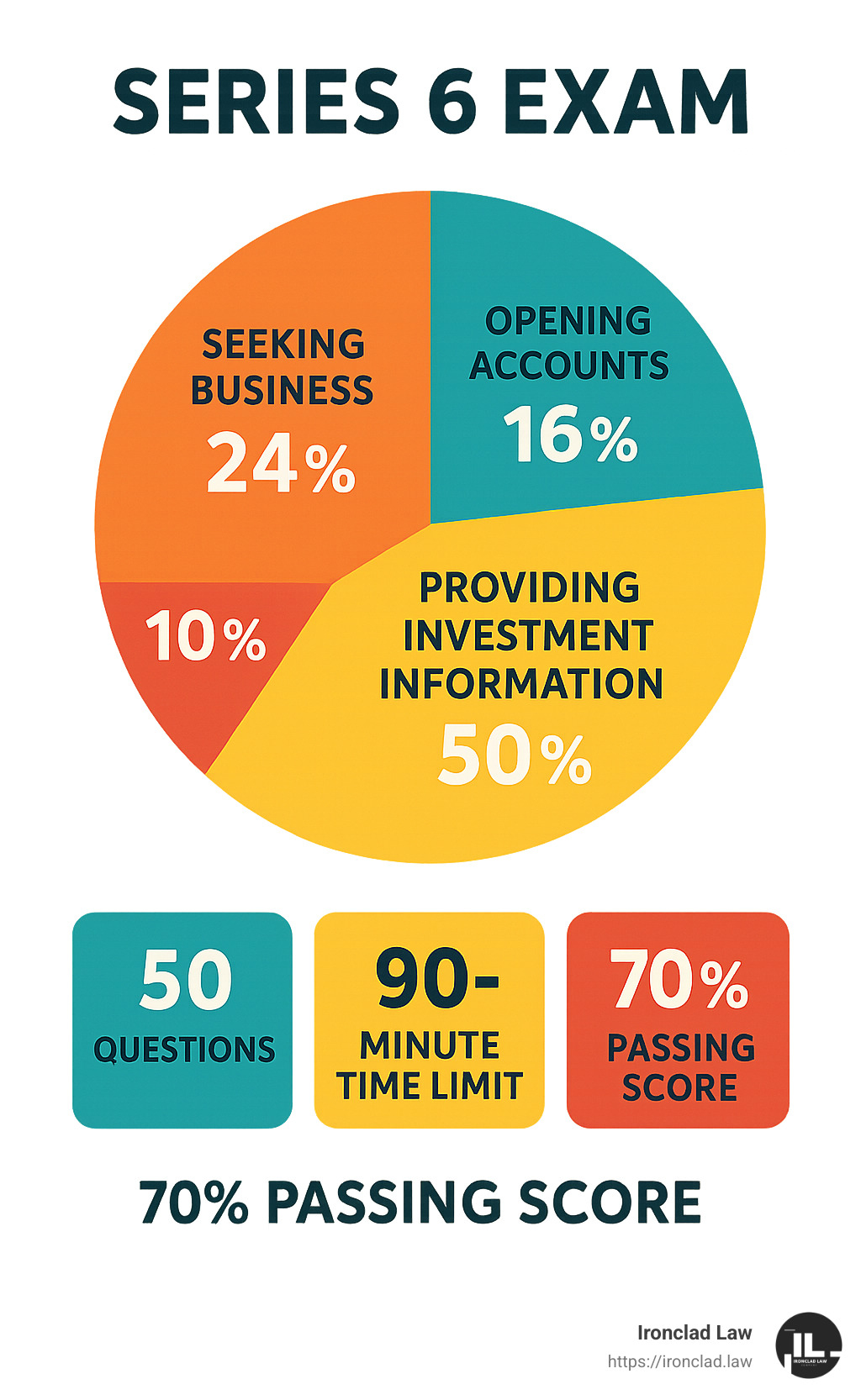
- Format: 50 multiple-choice questions (plus 5 unscored questions)
- Time Limit: 1 hour and 30 minutes
- Passing Score: 70% (35 correct answers)
- Cost: $75
- Pass Rate: Approximately 58%
The Series 6 financial exam serves as an entry point into the financial services industry, providing a more focused alternative to the broader Series 7 exam. While the Series 7 allows professionals to sell a wide range of securities, the Series 6 specifically permits the sale of mutual funds, variable annuities, variable life insurance, unit investment trusts (UITs), and municipal fund securities such as 529 college savings plans.
To take the exam, you must be sponsored by a FINRA member firm and pass the Securities Industry Essentials (SIE) exam, which serves as a corequisite. The exam content is divided into four functions, with half of the questions focusing on providing customers with investment information and making suitable recommendations.
As Michael Hurckes, Managing Partner at Ironclad Law, I’ve guided numerous financial professionals through the Series 6 financial exam process and have extensive experience with FINRA broker-dealer regulations, helping clients steer securities licensing requirements with confidence.
Quick series 6 financial exam definitions:
– securities license exam
– series 65 exam
– series 7 exam requirements
What Is the Series 6 Financial Exam?
The Series 6 financial exam, officially known as the Investment Company and Variable Contracts Products Representative Examination, serves as a critical gateway for those stepping into the financial services industry with a focus on investment company products and variable contracts. Administered by FINRA, this exam has been shaping careers since 1980.
Think of the Series 6 financial exam as your ticket to mutual funds, variable annuities, and life insurance products. It’s designed to test whether entry-level representatives have what it takes to perform their job effectively. You’ll be evaluated on your understanding of investment company products, variable contracts, and the essential regulatory requirements. Plus, you’ll need to show that you can provide suitable recommendations to your clients. According to FINRA, “The Series 6 exam ensures that candidates possess the essential knowledge to perform the critical functions of a limited representative.”
While this exam doesn’t cover everything in the securities world, it’s an ideal starting point for those specializing in specific investment products. If you’re looking to broaden your horizons further, you might consider additional Securities Licensing exams in the future.
Permitted Activities with a Series 6 License
Passing the Series 6 financial exam opens the door to selling a select group of investment products. You can confidently engage in the sale of mutual funds, which are open-end investment company securities. You can also deal in variable annuities, offering clients investment features with tax-deferred growth.
In addition, variable life insurance products are within your reach, allowing you to offer policies with investment components. The exam also covers Unit Investment Trusts (UITs), which are fixed portfolios with a specified termination date. Don’t forget municipal fund securities such as 529 college savings plans and local government investment pools.
However, it’s crucial to know the limits of a Series 6 license. You won’t be selling individual stocks, bonds, options, or ETFs. As one expert puts it, “The greatest disadvantage of a Series 6 license is that holders are not authorized to sell exchange-traded funds (ETFs),” which have become quite the hit in recent years.
Many financial professionals eventually pursue the broader Series 7 license to expand their product offerings. But for those dedicated to mutual funds, variable annuities, and the like, the Series 6 provides a streamlined and efficient path to getting started.
Steps to Obtain Your Series 6 License
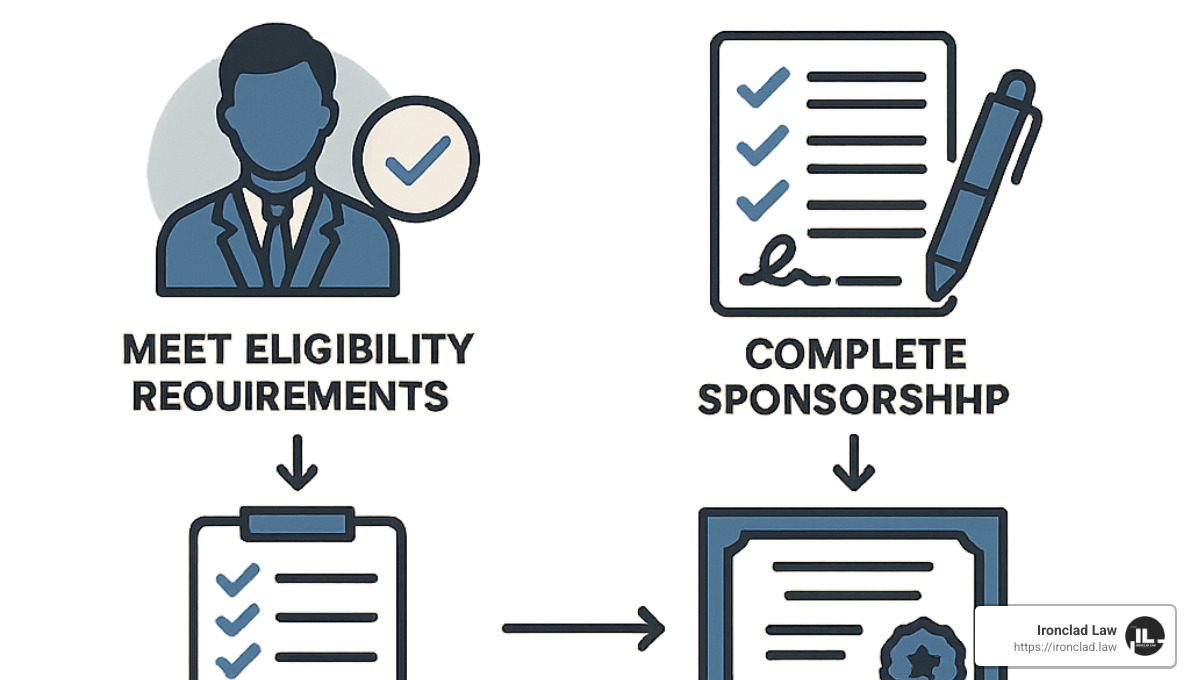
Obtaining your Series 6 financial exam license involves a structured process with several key steps. Understanding this journey will help you plan effectively and avoid unnecessary delays in launching your financial services career.
Step 1: Pass the Securities Industry Essentials (SIE) Exam
The first step toward obtaining your Series 6 license is passing the Securities Industry Essentials (SIE) exam. Created in 2018 as part of FINRA’s exam restructuring, the SIE serves as a corequisite for the Series 6 and other representative-level exams.
The SIE exam covers foundational knowledge of the securities industry, including:
– Basic market structure and functions
– Regulatory agencies and their jurisdictions
– Fundamental securities products
– Prohibited practices
– Ethical considerations
An important note about the SIE exam is that it doesn’t require firm sponsorship, meaning you can take it before securing employment with a financial firm. This gives candidates the flexibility to demonstrate their baseline knowledge to potential employers.
While the SIE and Series 6 are corequisites, they can be taken in either order. However, you must pass both to become registered as an Investment Company and Variable Contracts Products Representative. The SIE exam results remain valid for four years, giving you ample time to complete the Series 6 component.
Step 2: Secure Sponsorship from a FINRA Member Firm
Unlike the SIE exam, the Series 6 financial exam requires sponsorship from a FINRA member firm or another applicable self-regulatory organization (SRO). This requirement exists because securities representatives must work under the supervision of a registered broker-dealer.
To secure sponsorship:
1. Obtain employment with or an offer from a broker-dealer or financial services firm
2. Have the firm file a Form U4 (Uniform Application for Securities Industry Registration) on your behalf
3. Receive approval to take the exam through FINRA’s Central Registration Depository (CRD) system
The sponsorship requirement ensures that individuals entering the industry have proper supervision and oversight as they begin their careers. Your sponsoring firm typically provides guidance through this process and may even offer training resources to help you prepare for the exam.
At Ironclad Law, we’ve helped numerous financial firms steer the sponsorship process for their candidates, ensuring all regulatory requirements are met efficiently.
Step 3: Prepare for the Series 6 Financial Exam
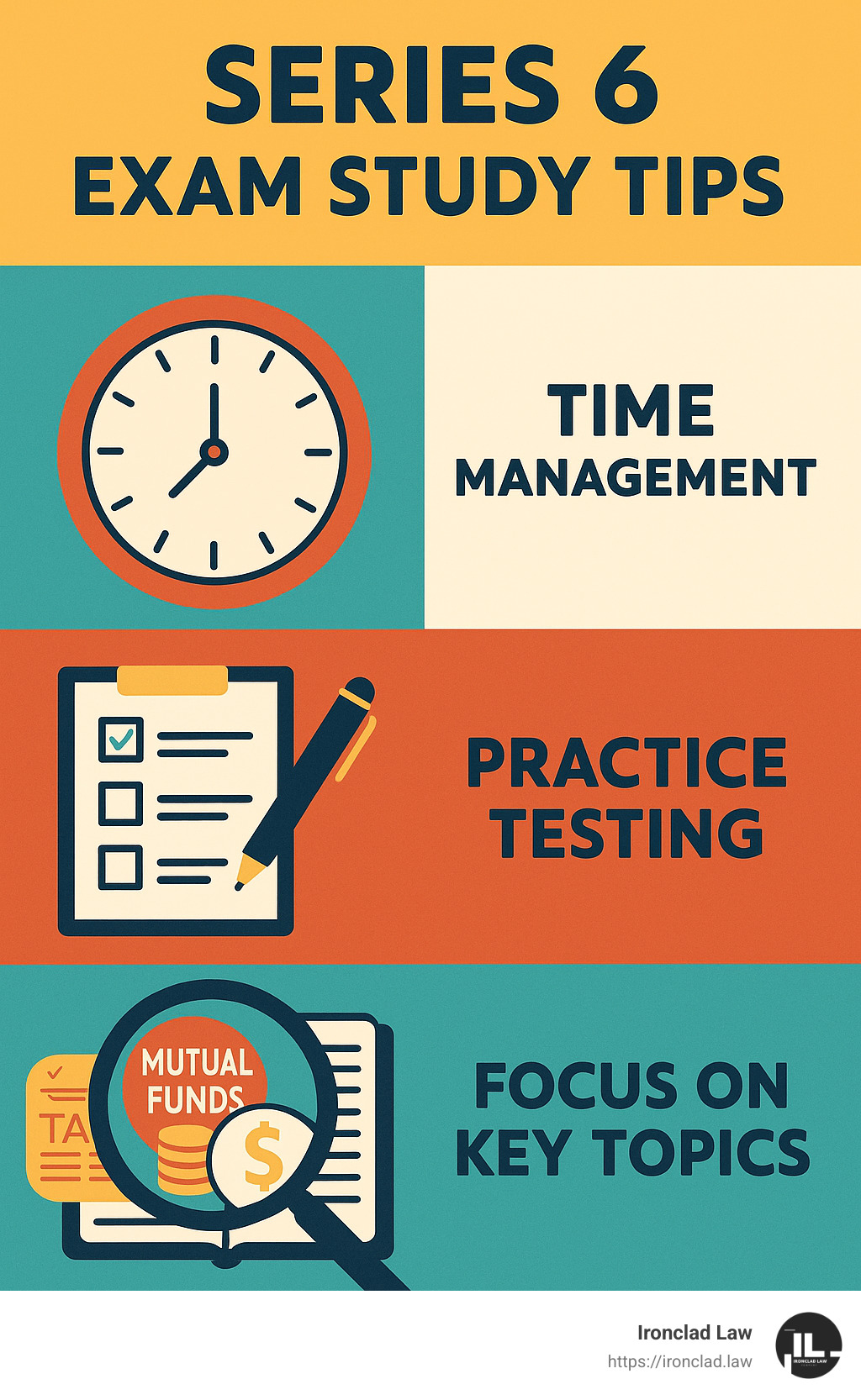
Proper preparation is crucial for success on the Series 6 financial exam. Industry experts recommend dedicating 40-50 hours of focused study time to master the material.
Effective preparation strategies include:
-
Understand the exam structure: Familiarize yourself with the four major job functions and the percentage of questions dedicated to each area.
-
Focus on key topics: Pay special attention to making suitable recommendations, understanding investment companies, comprehending how mutual funds work, and knowing the tax implications of different products.
-
Read for comprehension: Rather than simply memorizing facts, aim to truly understand the concepts. As one exam preparation expert noted, “Retention over memorization is key to success on the Series 6 exam.”
-
Take practice exams: Use practice tests to assess your knowledge and identify weak areas, but don’t rely on them as your primary learning method.
-
Study FINRA rules: Many questions relate to specific FINRA regulations, so ensure you’re familiar with the relevant rules for each exam section.
Math questions typically make up only a small portion of the exam (5 or fewer questions), often involving scenarios comparing taxable yields to tax-free yields. While not math-intensive, you should be comfortable with basic calculations relevant to investment recommendations.
Step 4: Register and Schedule Your Exam
Once you’ve prepared thoroughly, it’s time to register and schedule your Series 6 financial exam. The process involves several steps:
-
Registration: Your sponsoring firm will handle the initial registration through the CRD system.
-
Fee payment: The exam fee is $75, typically paid by either you or your sponsoring firm.
-
Scheduling: After registration is approved, you’ll receive an email with instructions to schedule your exam through Prometric, FINRA’s testing vendor.
-
Testing options: You can choose between in-person testing at a local test center or remote online testing (with certain technical requirements).
For remote testing, be aware that FINRA currently requires an approved accommodation to schedule an online appointment. This approach reflects FINRA’s evolving approach to exam administration.
When scheduling, your exam appointment includes an additional 30 minutes beyond the stated exam duration for tutorials and post-exam surveys. Plan accordingly to ensure you have sufficient time on exam day.
Series 6 Financial Exam Format and Structure
Understanding the format and structure of the Series 6 financial exam is essential for gearing up and boosting your exam-day confidence. This exam is finely crafted to test your smarts on various aspects of investment company and variable contracts products representation.
You’ll be tackling 50 scored multiple-choice questions and a sneaky 5 additional unscored pretest questions—which are cleverly mixed in and indistinguishable from the rest. You’re allotted 1 hour and 30 minutes to complete the exam, aiming for a passing score of 70%. That means getting at least 35 out of those 50 scored questions right.
Don’t fret over guessing—there’s no penalty for it. So, give it your best shot on each question. The exam can be taken either at a Prometric testing center or through remote proctoring. Both methods stick to the same time limits and question formats, so you’re good to go either way.
Exam Content Breakdown
The exam breaks down into four key functions, reflecting the real-world responsibilities of an investment company and variable contracts products representative.
-
Function 1: Seeking Business (24% of the exam, about 12 questions) focuses on reaching out to current and potential customers and developing promotional material, all while keeping a keen eye on FINRA communication rules.
-
Function 2: Opening Accounts (16% of the exam, around 8 questions) is all about procedures for setting up accounts, evaluating customer suitability, and staying compliant with regulatory requirements.
-
Function 3: Providing Information and Recommendations (50% of the exam, roughly 25 questions) is the biggie. It covers making solid investment recommendations, knowing your products inside out, and meeting disclosure and record-keeping obligations. This function underscores the core duty of offering accurate information and smart recommendations.
-
Function 4: Processing Transactions (10% of the exam, about 5 questions) deals with order processing, confirming transactions, and ensuring everything runs smoothly and legally.
Comparing Series 6 and Series 7 Exams
Deciding between the Series 6 financial exam and the Series 7 exam can shape your career path. While both open doors to selling securities, they diverge in scope and demands.
Think of the Series 7 as the full-course meal, covering a broad range of securities including stocks, bonds, and options. It’s more comprehensive, has a longer duration, and comes with a higher price tag. On the flip side, the Series 6 is like a focused appetizer, ideal for those concentrating on mutual funds and related products.
| Feature | Series 6 | Series 7 |
|---|---|---|
| Official Name | Investment Company and Variable Contracts Products Representative Exam | General Securities Representative Exam |
| Number of Questions | 50 scored (plus 5 unscored) | 125 scored (plus unscored pretest questions) |
| Time Limit | 1 hour 30 minutes | 3 hours 45 minutes |
| Cost | $75 | $300 |
| Pass Rate | Approximately 58% | Approximately 65% |
| Permitted Activities | Mutual funds, variable annuities, variable life insurance, UITs, municipal fund securities | All Series 6 products plus stocks, bonds, options, ETFs, and more |
| SIE Corequisite | Required | Required |
| Typical Study Time | 40-50 hours | 80-100 hours |
Opting for the Series 6 gives you a more accessible entry point. It’s perfect for those whose roles revolve around selling selected investment products. Meanwhile, the Series 7 is your ticket to a broader range of client offerings.
Choosing between these exams should align with your career aspirations and what your potential employer expects. At Ironclad Law, we’re here to help you figure out which path aligns best with your professional dreams.
Preparing Effectively for the Series 6 Financial Exam
Getting ready for the Series 6 financial exam is like preparing for a big race. It takes planning, practice, and a good strategy to cross the finish line successfully. This exam isn’t just about knowing facts; it’s about understanding concepts and applying them in real-world scenarios. So, let’s dive into some friendly advice to help you pass with flying colors!
Tips and Strategies for Success
First things first, give yourself enough time. Experts recommend setting aside 40-50 hours for study. Think of it as training for a marathon—consistent, paced, and purposeful. You’ll want to spread these hours over several weeks, focusing heavily on Function 3, which is all about providing investment information. This section makes up a whopping 50% of the exam, so it’s crucial to master it!
Understanding over memorization is the name of the game. Instead of cramming, dive deep into the concepts. Ask yourself, “Why does this work this way?” This approach not only helps you ace the test but also makes you better at your job. Using a mix of study materials like textbooks, online courses, and even flashcards can keep your learning fresh and engaging. Variety is the spice of study!
Practice exams are your best friends. Start with untimed, open-book sessions to build confidence. Once you’re comfortable, switch gears to timed practice exams to mimic real exam conditions. This helps you manage time pressure and identify areas that need more attention.
When you review practice tests, look for patterns in the questions you miss. Do certain topics keep tripping you up? Spend extra time there. It’s these insights that turn weaknesses into strengths.
Don’t forget about the FINRA rules—they’re the backbone of many exam questions. A solid grip on these rules is essential. And when you encounter scenario-based questions, focus on the customer’s investment objectives, time horizon, and risk tolerance to make informed decisions.
Now, here’s a twist—soft skills matter too. Communicating effectively and marketing yourself can be as important as technical knowledge. According to a study, 84% of financial pros think these skills are crucial for career growth.
Finally, simulate exam day. A week before your test, do a full-length practice run under exam-like conditions. This helps reduce anxiety and boosts confidence.
Pass Rates and Difficulty Level
With a pass rate of about 58%, the Series 6 financial exam isn’t a walk in the park, but it’s definitely doable with the right prep. It’s considered moderately difficult. So, what makes it tricky?
Well, the exam tests your understanding of regulatory complexity—think intricate FINRA rules and regulations. The suitability questions are another challenge, as they require applying your knowledge to real-world scenarios. You’ll also need to know your product-specific details like tax implications and risk profiles. And let’s not forget the time pressure of answering 55 questions in just 90 minutes.
If things don’t go your way on the first try, don’t worry. You can retake the exam, but there are waiting periods: 30 days after the first or second failed attempt, and 180 days for the third attempt. This means it’s important to be thoroughly prepared before you sit for the exam.
At Ironclad Law, we’ve helped many candidates like you develop personalized study strategies that play to their strengths and address their weaknesses. With dedication and the right approach, you’ll be well on your way to acing the Series 6 financial exam and stepping into a promising financial career. Good luck—you’ve got this!
Costs and Continuing Education Requirements
Passing the Series 6 financial exam isn’t the end of your journey—it’s just the beginning! Let’s explore the numbers and ongoing learning requirements you should consider for your career.
First up, the Series 6 financial exam itself costs $75. This fee is generally covered by your company or reimbursed once you pass, but it’s always good to double-check with your employer. And this is just the starting point.
Other costs can include the SIE Exam fee of $80, which is a must-do before tackling the Series 6. Don’t forget about study materials, which can set you back anywhere from $100 to $500, depending on how fancy you want to get with your prep. If you don’t nail it on your first try, retakes run you another $75 each time. So, study up!
Once you’re licensed, it’s all about keeping that license active. To stay in the game, FINRA requires some Continuing Education (CE). Think of it as a pit stop for your brain:
-
Regulatory Element: This is a computer-based training session on compliance and other essential standards. You’ve got to check this off within 120 days after your second anniversary in the biz, and every three years after that. Fun, right?
-
Firm Element: Your employer will have you covered here with training custom to your role. This usually involves annual compliance refreshers, updates on the products you sell, and any regulatory changes that might pop up.
If you ever leave your current firm, you’ve got a two-year grace period to join another FINRA member and keep your license active. It’s like a little safety net for career changes.
For many, passing the Series 6 financial exam is just the start. You might find yourself exploring other licenses like the Series 7, Series 63, or Series 65 down the line. Each step opens more doors and expands what you can offer in your financial services career.
At Ironclad Law, we’re here to guide you through this maze. Whether it’s understanding costs or navigating continuing education, we’ve got your back every step of the way.
Frequently Asked Questions About the Series 6 Financial Exam
How Does the Series 6 Exam Compare to the Series 7 Exam?
The Series 6 financial exam and the Series 7 exam serve different purposes and have distinct scopes. Here’s a comprehensive comparison:
Scope and Purpose:
– Series 6: Focuses specifically on mutual funds, variable annuities, variable life insurance, UITs, and municipal fund securities
– Series 7: Covers a much broader range of securities, including all Series 6 products plus stocks, bonds, options, ETFs, and direct participation programs
Exam Structure:
– Series 6: 50 scored questions (plus 5 unscored), 90-minute time limit
– Series 7: 125 scored questions, 225-minute (3 hours and 45 minutes) time limit
Cost and Preparation:
– Series 6: $75 exam fee, typically requires 40-50 hours of study
– Series 7: $300 exam fee, typically requires 80-100 hours of study
Career Implications:
– Series 6: Ideal for those focusing on packaged investment products, often suitable for financial advisors in insurance companies or those specializing in retirement planning
– Series 7: Provides broader capabilities, necessary for traditional stockbrokers and comprehensive financial advisors
Both exams require passing the SIE exam as a corequisite and sponsorship by a FINRA member firm. Your career goals should guide which exam is right for you—the more focused Series 6 or the comprehensive Series 7.
For detailed information about the Series 7, you can visit our Series 7 Exam Requirements page.
What Are the Prerequisites for Taking the Series 6 Exam?
The prerequisites for the Series 6 financial exam are straightforward but mandatory:
-
SIE Exam: You must pass the Securities Industry Essentials (SIE) exam, which serves as a corequisite. While there’s no required order, both must be passed to become registered.
-
Sponsorship: You must be sponsored by a FINRA member firm or another self-regulatory organization (SRO). This requires:
- Employment with or an offer from a financial firm
- Submission of Form U4 through the Central Registration Depository (CRD)
-
Approval from FINRA to take the exam
-
Background Check: As part of the registration process, you’ll undergo a background check that reviews your criminal history, financial background, and regulatory records.
Unlike some other professional certifications, the Series 6 financial exam does not require:
– Prior work experience in the financial industry
– A college degree or specific educational background
– Completion of other securities exams (beyond the SIE corequisite)
This relatively accessible entry point makes the Series 6 an attractive option for those new to the financial services industry. For comparison with other licensing exams, you might find our Series 65 Exam page helpful.
How Can I Retake the Series 6 Exam if I Fail?
If you don’t pass the Series 6 financial exam on your first attempt, you have options to retake it. However, FINRA has established specific waiting periods and procedures:
Waiting Periods:
– After the first or second failed attempt: You must wait 30 calendar days before retaking the exam
– After three or more failed attempts: You must wait 180 calendar days (approximately 6 months)
These waiting periods are mandatory and cannot be waived, emphasizing the importance of thorough preparation before your initial attempt.
Retake Process:
1. Consult with your sponsoring firm, as they must resubmit your exam application
2. Pay the $75 exam fee again for each retake
3. Receive a new enrollment window and schedule your exam date
Preparation Strategies for Retakes:
1. Analyze your performance: Review your score report to identify weak areas
2. Adjust your study approach: If your initial method wasn’t effective, consider different study materials or a structured prep course
3. Focus on challenging topics: Allocate more time to the sections where you struggled
4. Take more practice exams: Use different practice questions to test your knowledge from various angles
5. Consider a tutor: One-on-one guidance can be valuable, especially for difficult concepts
Many successful financial professionals didn’t pass on their first attempt. The key is to learn from the experience and approach your retake with a refined strategy and renewed dedication.
At Ironclad Law, we’ve worked with many professionals through the licensing process, including helping them develop effective strategies after an unsuccessful first attempt.
Conclusion
The Series 6 financial exam represents an important milestone in your financial services career. As we’ve explored throughout this guide, this license opens doors to selling mutual funds, variable annuities, and other packaged investment products that form the backbone of many clients’ investment portfolios.

Successfully navigating the Series 6 financial exam requires understanding its structure, dedicating sufficient study time, and approaching the material with a focus on comprehension rather than memorization. With a pass rate of approximately 58%, thorough preparation is essential for success on your first attempt.
Remember these key takeaways:
-
The exam tests four major job functions, with half the questions focusing on providing investment information and making suitable recommendations
-
You must pass both the SIE exam and the Series 6 exam to become registered, and sponsorship by a FINRA member firm is required
-
Effective preparation typically requires 40-50 hours of focused study, with particular attention to FINRA rules and suitability scenarios
-
After passing, you’ll need to fulfill continuing education requirements to maintain your license
At Ironclad Law, we specialize in helping financial professionals steer the complex regulatory landscape of the securities industry. Whether you’re just starting your journey toward the Series 6 license or looking to expand your qualifications beyond it, our team can provide the legal guidance and support you need.
For official information about the Series 6 exam, you can visit the FINRA Series 6 page.
For more information about securities licensing and how we can support your professional journey, visit our Securities Licensing page or contact our New York office to schedule a consultation.