
You have 0 items in your cart

Understanding Securities Licensing: Your Gateway to the Financial Industry

Securities Licensing is the mandatory regulatory process that authorizes financial professionals to buy, sell, or advise on investment products like stocks, bonds, mutual funds, and other securities.
Key Requirements:
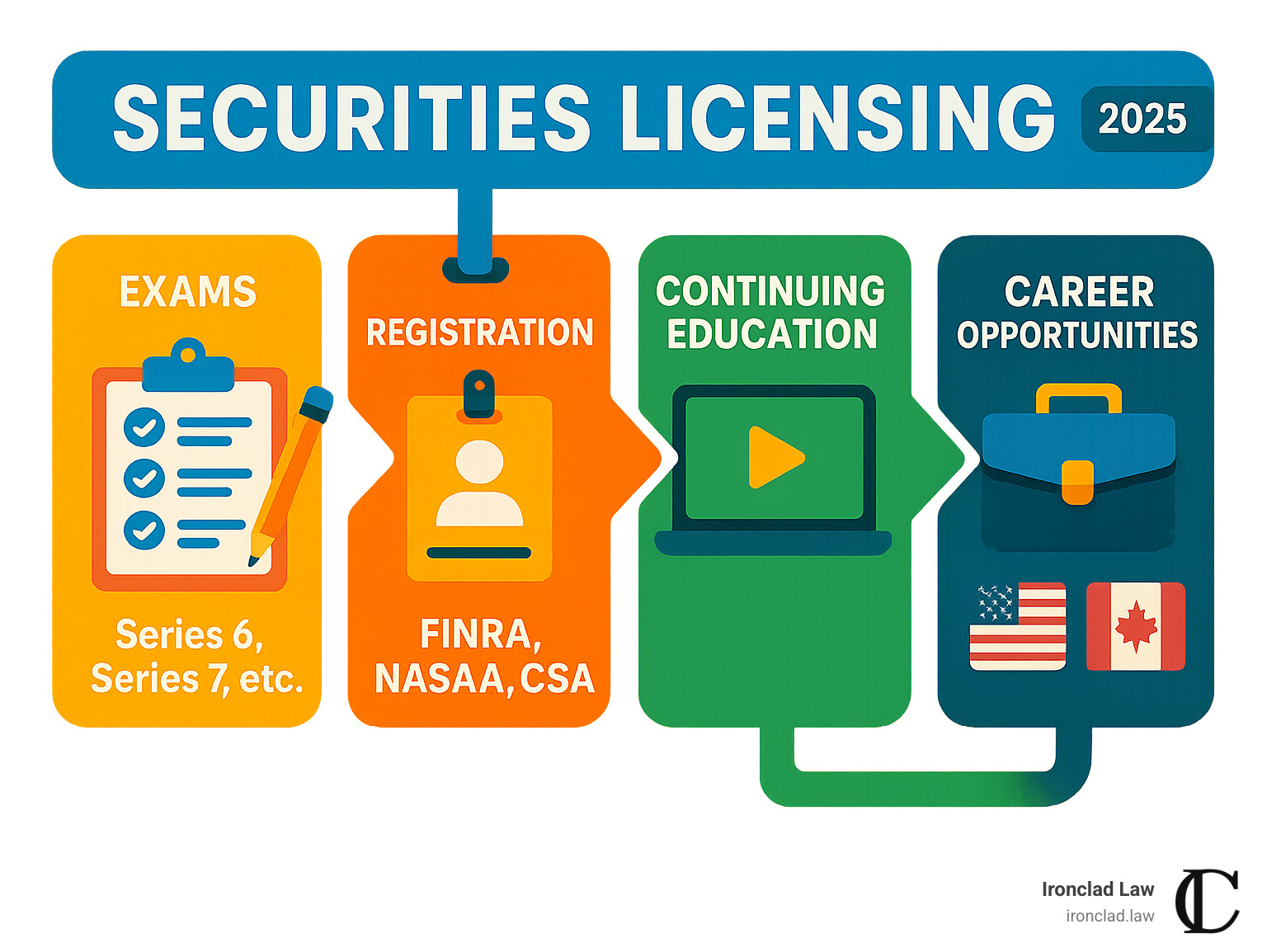
- Pass industry qualification exams (Series 6, 7, 63, 65, 66, etc.)
- Complete registration with regulatory bodies (FINRA, NASAA, CSA)
- Maintain continuing education requirements
- Obtain sponsorship from a registered firm (for most licenses)
Main Regulators:
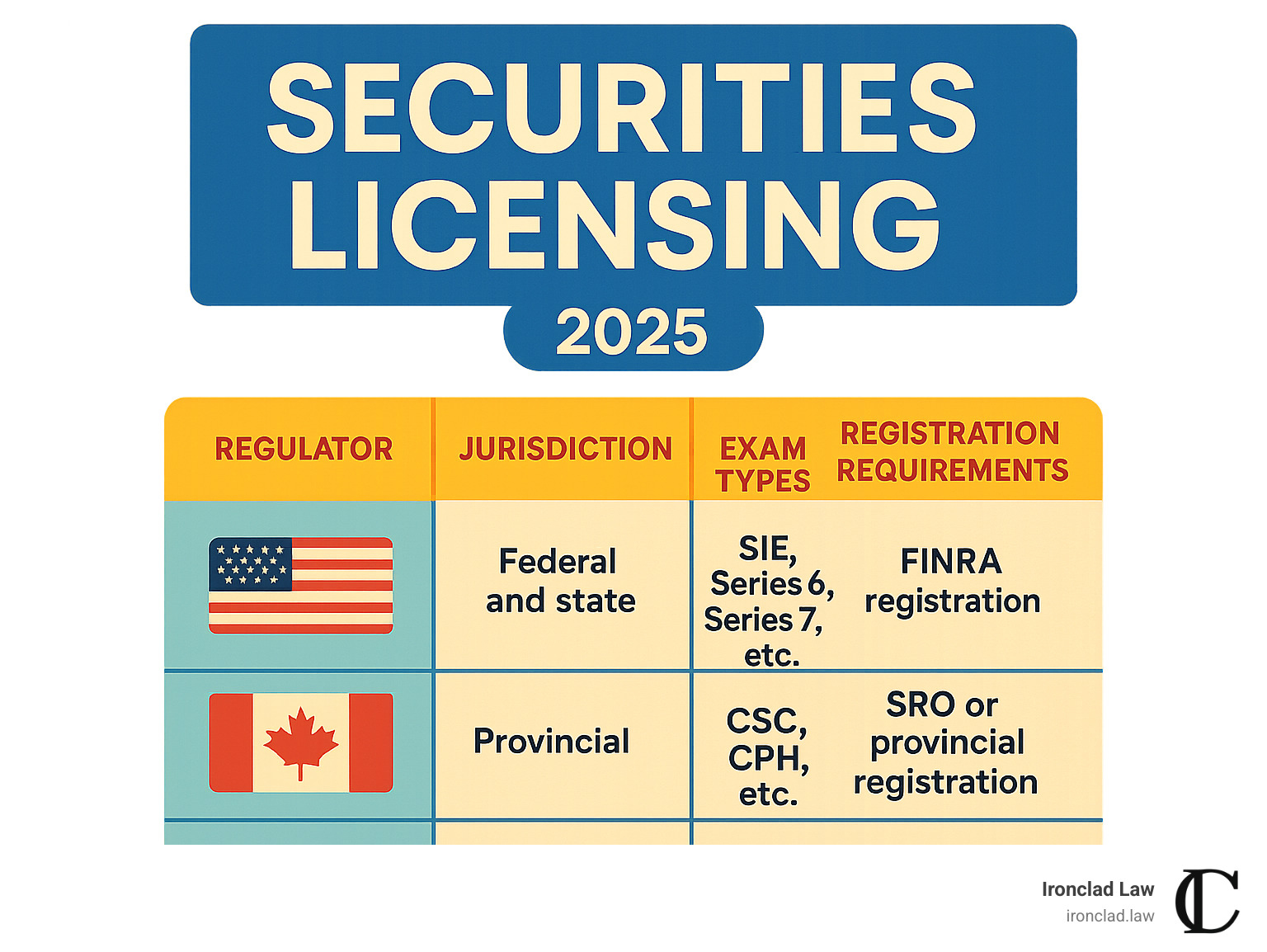
- United States: FINRA, SEC, NASAA (state level)
- Canada: CSA, CIRO, AMF (provincial level)
Common License Types:
- Series 6: Mutual funds and variable annuities
- Series 7: General securities (stocks, bonds, options)
- Series 65/66: Investment advisory services
- CSC (Canada): Foundational securities credential
The licensing process typically takes 2-6 months and costs between $200-$500 in exam fees. No college degree is required for most licenses, though sponsorship from a registered firm is usually necessary.
As someone who’s steerd the complex world of financial regulations for over a decade, I’ve seen how proper Securities Licensing can make or break a financial professional’s career. At Ironclad Law, I’ve helped countless clients understand and comply with FINRA, SEC, and state securities regulations while building successful practices in the financial services industry.
Securities Licensing terms to learn:
Why Securities Licensing Matters: Investor Protection & Compliance
Securities Licensing serves as the financial industry’s shield between investors and potential fraud. From Bernie Madoff’s Ponzi scheme to countless pump-and-dump operations, history shows us what happens when proper oversight falls short. Organizations like FINRA, NASAA, CSA, and CIRO exist as watchdogs ensuring everyone plays by the rules.
When a financial professional gets licensed, they submit to background checks, agree to follow suitability rules, and accept ongoing monitoring. Break the rules? You face serious penalties, including fines, license suspension, or industry bans.
The National Registration Search tool exemplifies this transparency. Any investor can look up their advisor’s credentials, check disciplinary history, and verify qualifications.
FINRA Rule 2111 requires brokers to ensure recommendations match each client’s situation. Licensed professionals know these rules inside and out, while the Central Registration Depository tracks everything – employment history, exam results, complaints, and disciplinary actions.
Primary Benefits of Securities Licensing
Licensing provides credibility that represents real knowledge and accountability. Legal authority is crucial – without proper licensing, selling securities is illegal. The license gives professionals the right to conduct business, earn commissions, and provide investment advice.
Most importantly, licensing builds client trust. Investors sleep better knowing their advisor is licensed, monitored, and held to professional standards. If something goes wrong, there’s recourse through regulatory channels.
At Ironclad Law, we’ve represented too many people who learned the hard way about working with unlicensed individuals. The licensing process might seem like a hassle, but it’s infinitely better than dealing with the legal mess that comes from cutting corners on compliance.
Key Regulators & Exams in the US and Canada
In the United States, three main players govern securities licensing. FINRA writes rules for broker-dealers, creates most exams, and tracks licensing history. The SEC oversees investment advisers managing over $100 million in client assets. NASAA coordinates state-level requirements.
Canada operates similarly with different names. The CSA sets the overall framework across provinces. CIRO handles day-to-day oversight of investment dealers and mutual fund dealers. In Quebec, the AMF has special provincial authority.
Securities Industry Essentials (SIE) Exam – Your First Milestone
The SIE exam is your learner’s permit for the securities world. FINRA introduced it in October 2018 to provide common foundation before specialized licenses.
Key details: 75 multiple-choice questions in under two hours, 70% passing score, $80 cost, and no firm sponsorship required. This is huge for career prospects – employers know you’re serious when you’ve already passed the SIE.
The exam covers products and risks (nearly half the questions), capital markets, trading and customer accounts, and regulatory framework. The FINRA SIE Practice Exam helps you get comfortable with format and timing.
State & Provincial Oversight Requirements
Each state and province has “Blue Sky” laws protecting local investors. In the United States, you’ll file Form U4 in every state where you plan business. Most states require the Series 63 exam covering state regulations and ethics.
Canada works similarly with provincial securities commissions. Each province has registration requirements, educational credentials like the CSC, and fee structures. The National Registration Search tool checks registration status across all jurisdictions.
Role of Sponsorship in Securities Licensing
Most securities licenses require sponsorship from a FINRA member firm or registered dealer. You need a job offer before getting fully licensed. This creates accountability and ongoing supervision.
Your firm files Form U4 on your behalf, giving you 120 days to pass required exams. The SIE exam is the notable exception – no sponsorship required, which is why we recommend taking it early in career planning.
Types of Securities Licenses & What They Let You Do

Choosing the right Securities Licensing path is like picking the right tool for a job – each license opens specific doors in financial services.
FINRA Representative & Principal Licenses
The Series 6 License focuses on packaged investment products – mutual funds, variable annuities, and unit investment trusts. The exam takes 90 minutes with 50 questions, requires 70% passing, and costs $75. Perfect for insurance agents adding investment products or bank representatives with conservative investors.
The Series 7 License is the heavyweight champion – authorizing stocks, bonds, options, and most securities except commodities. It’s challenging: 3 hours 45 minutes, 125 questions, 72% passing score, $300 fee. If you’re serious about becoming a stockbroker or full-service financial advisor, this is your golden ticket.
The Series 24 License lets you supervise Series 7 representatives at the principal level (requires Series 7 first). The Series 26 License serves similar supervisory function for Series 6 representatives.
NASAA Uniform State Exams
The Series 63 License focuses on state securities law compliance: 1 hour 15 minutes, 60 questions, 72% passing score. You’ll almost always need this alongside Series 6 or 7.
The Series 65 License authorizes investment adviser representative activities: 3 hours, 130 questions, 72% passing score. Perfect for fee-based advisors charging fees rather than earning commissions.
The Series 66 License combines Series 63 and 65 authority: 2 hours 30 minutes, 100 questions, 73% passing score. Requires Series 7 first. The Series 7 and Series 66 Licenses combination allows maximum flexibility in both broker and investment adviser roles.
Canadian Core Credentials
The Canadian Securities Course (CSC) serves as foundational requirement for most Canadian securities licenses. The Exempt Market Dealer License lets you sell private placements and exempt securities. The Portfolio Manager License authorizes discretionary investment management, requiring the CIM designation.
Securities Licensing Exam Difficulty
These aren’t weekend projects. Series 6 requires 40-60 study hours, Series 7 demands 80-120 hours, Series 65 needs 60-80 hours, and Series 66 requires 50-70 hours.
Pass rates tell the story: Series 6 sees 70% pass, Series 7 around 65%, Series 65 approximately 68%, and Series 66 about 75%. The Series 65 License exam presents complex client scenarios requiring you to identify appropriate actions – not just memorization.
Step-by-Step Process to Obtain Your Securities License

Getting your Securities Licensing follows a clear roadmap. Start by determining your license needs based on career goals, then consider taking the SIE exam first – it doesn’t require firm sponsorship.
Next, secure sponsorship from a registered firm. Many firms pay for exam fees, study materials, and provide paid study time. Your firm completes registration by filing Form U4, including background checks and fingerprinting. This takes 2-3 weeks, giving you a 120-day window to pass exams.
Schedule exams through Prometric testing centers early – don’t wait until the last minute. Finally, maintain your license through continuing education and keeping Form U4 updated.
Do You Need a College Degree?
No college degree is required for most securities licenses. FINRA and NASAA care about competency demonstrated through exams, not formal education. Individual employers may prefer degrees, but many smaller firms hire based on licensing and sales ability rather than diplomas.
Registration & Scheduling of Exams
For FINRA exams, you need firm sponsorship except for the SIE. Once your firm files Form U4, you have 120 days to schedule and pass required exams. Register at the FINRA exam enrollment portal.
Exam fees add up: SIE costs $80, Series 6 is $75, Series 7 is $300, Series 63 is $147, Series 65 is $175, and Series 66 is $165. Budget for potential retakes after 30-day waiting periods.
Continuing Education & Renewal
The Regulatory Element hits every three years with computer-based training covering rule changes. Your firm provides Firm Element training annually. Missing deadlines can result in license suspension.
Common Pitfalls to Avoid
Insufficient study time is the biggest trap – with 60-70% pass rates, one-third fail initially. Ignoring state requirements is costly since each state has its own laws. Lapsed continuing education can derail careers. Incomplete Form U4 disclosure creates long-term problems.
Securities Licensing for Career Advancement
The financial impact is significant: median salary for securities professionals is $62,910, while personal financial advisors earn $94,170. Projected job growth of 10-15% through 2031 means strong demand. Licensed professionals command higher salaries, better benefits, and more career options.
Careers & Growth Opportunities After Licensing

Once you’ve earned your Securities Licensing, numerous career possibilities open up with substantial earning potential.
Stockbroker positions require Series 7 and Series 63 licenses. Earning potential ranges from $45,000 for new graduates to over $150,000 for top producers, with income depending on business generation.
Investment advisors use Series 65 or Series 66 licenses for fee-based financial planning rather than commission-based sales. This creates predictable income of $60,000 to $200,000 annually with stronger client relationships.
Financial planners typically need Series 7 and Series 66 licenses plus additional certifications like CFP. This comprehensive approach offers $70,000 to $300,000+ earning potential, especially in high-net-worth planning.
Compliance officers with Series 7 and Series 24 or Series 26 licenses ensure regulatory compliance. These positions offer stable $75,000 to $150,000 salaries with regular hours – perfect for detail-oriented professionals preferring steady income over sales pressure.
Portfolio managers sit at the top, managing institutional money or high-net-worth portfolios. Requiring Series 7 and Series 66 plus advanced credentials, compensation ranges from $100,000 to $500,000+ with performance bonuses.
Career progression typically follows: entry-level representative → senior representative → team leadership → branch manager or independent advisor. Understanding What is a Broker-Dealer? becomes crucial as you advance, affecting licensing requirements and compensation structures.
Growth forecasts remain strong, with financial advisor positions projected to grow 15% through 2031 – much faster than average. This growth is driven by an aging population needing retirement planning and younger generations seeking professional financial guidance.
Frequently Asked Questions about Securities Licensing
What is the Securities Industry Essentials (SIE) exam?
The SIE exam is your passport to the securities world – a 75-question multiple-choice test covering fundamental knowledge every securities professional needs. You have 1 hour and 45 minutes to complete it, need a 70% score to pass, and pay an $80 exam fee.
The exam focuses on four areas: Capital markets knowledge (16%), Products and risks (44%), Trading and customer accounts (31%), and Regulatory framework (9%). The SIE consolidates common content from various licensing exams into one foundational test.
Do I need sponsorship to take the SIE?
No sponsorship required for the SIE exam. You can take it while in college, between jobs, or exploring the securities industry. However, you’ll still need firm sponsorship for “top-off” exams like Series 6, 7, or 66, and you can’t work as a securities representative until registered with a member firm.
Having the SIE completed makes you a much more attractive job candidate, showing employers you’ve invested in securities education.
How can investors verify a professional’s license?
Always verify licensing before investing. In the United States, FINRA’s BrokerCheck database provides detailed reports on license status, employment history, and red flags. For Canadian investors, the National Registration Search tool covers all provinces and territories.
These databases show current license status, employment history, disciplinary actions, customer complaints, and regulatory violations. The verification process takes five minutes and could save thousands of dollars and years of legal headaches.
Conclusion
Your Securities Licensing journey builds a foundation supporting your entire financial services career. Whether starting out or expanding client offerings, proper licensing demonstrates professional competency and creates opportunities for higher earnings, professional credibility, and career flexibility.
The process requires dedication – hours of studying, navigating regulatory requirements, and ongoing continuing education. But every hour invested returns through improved earning potential and professional opportunities that unlicensed competitors can’t match.
At Ironclad Law, we understand the securities industry’s complexity. We take an aggressive approach when representing financial professionals, fighting hard when FINRA or state regulators come knocking. We’ve helped countless professionals steer investigations, regulatory actions, and compliance challenges that could have ended careers.
Securities Licensing goes beyond checking regulatory boxes – it’s about building practices that serve clients well while protecting professional reputations. The rules protect both investors and honest professionals who play by the rules.
Whether pursuing your first license or adding credentials, invest in doing it right. Study properly, understand regulations thoroughly, and maintain the highest ethical standards. Your future clients depend on it, and your career success requires it.
The financial services industry rewards those who take licensing seriously. With proper preparation and ongoing compliance, you’re building trust that translates directly into business success.
For comprehensive guidance on securities law and licensing compliance, visit our Securities Licensing services page. We’re here to help you steer the complex world of securities regulation with confidence and success.