
You have 0 items in your cart

What Is the FINRA Series 6 Exam and Why It Matters
The FINRA Series 6 exam is a securities licensing qualification exam that allows financial professionals to sell mutual funds, variable annuities, variable life insurance products, unit investment trusts (UITs), and municipal fund securities. Here’s what you need to know:
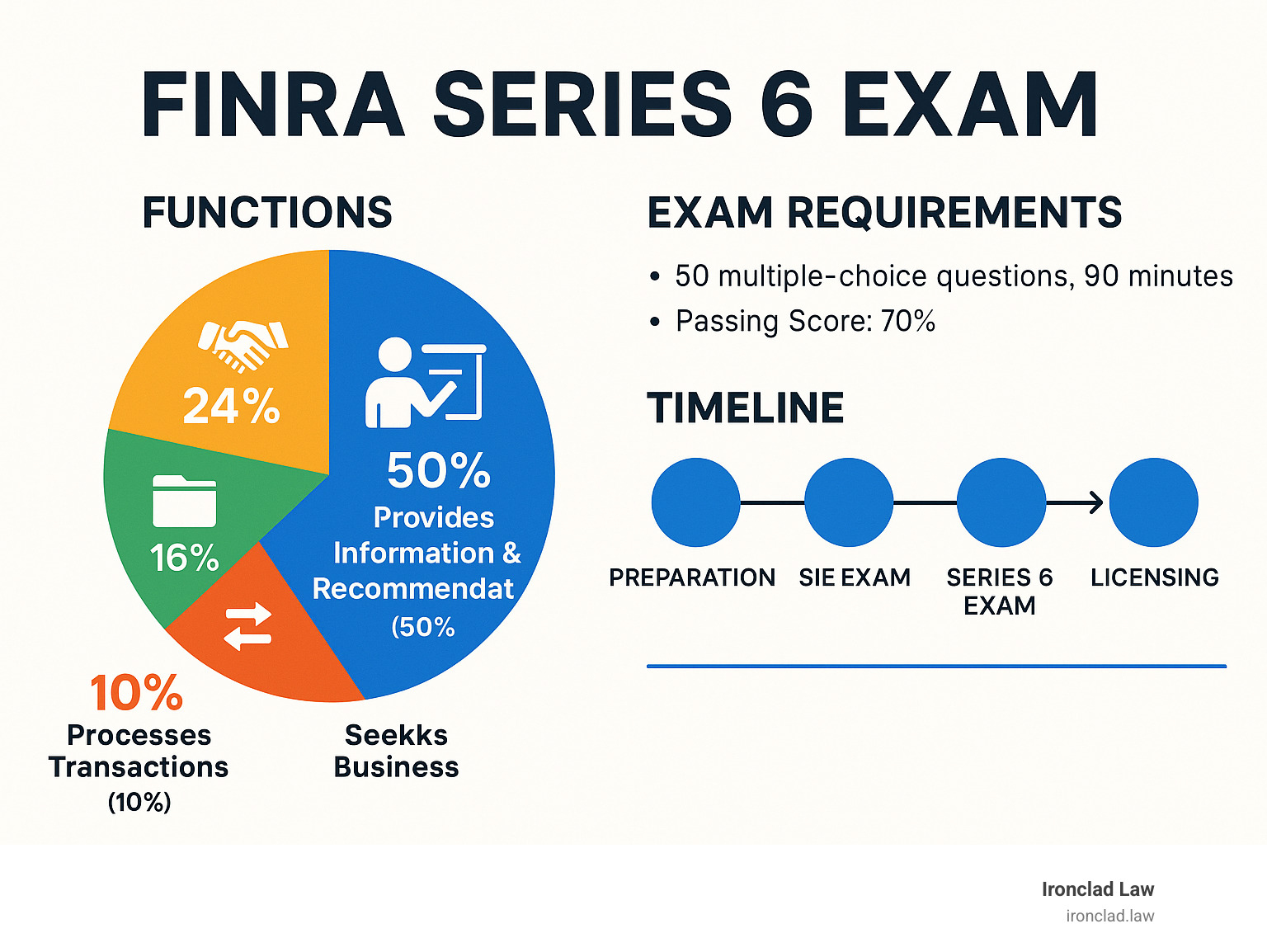
- Exam Format: 50 multiple-choice questions completed in 90 minutes
- Passing Score: 70% (at least 35 correct answers)
- Cost: $75 exam fee
- Prerequisites: Must pass the Securities Industry Essentials (SIE) exam and have sponsorship from a FINRA member firm
- Content Focus: Four job functions with heaviest weight (50%) on providing information and recommendations to customers
The FINRA Series 6 license serves as an entry point into the securities industry for many professionals, particularly those in the insurance sector looking to expand their product offerings. Unlike the more comprehensive Series 7 license, the Series 6 is specifically focused on packaged investment products rather than individual securities like stocks and bonds.
Getting your Series 6 license can significantly improve your career prospects and earning potential in the financial services industry. According to industry research, 84% of financial professionals recognize that training related to practical skills, such as client communication and marketing, is crucial for career development alongside technical knowledge of investment products.
My name is Michael Hurckes, and as an attorney with experience in broker-dealer regulations and FINRA compliance, I’ve guided numerous professionals through the FINRA Series 6 licensing process and helped firms steer the regulatory landscape of securities offerings. Let me walk you through exactly what you need to know to ace this exam.
Common finra series 6 vocab:
– series 7 license
– series 63
– securities license exam
What to Expect on Your Path
Your journey to obtaining the FINRA Series 6 license involves several key milestones. First, you’ll need to pass the Securities Industry Essentials (SIE) exam, which tests your basic knowledge of the securities industry. Next, you’ll secure sponsorship from a FINRA member firm, which is required before you can sit for the Series 6 exam. Once you’ve passed both exams, you’ll register your license and potentially complete additional state requirements.
The right preparation mindset is crucial. This isn’t just about memorizing facts—it’s about understanding how investment products work and how regulations protect investors. Approach your studies with patience and consistency, and remember that this knowledge will serve you throughout your career, not just on exam day.
Understanding the FINRA Series 6 License
Think of the FINRA Series 6 license as your entry ticket to a specific corner of the investment world. Unlike its bigger sibling (the Series 7), this license focuses on packaged investment products that many everyday investors rely on for their retirement and education savings.
When you earn your Series 6, you become qualified to help clients with several important investment vehicles. You can sell mutual funds that pool money from many investors to purchase diversified portfolios. You can offer variable annuities, those retirement vehicles that combine insurance with investment features. Your license also covers variable life insurance products, which provide both death benefits and investment components.
Beyond these, you’ll be able to work with Unit Investment Trusts (UITs) that offer fixed portfolios of securities, and municipal fund securities like 529 college savings plans that help families save for education expenses.
The industry officially calls this the “Investment Company and Variable Contracts Products Representative Qualification Examination,” but we all just call it the Series 6. Your role as a “limited representative” means you can only sell these specific types of securities – an important distinction that keeps you in compliance with regulations.
For deeper insights into exam requirements and structure, our FINRA Series 6 Financial Exam page provides additional resources.
What the Series 6 Qualifies You to Do
With your FINRA Series 6 license in hand, you become a valuable guide for clients navigating these specific investment products. You can sit down with clients and explain how mutual funds work, help them understand the tax benefits of variable annuities, and recommend suitable options based on their unique financial situation and goals.
Your daily activities might include analyzing a client’s risk tolerance, discussing investment timeframes, processing buy and sell orders for mutual funds, and providing ongoing support as their financial needs evolve. You become their trusted advisor for these particular products.
However, it’s crucial to understand where the boundaries lie. Your Series 6 license doesn’t permit you to sell individual stocks or bonds. You can’t offer options or futures contracts. Direct participation programs like limited partnerships are off-limits, as are margin trading accounts. And you can’t act as a principal in securities transactions. These clear boundaries help maintain regulatory compliance and protect both you and your clients.
Who Needs a Series 6 vs. Other Licenses
The Series 6 license shines for certain professionals. Insurance agents often add this license to expand beyond traditional insurance products. Bank representatives find it valuable when helping customers move beyond savings accounts into investments. Financial advisors who primarily work with retirement accounts and mutual funds find it perfectly suited to their practice. And retirement specialists focusing on 401(k)s and IRAs gain the credentials they need.
Many professionals wonder about the difference between the Series 6 and Series 7. Here’s how they compare:
| Feature | Series 6 | Series 7 |
|---|---|---|
| Exam Length | 50 questions, 90 minutes | 125 questions, 225 minutes |
| Exam Fee | $75 | $300 |
| Mutual Funds | Yes | Yes |
| Variable Annuities | Yes | Yes |
| Individual Stocks | No | Yes |
| Bonds | No | Yes |
| Options | No | Yes |
| Direct Participation Programs | No | Yes |
| Complexity | Moderate | High |
| Typical Study Time | 40-60 hours | 80-100+ hours |
Many financial professionals begin their careers with the Series 6 and later upgrade to the Series 7 as their responsibilities grow. The FINRA Series 6 offers a more focused and manageable entry point, especially if your primary business revolves around retirement planning and packaged investment products. It’s like starting with a specialized toolkit before eventually expanding to a full workshop.
Step-by-Step: Eligibility, Registration & Costs
Ready to start your FINRA Series 6 journey? I’ll walk you through exactly what to expect, from eligibility requirements to what you’ll pay along the way.

1. Pass (or Schedule) the SIE Exam
First things first—you’ll need to tackle the Securities Industry Essentials (SIE) exam. Think of this as your industry passport that pairs with the Series 6. The good news? You can take these exams in whatever order works for you.
The SIE covers the fundamentals: capital markets, investment products, trading basics, and regulatory frameworks. It’s 75 multiple-choice questions and you’ll have 1 hour and 45 minutes to show what you know. The fee is $80—a small investment in your future career.
Here’s a perk many candidates love: your SIE results stay valid for four years. This means you can pass it while still in college or before landing your first industry job. Having this exam under your belt can make you much more attractive to potential employers—it shows you’re serious and already have a head start.
2. Secure Firm Sponsorship & File Form U4
Unlike the SIE, you can’t just sign up for the FINRA Series 6 on your own. You’ll need a FINRA member firm to sponsor you—it’s required by FINRA Rule 1210.
Why the sponsorship requirement? Because securities representatives must work under the supervision of a registered broker-dealer who’s responsible for your activities. Think of it as having a professional mentor who ensures you’re following all the rules.
Your sponsoring firm will handle the paperwork by filing Form U4 (Uniform Application for Securities Industry Registration or Transfer) through FINRA’s Central Registration Depository (CRD) system. They’ll also cover any registration fees associated with your application.
3. Enroll & Pay for the FINRA Series 6 Exam
With your sponsorship secured, it’s time to officially enroll for the exam. The FINRA Series 6 exam fee is $75 as of 2022. While most firms cover this cost for their candidates, policies do vary, so it’s worth confirming who’s handling the payment.
After enrollment, the clock starts ticking—you’ll have a 120-day window to schedule and take your exam. You can book your test at a Prometric testing center, or in some cases, take advantage of remote proctoring from the comfort of your home.
Need testing accommodations due to a disability? No problem—just submit your request to FINRA before scheduling. They’re committed to making the process accessible for everyone.
For deeper insights into the registration process, check out our Securities License Exam page. If you’re representing a firm navigating compliance requirements, our Broker-Dealer Compliance resources will be invaluable.
4. Sit for the Exam & Receive Your Score
Exam day has arrived! You’ll have 90 minutes to answer 50 scored multiple-choice questions, plus 5 unscored pretest questions that are sprinkled throughout (don’t worry—you won’t know which ones don’t count, so give each question your best effort).
The magic number is 70%—you’ll need to answer at least 35 questions correctly to pass. FINRA uses a process called “equating” to ensure fairness across different versions of the exam, so the playing field stays level for everyone.
One of the best parts of the process? You’ll know your results immediately after completing the exam. If you don’t pass on your first attempt, don’t be discouraged. You can retake the exam after a 30-day waiting period. After three unsuccessful attempts, the waiting period extends to 180 days—giving you plenty of time to strengthen your knowledge.
5. Register Your License & State Requirements
Congratulations on passing both exams! Now your sponsoring firm will finalize your registration with FINRA. But wait—there’s often one more step. Many states require you to also pass the Series 63 (Uniform Securities Agent State Law Examination) to sell securities within their borders.
The Series 63 focuses on state securities regulations and consists of 60 questions to be completed in 75 minutes. For more details about this requirement, our Series 63 License page has everything you need to know.
Once you’re fully registered, learning never stops in this industry. You’ll need to complete continuing education (CE) requirements to keep your license active:
Regulatory Element: Required every three years to stay current on regulations
Firm Element: Annual training provided by your broker-dealer to improve your professional knowledge
These ongoing education requirements ensure you’re always equipped with the latest industry knowledge to serve your clients effectively.
Mastering the FINRA Series 6 Exam Format
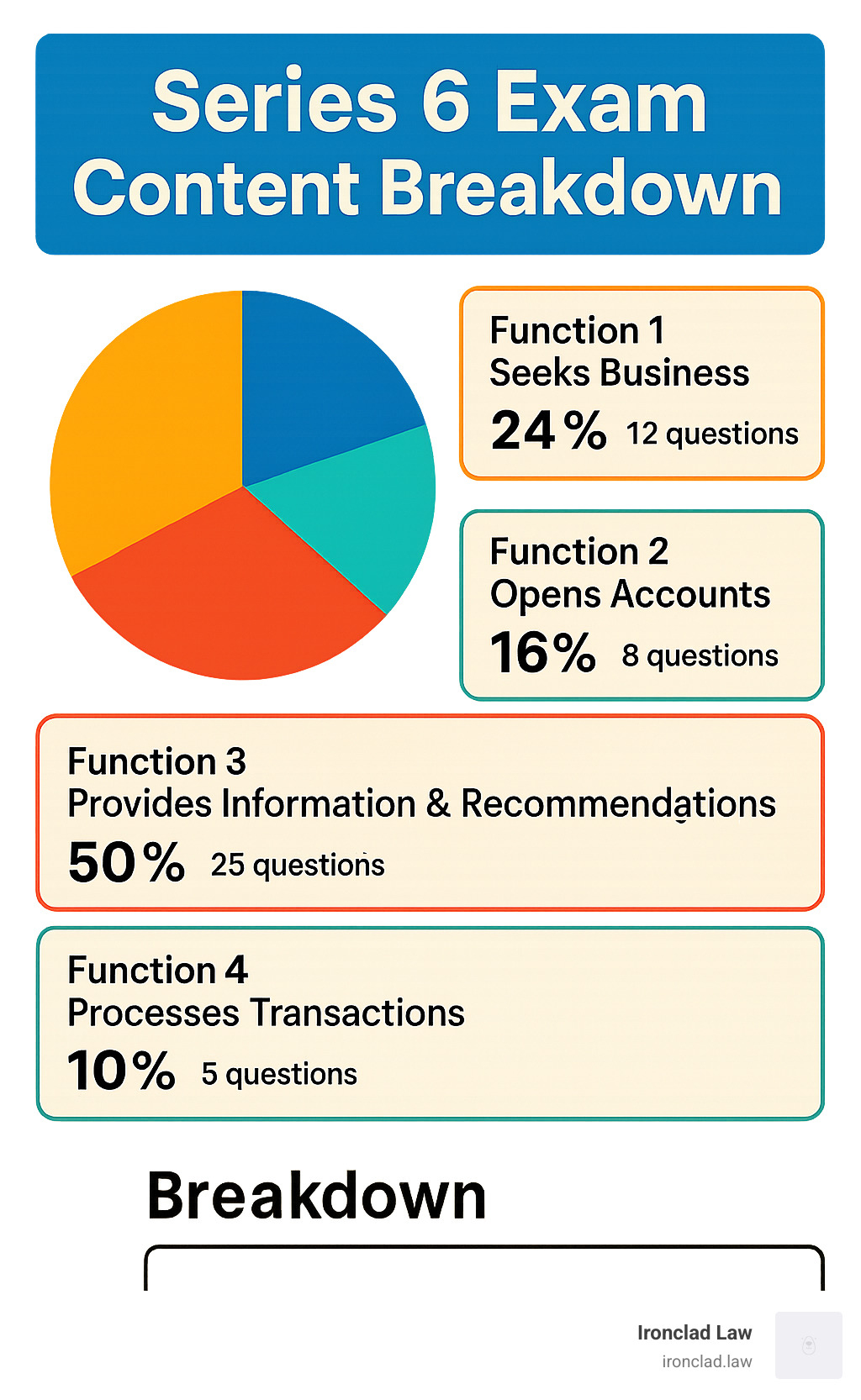
Understanding the structure of the FINRA Series 6 exam is like having a map before your journey—it helps you steer more confidently. The exam mirrors what you’ll actually do in your day-to-day work, focusing on four key job functions that investment representatives perform regularly.
When you sit down for your exam, you’ll face 50 scored multiple-choice questions that you’ll need to complete in 90 minutes. That gives you a little under 2 minutes per question—plenty of time if you’re prepared, but you’ll want to keep an eye on the clock. There are also 5 additional “pretest” questions mixed in that don’t count toward your score. The catch? You won’t know which ones they are, so treat every question as if it counts!
The exam weights each function differently, with the heaviest emphasis (50%) on providing information and recommendations to clients—which makes sense, as that’s the heart of what you’ll do in this role.
FINRA Series 6 Exam Format & Structure
The FINRA Series 6 is entirely computer-based, which is good news—no number 2 pencils required! The questions come in different formats to test your knowledge in various ways. Sometimes you’ll see a complete question followed by multiple-choice options (closed-stem). Other times, you’ll need to complete a sentence with the correct option (open-stem). And be on the lookout for those tricky “EXCEPT” or “NOT” questions that ask which option doesn’t apply.
Here’s a tip from someone who’s been there: don’t leave any questions blank. There’s no penalty for guessing on the Series 6, so even if you’re stumped, take your best shot. The testing platform lets you flag questions to revisit later if time allows—a feature I found incredibly helpful when I took the exam.
Before the official countdown begins, you’ll get a chance to play around with a tutorial that shows you how to use the testing system. This doesn’t count against your 90 minutes, so take the time to get comfortable with the interface.
Passing the FINRA Series 6: Score & Retakes
To pass the FINRA Series 6, you need to score at least 70%, which means getting 35 out of those 50 scored questions correct. FINRA uses a process called “equating” to ensure fairness across different versions of the exam. In plain English, this means they adjust for any variations in difficulty, so no one gets an unfairly easy or hard version.
If your first attempt doesn’t go as planned—which happens to many successful professionals—you’ll need to wait 30 days before trying again. The same waiting period applies if you need a third attempt. After three unsuccessful tries, the waiting period jumps to 180 days, giving you plenty of time to regroup and prepare more thoroughly.
FINRA takes exam security very seriously (and so should you). Sharing exam content or attempting to cheat can result in serious consequences, including being barred from the securities industry—definitely not worth the risk.
Cognitive science offers some great insights for exam prep. Research shows that spaced repetition—reviewing material at increasing intervals over time—is one of the most effective ways to cement information in your long-term memory. It’s much more effective than cramming the night before! For more on this approach, check out this fascinating Scientific research on effective spaced repetition.
Proven Study Strategies & Resources
Let’s be honest – preparing for the FINRA Series 6 exam isn’t something you can wing the night before. Most people who pass spend about 40-60 hours with their nose in the books. That might sound intimidating, but don’t worry – I’ll help you make those hours count!

Since we know exactly how the exam is weighted, you can be smart about where you focus your energy:
Half of your study time should go toward Function 3 (Providing Information & Recommendations) since it makes up 50% of the exam. Then dedicate about a quarter of your time to Function 1 (Seeking Business), followed by smaller chunks for Functions 2 and 4. This targeted approach helps you work smarter, not harder.
Here’s something interesting – a recent industry survey found that 84% of financial professionals believe soft skills like client communication are just as crucial for career growth as technical knowledge. While you won’t be tested on your people skills during the Series 6, developing them alongside your technical studying will give you a serious edge once you’re licensed.
For more comprehensive guidance on both the Series 6 and the state-level Series 63 (which many states require), check out our guide on Series 6 and Series 63.
Building a 4-Week, 6-Week, or 8-Week Plan
Your study schedule should fit your life, not the other way around. Here are three timeframes that work well for different situations:
If you’re in a hurry, the 4-Week Intensive Plan is your friend. Start with a practice test to see where you stand, then dive deep into Function 3 for the first week and a half. Use the remaining time to tackle the other functions, with your final week dedicated to practice exams and shoring up weak spots.
Most people find the 6-Week Balanced Plan more manageable. Spend your first two weeks mastering Function 3 (remember, that’s half the exam right there!). Then dedicate a week each to Functions 1 and 2, followed by a few days for Function 4. Your final week should be all about review and practice tests.
If you’ve got more breathing room, the 8-Week Gradual Plan lets you take a more relaxed approach. Break each function into bite-sized daily topics, allowing concepts to really sink in. This timeline gives you plenty of space for review and practice.
No matter which timeline works for you, make sure to:
* Set specific daily goals (like “Today I’ll master mutual fund share classes”)
* Take at least 2-3 full practice exams under timed conditions
* Schedule regular days off – your brain needs rest to process information
* Revisit tough concepts regularly – spaced repetition is your friend!
Must-Have Resources & Prep Courses
Start with the basics – FINRA’s official content outline is your roadmap to what’s covered on the exam. It’s not exactly beach reading, but know exactly what you’re up against.
From there, you’ll want to build your study toolkit. Most successful candidates use a mix of:
Study materials from established providers like Kaplan, Securities Training Corporation, or ExamFX. These typically include textbooks that break down complex concepts into digestible chunks. Flashcards are perfect for drilling key terms and definitions – whether you prefer physical cards or apps like Anki or Quizlet.
Practice questions are absolutely worth their weight in gold. Nothing prepares you for the actual exam like answering questions in the same format you’ll see on test day. Look for question banks that explain why answers are right or wrong – understanding the reasoning is as important as knowing the correct answer.
If you’re a visual or auditory learner, video lectures can be game-changers. Watching someone explain concepts can make abstract ideas click in ways that reading sometimes can’t.
When choosing a prep course, consider what works best for your learning style and budget. Most comprehensive packages include study materials, practice exams, and some form of instructor support. Many even offer money-back guarantees if you don’t pass – though with proper preparation, you won’t need to worry about that!
Mindset & Test-Day Tips
All the knowledge in the world won’t help if test anxiety gets the better of you. Your mental and physical preparation matters just as much as memorizing mutual fund facts.
In the days before your exam, prioritize sleep. I know it’s tempting to pull all-nighters, but your brain consolidates information during sleep. Aim for 7-8 solid hours each night.
Nutrition plays a bigger role than you might think. On exam day, eat a balanced meal with protein and complex carbs to keep your energy stable. Go easy on caffeine – a little can sharpen focus, but too much might make you jittery.
When you sit down for the exam, use the tutorial time to get comfortable with the system and take a few deep breaths. As you work through questions, watch for tricky wording like “except” or “not” that can completely change what’s being asked.
If you hit a tough question, don’t panic. Mark it for review and move on – you can always come back if time allows. There’s no penalty for guessing, so never leave a question unanswered.
When stress creeps in, try this quick technique: breathe in for 4 seconds, hold for 4, then exhale for 4. It sounds simple, but it really helps reset your nervous system. Combine this with positive self-talk: “I’ve prepared thoroughly and I know this material.”
Test anxiety is perfectly normal – even the most prepared candidates feel it. The difference is in how you manage it. With solid preparation and these strategies in your back pocket, you’ll be well-equipped to tackle the FINRA Series 6 with confidence.
At Ironclad Law, we’ve seen countless professionals transform their careers with securities licensing. When you’re ready to take that next step – or if regulatory questions ever turn into disputes – we’re here to be your aggressive ally.
Career Impact, Continuing Education & Compliance
So you’ve passed the FINRA Series 6 exam – congratulations! Now what? Let’s talk about how this license can transform your career and what you’ll need to do to keep it active.
Your new credential opens doors to several rewarding roles in the financial industry. You might become an Investment Company Representative helping clients build retirement portfolios, or a Financial Advisor focused on mutual funds and variable products. Many insurance agents add the Series 6 to offer investment options alongside insurance policies, while banks often seek out Series 6 holders for their investment services departments.
The financial impact is tangible too. Most firms offer a noticeable compensation boost once you’re licensed, either through higher commission rates or by giving you access to additional product lines that weren’t previously available to you.
To keep your FINRA Series 6 license in good standing, you’ll need to stay on top of continuing education requirements. These come in two flavors:
The Regulatory Element must be completed every three years and focuses on compliance, regulatory standards, ethical considerations, and sales practices. Think of it as your regulatory refresher course.
The Firm Element happens annually and is provided by your broker-dealer. This training is custom to the specific products you sell and your role within the organization.
For deeper insights into ongoing compliance requirements, our FINRA Compliance page has you covered.
Maintaining Your License Long-Term
When it comes to CE deadlines, FINRA doesn’t mess around. Missing your continuing education requirements can quickly lead to your registration becoming inactive, which means you’ll be temporarily sidelined from any activities requiring the license.
If your registration remains inactive for two years, FINRA will terminate it entirely. At that point, you’d need to retake both the SIE and Series 6 exams to get back in the game – not an experience anyone wants to repeat!
While your firm’s compliance department typically tracks these deadlines, the ultimate responsibility falls on your shoulders. Some firms have zero-tolerance policies that could end your employment if your license lapses, so these deadlines deserve your full attention.
Leveraging Series 6 for Career Growth
Your FINRA Series 6 license isn’t just a credential – it’s a career accelerator.
The ability to offer both insurance and investment products creates natural cross-selling opportunities. This comprehensive approach not only increases your potential revenue but also strengthens client relationships by positioning you as a more complete financial resource.
Many professionals use the Series 6 as a stepping stone to the Series 7 (General Securities Representative) license. The Series 7 dramatically expands your product range to include individual stocks, bonds, options, and more. Your Series 6 knowledge provides a solid foundation for this next step.
The knowledge you’ve gained also gives you a head start if you decide to pursue advanced designations. The Certified Financial Planner (CFP), Chartered Financial Consultant (ChFC), and Chartered Life Underwriter (CLU) designations all build upon concepts you’ve already mastered, making them natural next steps for ambitious professionals.
In the financial services industry, credentials open doors – and your FINRA Series 6 license has just open uped an important one. Your career path is now limited only by your ambition and willingness to keep learning.
Frequently Asked Questions about the FINRA Series 6
Navigating securities licensing can feel overwhelming at times. I’ve compiled answers to the most common questions I hear from candidates preparing for their FINRA Series 6 exam.
How long do SIE results remain valid?
Good news for those who have already tackled the SIE exam – your results stay valid for a full four years. This generous timeframe gives you plenty of breathing room to find the right firm sponsorship and complete your FINRA Series 6 exam without feeling rushed. Just remember that if those four years slip by without obtaining your Series 6 or another representative-level license, you’ll need to retake the SIE. Think of the SIE as the foundation that supports your securities career – solid, but not permanent if left unused.
Can I take FINRA Series 6 before the SIE?
Yes! This is one of my favorite flexibility aspects of the current licensing structure. The FINRA Series 6 and SIE exams are considered “corequisites,” which means you need both to become registered, but you can tackle them in whatever order works best for you.
Some candidates prefer getting the broader industry knowledge from the SIE first, while others want to dive straight into the specific product knowledge of the Series 6. Either approach is perfectly fine – what matters is that you eventually pass both exams to earn your Investment Company and Variable Contracts Products Representative registration. It’s like needing both bread and filling to make a sandwich – the order of preparation is up to you!
What products are off-limits with only a Series 6?
Understanding the boundaries of your FINRA Series 6 license is crucial for staying compliant. With your Series 6, you’ll be able to sell mutual funds, variable annuities, and similar packaged products – but several securities will remain off-limits.
You cannot sell individual stocks or bonds (whether corporate, municipal, or government). Options, futures contracts, and direct participation programs like limited partnerships are also beyond your scope. The same goes for private placements and most REITs (except those structured specifically as mutual funds). While you can sell closed-end funds during their initial offerings, you can’t facilitate secondary market transactions for these products.
If your career goals involve offering these additional securities to clients, you’ll need to expand your credentials. Most professionals eventually pursue the Series 7 license, which opens doors to a much broader range of investment products. Think of the Series 6 as your specialized license for packaged products, while the Series 7 is your all-access pass to the wider securities world.
For more information about how the Series 6 compares to other licenses and what might be the best fit for your career goals, check out our detailed guide on Securities License Exams.
Conclusion
Reaching the finish line and earning your FINRA Series 6 license is more than just passing an exam—it’s open uping a new chapter in your financial services career. The journey we’ve walked through together covers everything from understanding the exam structure to creating an effective study plan, and finally maintaining your credentials through ongoing education.
Think of your Series 6 license as a key that opens doors to opportunities in mutual funds, variable annuities, and other packaged investment products. The knowledge you’ve gained isn’t just for test day—it’s the foundation for truly serving your clients’ needs with confidence and expertise.
Here at Ironclad Law, we see the challenges financial professionals face when navigating the complex world of securities regulations. Sometimes even the most careful professionals encounter compliance questions or regulatory disputes. That’s where our approach makes a difference. We’re not just advisors—we’re aggressive advocates ready to stand in your corner when challenges arise.
Passing your exam is really just your starting point. The financial industry continues to evolve, and your career will grow alongside it. Stay curious, keep learning about industry developments, and always put your clients’ best interests at the heart of what you do. That’s the true formula for long-term success in this field.
Whether you’re just beginning your securities career or expanding your professional capabilities, we’re here to support your journey. When regulatory questions turn into compliance headaches—or worse, disputes—having an experienced legal team makes all the difference.
For more information about how we can support your career goals and help steer securities licensing challenges, visit our securities licensing services page.
Your FINRA Series 6 journey is personal to you, and so is our approach to serving as your legal ally. We’re ready when you need us.