
You have 0 items in your cart

Why Global Commercial Disputes Are Reshaping International Business
Global commercial disputes are complex legal conflicts that arise when businesses operate across international borders. As companies expand worldwide, these disputes have become a critical concern for executives, legal departments, and business owners who need to protect their interests in an increasingly interconnected marketplace.
Quick Answer: What You Need to Know About Global Commercial Disputes
- Definition: Legal conflicts between parties in different countries involving contracts, trade, intellectual property, or other commercial matters
- Main Resolution Methods: International arbitration, litigation in domestic or specialized courts, and alternative dispute resolution (ADR)
- Key Drivers: Cross-border transactions, supply chain disruptions, geopolitical tensions, and regulatory differences
- Primary Challenges: Jurisdictional complexity, enforcement difficulties, high costs, and navigating different legal systems
- Critical Success Factors: Clear dispute resolution clauses, strategic forum selection, and experienced legal counsel
In mid-2024, a major cryptocurrency exchange faced losses exceeding $230 million in a catastrophic security breach. Rather than accepting liquidation, the platform pursued a complex international restructuring involving over 300 token types across 240,000 wallets, navigating trust law disputes across multiple jurisdictions. This case exemplifies the modern reality of global commercial disputes—they’re technically complex, legally multifaceted, and demand sophisticated strategies that span borders and legal systems.
The landscape has changed dramatically. According to recent statistics, the International Chamber of Commerce administered 890 cases in 2023 alone, involving parties from 141 countries with disputes totaling over $53 billion in aggregate value. The stakes are higher than ever.
Why businesses are facing more international disputes:
Traditional business conflicts have evolved into multi-jurisdictional challenges. When a company in one country contracts with a supplier in another, manufactures in a third, and sells to customers in dozens more, every transaction creates potential legal exposure across multiple legal systems.
The numbers tell a compelling story. The London Commercial Court saw 77% of its 2019 cases involve at least one foreign party. The Singapore International Commercial Court decided 30 cases in 2020, bringing its total to 95 since establishment in 2015. More than 13 major international commercial courts now operate worldwide, offering specialized venues for cross-border disputes.
These specialized courts represent a fundamental shift. They combine features of both traditional litigation and international arbitration—offering the transparency and precedent-setting power of courts with the flexibility and international expertise traditionally associated with arbitration.
For businesses, this creates both opportunity and complexity. The right strategy can mean the difference between a favorable resolution and catastrophic loss. The wrong forum choice, unclear contract language, or failure to understand international enforcement mechanisms can turn a manageable disagreement into an existential threat.
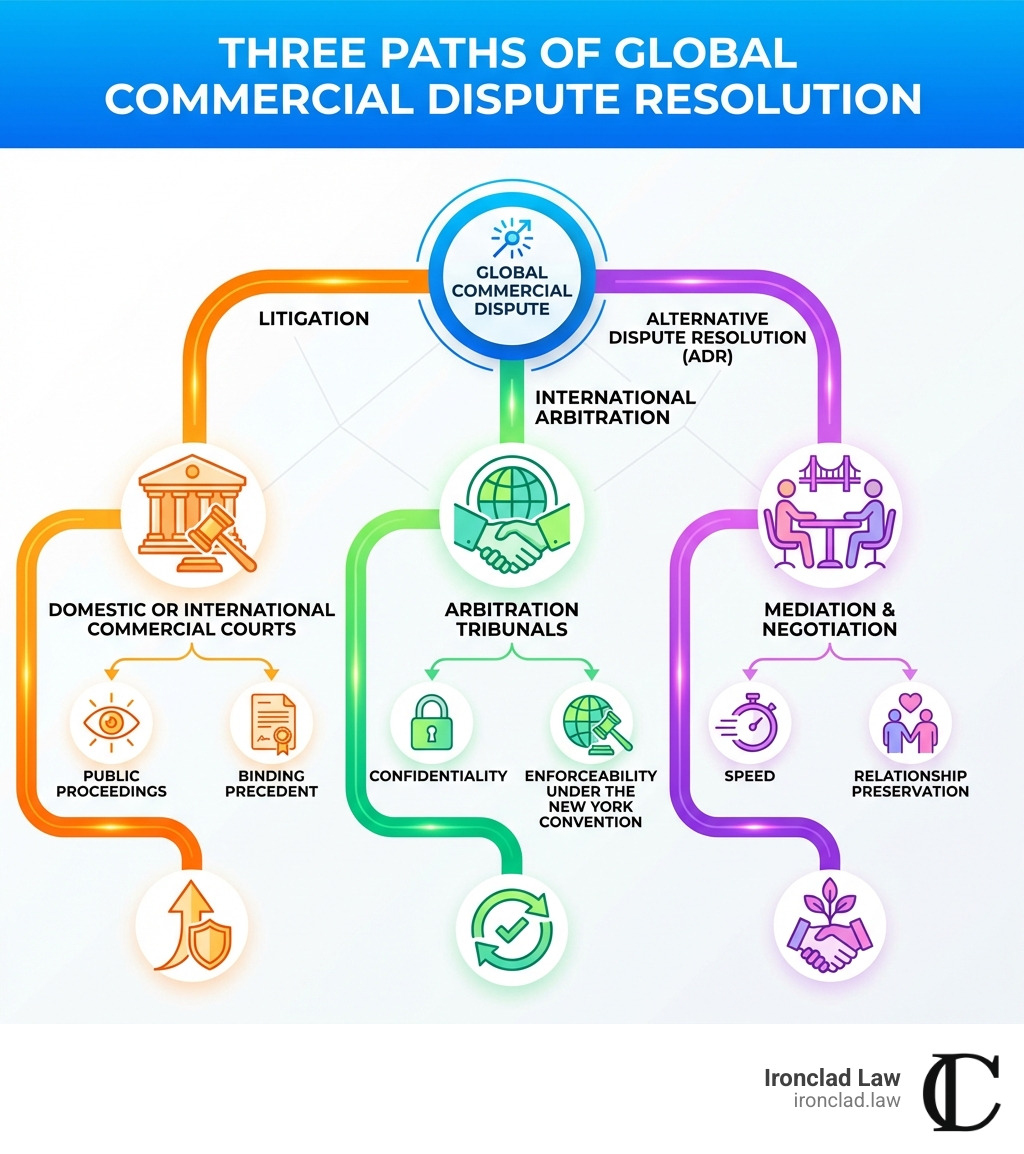
Understanding how to steer this complex landscape isn’t optional anymore—it’s essential for protecting your business interests in the global marketplace.
The Drivers and Landscape of Global Commercial Disputes

The world of international commerce is a dynamic, ever-shifting terrain. Just as businesses innovate and expand, so too do the complexities and potential for friction. We’ve seen a notable increase in global commercial disputes, driven by a confluence of economic, geopolitical, and technological factors that demand our constant attention. As outlined in the Global Disputes Forecast 2026, the disputes landscape is increasingly shaped by these interconnected forces.
Understanding the Primary Drivers of Global Commercial Disputes
At its core, the rise in global commercial disputes is a natural consequence of increasing globalization. As more companies engage in cross-border transactions, the opportunities for disagreements multiply. Consider the sheer volume of contracts, partnerships, and supply chains spanning continents—each link in this chain represents a potential point of contention.
We frequently see disputes stemming from:
- Increased Cross-Border Transactions: The more parties involved from different jurisdictions, the higher the likelihood of misunderstandings or disagreements over contract interpretation, performance, or payment.
- Contractual Breaches: This remains a perennial driver. What constitutes a breach can be interpreted differently under various national laws, leading to complex legal battles.
- Mergers & Acquisitions (M&A) Disagreements: When companies combine or acquire assets across borders, disputes often arise concerning company structure, governance, shareholder agreements, or joint venture terms. These can be high-stakes matters where clear legal counsel is paramount. You can find More info about Mergers & Acquisitions services on our website.
- Intellectual Property (IP) Theft and Infringement: In a digital age, protecting trademarks, patents, and copyrights globally is a monumental task. Infringement across borders can lead to intricate and costly legal actions.
- Technology-Driven Disputes: The advent of blockchain, cryptocurrencies, and digital assets has introduced entirely new categories of disputes. Issues like token standards, smart contract enforceability, and the legal classification of digital assets are becoming increasingly common and complex. As we’ve seen, proving custody control of digital assets through blockchain activity and navigating trust law disputes can be extraordinarily challenging.
The Influence of Geopolitical and Economic Factors
Beyond individual transactions, broader global forces exert immense pressure on the commercial landscape, inevitably leading to more disputes.
- Impact of Major Geopolitical Events: Wars, political instability, and shifts in international alliances can disrupt trade routes, trigger sanctions, and force companies to re-evaluate contracts. These events often create “force majeure” scenarios or lead to unforeseen breaches.
- International Infrastructure Initiatives: Large-scale projects spanning multiple countries, such as those aimed at connecting continents, generate complex contracts and often lead to disputes over construction, financing, and regulatory compliance among diverse stakeholders.
- Economic Sanctions and Trade Tensions: Governments increasingly use economic tools to exert influence. Sanctions regimes and escalating trade tensions can render existing contracts impossible to perform, leading to disputes over liability and damages.
- Financial Crises and Economic Volatility: Periods of economic downturn or instability often result in increased defaults, bankruptcies, and contract renegotiations, all fertile ground for disputes.
- ESG (Environmental, Social, and Governance) Litigation: ESG factors are no longer just buzzwords; they are becoming significant drivers of commercial litigation. Companies face increasing scrutiny and potential legal action over environmental impact, social responsibility, and governance practices. This creates new avenues for liability and regulatory challenges. As part of our comprehensive approach, we believe in proactive measures and offer More info about Strategic Business Planning to help businesses anticipate and mitigate these risks.
- Cybersecurity Breaches and Data Privacy Violations: With more data flowing globally, breaches are inevitable. These lead to complex disputes over liability, data protection regulations (like GDPR or CCPA), and reputational damage, often involving multiple jurisdictions.
These drivers underscore why businesses must be more vigilant than ever, equipped with robust legal strategies to steer the intricate world of global commercial disputes.
Navigating the Maze: Litigation vs. International Arbitration
When a global commercial dispute arises, one of the most critical decisions is choosing the appropriate forum for resolution. The choice between traditional litigation in domestic courts and international arbitration has profound implications for cost, speed, confidentiality, and enforceability. Each path presents its own set of advantages and disadvantages, shaped by factors like jurisdiction, choice of law, and procedural rules.
Traditional Litigation in Domestic Courts
For many, the first thought for dispute resolution is a courtroom. Traditional litigation involves bringing a case before a national court system. While familiar, this option presents unique challenges in a global context, especially for businesses operating in the United States, New York, Delaware, or California.
- Public Proceedings: Court proceedings are generally public, meaning sensitive commercial information can become part of the public record. This lack of confidentiality can be a significant drawback for businesses.
- Precedent-Based Decisions: Decisions are based on established legal precedents, offering a degree of predictability but potentially less flexibility for unique commercial arrangements.
- Appeals Process: While an appeals process offers a chance to correct errors, it can also prolong disputes and significantly increase costs.
- Jurisdictional Problems: A major hurdle in international litigation is establishing jurisdiction. Which country’s courts have the authority to hear the case? This can lead to lengthy preliminary battles even before the merits of the dispute are addressed. For example, the New York Supreme Court’s Commercial Division (NYCD), established in 1995, handles complex commercial disputes, often with a monetary threshold of $500,000. For foreign cases with little or no connection to New York, the requirements to establish jurisdiction can be stringent, typically requiring a dispute value over $1 million and a choice-of-forum clause.
- Enforcing Foreign Judgments: Even if you win a case in a domestic court, enforcing that judgment in another country can be an arduous and uncertain process, often requiring separate legal proceedings in the foreign jurisdiction. For example, obtaining measures like foreign anti-suit injunctions against foreign sovereigns showcases the extreme complexity involved in such matters.
For businesses engaged in complex legal battles, understanding the nuances of civil litigation is crucial. You can find More info about Civil Litigation on our website.
The Power of International Arbitration
International arbitration has emerged as a preferred method for resolving global commercial disputes, largely due to its distinct advantages over traditional litigation.
- Confidentiality: Unlike court proceedings, arbitration is typically confidential. This protects sensitive business information, trade secrets, and reputations, which is often a top priority for companies.
- Party Autonomy: Parties have greater control over the process, including the selection of arbitrators, the procedural rules, and the language of the proceedings. This flexibility allows for a custom approach to each dispute.
- Neutrality: Arbitration offers a neutral forum, avoiding the potential bias or unfamiliarity that can arise when litigating in a foreign national court. Parties can choose arbitrators with specific expertise in the relevant industry or legal area.
- Global Enforceability: This is perhaps the most significant advantage. Arbitral awards are generally much easier to enforce across borders than court judgments, thanks to international treaties like The New York Convention, which boasts 161 signatories worldwide. This means an award rendered in one signatory country can typically be enforced in another.
- Efficiency: While not always faster or cheaper, arbitration can often be more efficient than protracted litigation, especially when dealing with multiple jurisdictions.
The International Chamber of Commerce (ICC) is a leading institution in this field. In 2024, the ICC registered 831 new arbitration cases, with a total caseload value reaching an unprecedented US$354 billion. These cases involved parties from 136 jurisdictions, covering sectors like construction/engineering, energy, and transportation. The ICC’s long-standing history, with over 29,000 arbitrations since 1923, underscores its pivotal role in global dispute resolution.
Our expertise in dispute resolution spans various methods, always with an eye toward achieving the best outcome for our clients. For more detailed information, please visit More info about Dispute Resolution.
The Rise of International Commercial Courts (ICCs): A New Frontier
In recent years, a fascinating development has reshaped the landscape of global commercial disputes: the proliferation of International Commercial Courts (ICCs). These specialized tribunals are designed to bridge the gap between traditional litigation and international arbitration, offering a hybrid approach that seeks to combine the best features of both. Over the past decade, there has been a significant rise, with eleven new ICCs established since 2010, bringing the total to more than thirteen major courts worldwide.
These ICCs are specialized tribunals operating within domestic court hierarchies, specifically custom for the adjudication of complex cross-border commercial disputes. They are characterized by flexible procedural rules, often borrowing from international arbitration, the allowance for multilingual proceedings, and crucially, the recruitment of overseas judges or foreign legal experts. This trend is sometimes referred to as the “arbitralization” of judiciaries, where courts adopt features traditionally associated with arbitration to remain competitive and attractive to international parties.
Key Features and Advantages of ICCs
ICCs offer several compelling features that make them an attractive option for businesses involved in global commercial disputes:
- Expert Judiciary: Many ICCs boast benches composed of judges with deep experience in international commercial law, often including foreign judges. This ensures specialized knowledge and an understanding of diverse legal traditions.
- Procedural Flexibility: Unlike rigid domestic court rules, ICCs often adopt more flexible, arbitration-like procedures, allowing for greater party autonomy in managing the dispute process.
- Cost-Effectiveness: While litigation can be costly, some ICCs aim to provide a more streamlined and potentially cost-effective alternative to protracted arbitration or multi-jurisdictional litigation.
- Transparency: Compared to the confidentiality of arbitration, ICC proceedings can offer greater transparency, which may be desirable for certain types of disputes or for establishing legal precedents.
- Development of International Commercial Law: By adjudicating complex cross-border cases, ICCs contribute to the development of a coherent body of international commercial law, providing greater certainty for businesses.
- Choice of Law and Language: Many ICCs permit parties to choose foreign law as the governing law of their contract and often allow proceedings to be conducted in English, making them more accessible to international litigants.
For businesses, understanding the nuances of corporate governance can help prevent disputes from escalating to court. We offer More info about Corporate Governance to help you build strong foundations.
A Global Tour of Prominent ICCs
The rise of ICCs is a global phenomenon, with various jurisdictions establishing specialized courts to attract international business. While many of these courts are outside the United States, their existence and operational models directly influence the global landscape of dispute resolution, setting benchmarks and influencing strategic choices for businesses in the U.S. and worldwide.
One prominent example within the United States is the Commercial Division of the New York Supreme Court (NYCD), established in 1995. The NYCD was specifically designed to handle complex commercial disputes, aiming to provide a sophisticated and efficient forum. It has specific jurisdictional thresholds, typically requiring a dispute value of at least $500,000, and for foreign cases with little connection to New York, the threshold increases to over $1 million, coupled with a choice-of-forum clause. This illustrates how a key U.S. jurisdiction has adapted its court system to cater to the demands of international commerce.
Globally, other ICCs demonstrate diverse approaches and features:
- Long-standing commercial courts in major European financial centers see a vast majority of their cases involve at least one foreign party, highlighting their global reach.
- Newer courts in Asian hubs aim to develop a freestanding body of international commercial law, offering features like a ‘party opt-in’ for cases without a direct link to the host country.
- Some ICCs operate in special economic zones with distinct common law systems, featuring benches with a mix of domestic and international judges to attract significant international caseloads.
These examples underscore the global trend towards specialized, user-friendly judicial forums that compete with, and sometimes complement, international arbitration. For businesses in New York, Delaware, California, or anywhere in the U.S. involved in global trade, understanding these developments is key to making informed decisions about dispute resolution clauses and forum selection.
Strategic Considerations for Businesses in Global Commercial Disputes
Engaging in global commercial disputes is akin to a high-stakes chess match. Every move, from the initial contract drafting to the final enforcement, requires strategic foresight and a deep understanding of complex international rules. For businesses operating across the United States, New York, Delaware, and California, proactive risk management, careful forum selection, and diligent cost management are not just best practices—they are necessities.
Key Challenges in Global Commercial Disputes
Navigating international disputes presents a unique set of problems that can quickly complicate matters:
- Enforcement of Judgments and Awards: While international arbitration awards benefit from treaties like the New York Convention, enforcing domestic court judgments across borders remains challenging. Even for arbitral awards, local laws and political considerations can sometimes create obstacles.
- High Costs and Lengthy Proceedings: International disputes, whether through litigation or arbitration, can be incredibly expensive and time-consuming. Legal fees, expert witness costs, and travel expenses can quickly add up. For instance, the average duration for an ICC arbitration case concluding with a final award was 26 months in 2024, with a median of 22 months.
- Navigating Different Legal Traditions: The fundamental differences between common law (prevalent in the U.S., U.K.) and civil law systems (common in many European countries) can lead to vastly different procedural rules, evidence standards, and judicial approaches. This necessitates legal counsel fluent in cross-cultural legal practices.
- Technical and Regulatory Complexity in Emerging Areas: In sectors like cryptocurrency and digital assets, disputes are further complicated by nascent legal frameworks, rapidly evolving technology, and varied international regulatory approaches. Issues around token standards, smart contract enforceability, and digital asset ownership can be incredibly intricate.
- Data Privacy and Cybersecurity: Managing evidence and findy across jurisdictions, each with its own data privacy laws, adds another layer of complexity, particularly in cases involving cybersecurity breaches.
To mitigate these challenges, clear and carefully drafted contracts are paramount. Our firm provides comprehensive More info about Contract Review services to help businesses minimize future disputes.
Opportunities and Proactive Strategies
Despite the challenges, businesses have several opportunities to proactively manage and even prevent global commercial disputes:
- Drafting Clear Dispute Resolution Clauses: This is the single most important step. A well-drafted clause specifies the governing law, the chosen forum (arbitration or court), and the rules of engagement. This clarity can prevent costly jurisdictional battles later.
- Utilizing Mediation and Alternative Dispute Resolution (ADR): Before resorting to arbitration or litigation, mediation can offer a faster, less expensive, and more amicable path to resolution, often preserving valuable business relationships. The ICC’s International Centre for ADR administered 61 new cases in 2024, including 37 mediation requests involving parties from 33 countries.
- Choosing the Right Legal Hub: Strategic selection of a legal hub (like New York or Delaware for corporate matters) can provide access to specialized courts, experienced legal professionals, and a predictable legal framework.
- Leveraging Technology for Case Management: Advanced legal technology, including AI-powered research tools and data analytics, can streamline evidence gathering, predict case outcomes, and manage complex documentation, making the dispute resolution process more efficient.
- Proactive Risk Assessment and Compliance: Regularly assessing geopolitical, economic, and regulatory changes, particularly in areas like ESG and digital assets, can help businesses anticipate potential disputes and implement compliance programs to mitigate risks.
Effective risk management and robust legal support are integral to thriving in the global marketplace. Our general counsel services provide the strategic advice businesses need to steer these complexities. Find More info about General Counsel services on our website.
The Future of Cross-Border Dispute Resolution
The landscape of global commercial disputes is continuously evolving, driven by relentless technological innovation and shifting global dynamics. Looking ahead, we anticipate even more sophisticated mechanisms and challenges in cross-border dispute resolution.
The Impact of Technology and AI
Technology is not just influencing how disputes arise; it’s revolutionizing how they are resolved:
- AI in Evidence Analysis and Predictive Analytics: Artificial intelligence is changing legal research and findy. Tools like Jus Mundi | AI-Powered Search for International Law & Arbitration are becoming indispensable for legal professionals, offering powerful AI assistants for summarizing complex documents, strengthening arguments with case law, and verifying legal reasoning. Predictive analytics can help assess case outcomes and inform settlement strategies.
- Blockchain and Smart Contracts: The increasing adoption of blockchain technology and smart contracts introduces new legal frontiers. While smart contracts aim to automate agreements, their automated nature also creates complex liability challenges when technical failures lead to financial losses. The legal enforceability of these contracts, particularly across different jurisdictions, is a rapidly developing area.
- Tokenized Deposits and Digital Asset Disputes: The financial world is undergoing a significant change with the rise of tokenized deposits, projected to facilitate up to $140 trillion in annual transaction volume by 2030. This shift, exemplified by SWIFT’s migration to ISO 20022 and its compatibility with blockchain, creates new legal and regulatory questions regarding data privacy, transaction security, and dispute resolution mechanisms for digital assets. For businesses navigating this nascent field, specialized legal counsel is critical. We offer More info about Cryptocurrency & Digital Asset Counsel to address these cutting-edge issues.
- Online Dispute Resolution (ODR) Platforms: Technology facilitates entirely online dispute resolution processes, offering accessibility and efficiency, especially for smaller cross-border disputes.
The 2024 ICC Dispute Resolution Statistics highlight these trends, showing the increasing digitalization and global reach of dispute resolution services.
The Growing Importance of Legal Hubs and Specialization
The competition among jurisdictions to attract international business extends to dispute resolution. This has led to the growing importance of legal hubs and specialization:
- Major Global Legal Hubs: Cities like New York, London, Singapore, and Dubai are actively positioning themselves as preferred venues for international dispute resolution. New York, with its sophisticated commercial courts and robust legal infrastructure, remains a key hub for businesses in the U.S. and globally. Delaware is another critical jurisdiction for corporate law and related disputes.
- Agglomeration Effect: These hubs benefit from an “agglomeration effect,” where the concentration of legal talent, specialized courts (like the NYCD), arbitration centers, and financial services creates a powerful ecosystem that minimizes transaction costs and fosters efficient dispute resolution.
- Competition and Cooperation: While these hubs compete fiercely for caseloads, there’s also an element of cooperation. Many ICCs, for example, borrow best practices from established arbitration institutions and other courts, creating a more harmonized and effective global dispute resolution framework.
The future of cross-border dispute resolution will undoubtedly involve a blend of traditional legal expertise, advanced technological solutions, and strategic choices of specialized legal forums.
Conclusion
The world of global commercial disputes is undeniably complex and ever-expanding. From the intricate web of cross-border transactions and geopolitical shifts to the transformative impact of technology and the rise of specialized courts, businesses face an unprecedented array of challenges.
We’ve explored the primary drivers behind the increasing number of disputes, the distinct approaches of traditional litigation versus international arbitration, and the innovative role of International Commercial Courts. We’ve also highlighted the critical challenges—such as enforcement across borders, escalating costs, and navigating diverse legal traditions—and the proactive strategies businesses can adopt, including clear contract drafting, leveraging ADR, and choosing the right legal hub.
The future promises further integration of AI and blockchain into dispute resolution, alongside the continued specialization of legal hubs. For any business operating across the United States, New York, Delaware, or California, understanding these dynamics is not merely advantageous; it’s essential for survival and growth.
In this intricate landscape, strategic foresight and robust legal counsel are paramount. When facing complex international disputes, having aggressive “bulldog” litigators from a firm like Ironclad Law can be the decisive factor in protecting your global business interests. We are committed to fiercely fighting for our clients’ rights, ensuring that your business is well-equipped to steer the challenges and seize the opportunities in the global marketplace.