
You have 0 items in your cart

Understanding the Critical Role of Compliance Lawyers in Today’s Regulatory Landscape
A compliance lawyer is a legal professional who helps organizations steer complex regulations, develop compliance programs, and reduce legal risks. If you’re searching for information about compliance lawyers, here’s a quick overview:
What is a Compliance Lawyer?
* A legal professional who ensures organizations follow laws and regulations
* Combines legal expertise with business, HR, and risk management knowledge
* Serves as a proactive legal frontline before issues escalate
* Helps develop and implement compliance policies and procedures
* Works with regulators during investigations and enforcement actions
In today’s complex regulatory environment, compliance lawyers have become essential partners for businesses across virtually every industry. Unlike traditional attorneys who react to legal problems after they occur, compliance lawyers focus on preventing issues before they arise. They blend deep legal knowledge with practical business sense to help organizations stay on the right side of increasingly complex regulations.
The role has evolved significantly in recent years. What was once simply about following rules has transformed into a strategic function that shapes business culture, ethics, and commercial success. Modern compliance extends beyond mere checkbox exercises to become a competitive advantage when applied correctly.
As Michael Hurckes, I bring extensive experience as a compliance lawyer specializing in financial services regulation, having founded a top 10 legal and compliance firm recognized by Financial Services Review magazine and now serving as Managing Partner at Ironclad Law where we leverage advanced technology to deliver exceptional compliance solutions.
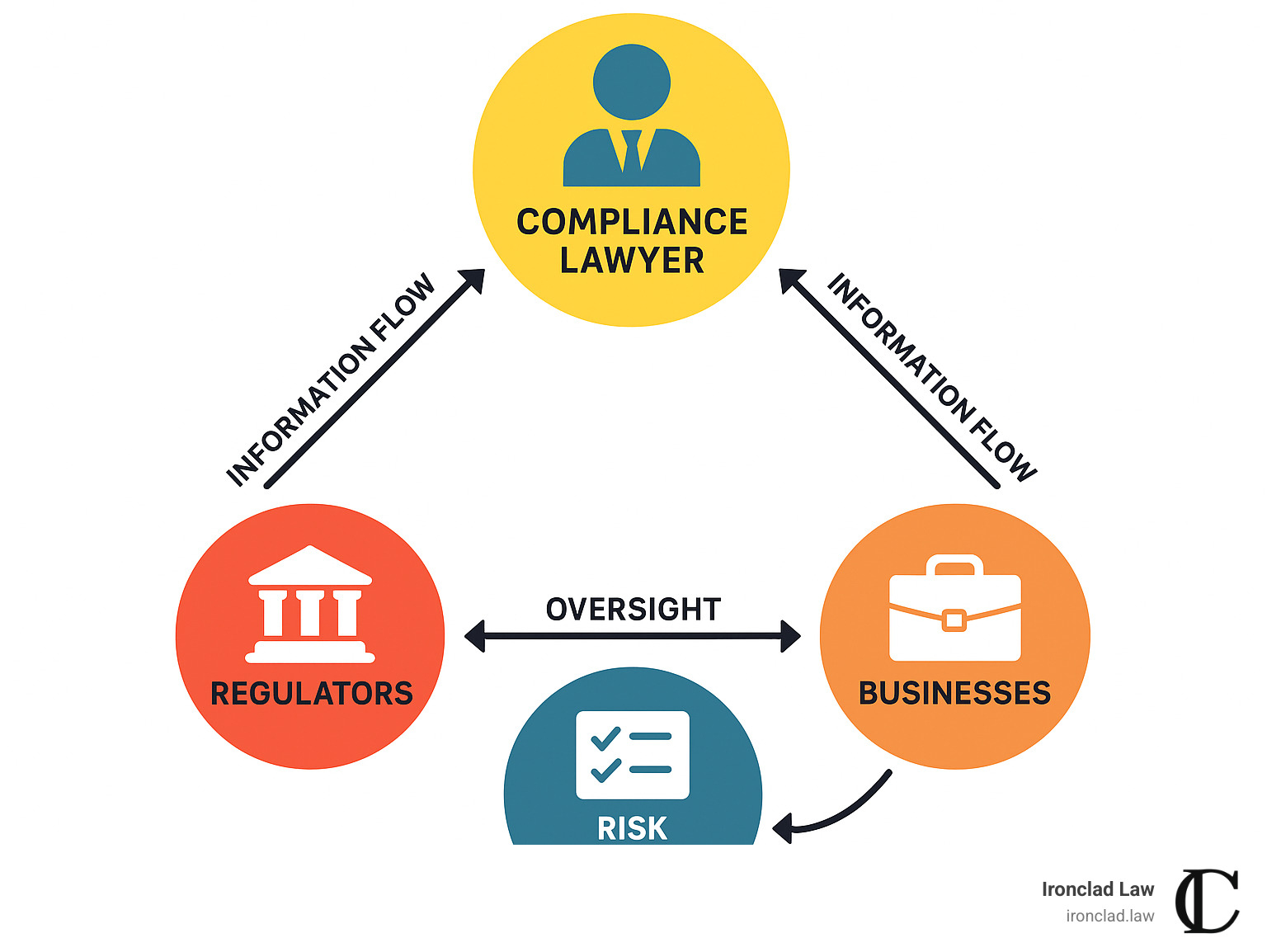
What Is a Compliance Lawyer?
A compliance lawyer is your organization’s legal guardian angel, working proactively to keep you out of regulatory hot water before problems arise. Unlike attorneys who swoop in after trouble has started, compliance lawyers blend sharp legal knowledge with practical business sense to spot potential issues on the horizon.
Think of them as your regulatory risk radar. These specialized attorneys identify where your business might be vulnerable, then develop systems and frameworks that protect everyone involved—your organization, leadership team, and stakeholders—from the triple threat of regulatory penalties, reputation damage, and costly litigation.
Compliance lawyers stand at the critical intersection where legal requirements meet day-to-day operations. They take complicated regulatory language and translate it into practical policies that your team can actually implement. Their trained legal eye catches potential compliance issues that might slip past even your most experienced business professionals.
As one compliance lawyer shared during our research: “Only an attorney can foresee and draft around potential downstream legal implications embedded in corporate policies.” This unique foresight is precisely what makes these professionals so valuable in today’s increasingly complex regulatory landscape.
How a Compliance Lawyer Differs from Other Attorneys
While most people are familiar with litigators and deal lawyers, compliance lawyers chart a different course with their own distinct focus and skill set. Here’s how they compare:
| Aspect | Compliance Lawyer | Litigator | Transactional Lawyer |
|---|---|---|---|
| Timing | Proactive/preventative | Reactive/remedial | Deal-focused/project-based |
| Focus | Risk identification & mitigation | Dispute resolution | Facilitating business transactions |
| Work Product | Policies, procedures, training | Court filings, arguments | Contracts, agreements, due diligence |
| Key Skills | Regulatory knowledge, risk assessment | Advocacy, argument, evidence | Negotiation, drafting, deal structure |
| Business Integration | Deeply embedded in operations | External to daily operations | Project-specific involvement |
| Success Metrics | Violations prevented, risks mitigated | Cases won, damages limited | Deals completed, terms secured |
The true value of a compliance lawyer often lies in what doesn’t happen—the enforcement action that never materializes, the fine that’s never imposed, the company reputation that remains spotless. While litigators are fighting legal battles after problems occur and transactional attorneys are structuring deals, compliance attorneys are quietly preventing fires before they start.
As one industry expert put it: “Compliance attorneys act as a legal frontline, preventing problems before they escalate into litigation or transactional disputes.” This preventative mindset requires a special blend of legal expertise, business understanding, and forward-thinking risk assessment.
Compliance Lawyer vs Compliance Officer
Though their job titles might sometimes overlap, compliance lawyers and compliance officers play distinct roles in your organization’s governance structure:
Compliance lawyers come equipped with legal training and credentials (J.D.), provide advice protected by attorney-client privilege, and focus primarily on legal interpretation and risk assessment. They typically maintain greater independence from operational decisions, can represent your organization in regulatory proceedings, and may serve either as outside counsel or in-house legal advisors.
Compliance officers, on the other hand, might come from various backgrounds (legal, business, or industry-specific), implement and oversee day-to-day compliance operations, and focus more on program execution and monitoring. They’re typically embedded within your operational structure, serve as the primary contact for routine regulatory matters, and are usually employees with direct reporting lines to leadership.
A crucial difference lies in personal liability exposure. Research shows that 74% of Chief Compliance Officers worry about personal liability in their roles—and with good reason. Compliance officers can face individual penalties for program failures even if they weren’t directly involved in any misconduct.
Compliance lawyers help structure reporting relationships and escalation protocols that protect both your organization and its compliance personnel. With proper authority and autonomy, compliance professionals can effectively raise concerns without fear of retaliation—an essential safeguard in today’s enforcement environment.
For organizations seeking comprehensive compliance support, our Compliance Attorney services at Ironclad Law provide both legal expertise and practical program implementation guidance that keeps you protected on all fronts.
Industries & Compliance Risks That Need Legal Expertise
In today’s complex regulatory environment, certain industries face particularly steep compliance challenges where specialized legal guidance isn’t just helpful—it’s essential. The regulatory maze can be overwhelming, and this is where a compliance lawyer becomes your trusted navigator.
Financial services organizations operate in perhaps the most heavily regulated space, with a web of oversight from the SEC, FINRA, Federal Reserve, and other agencies. Banking institutions must steer anti-money laundering requirements while investment advisers face strict disclosure and fiduciary obligations. One wrong step in this regulatory minefield can trigger severe penalties and reputational damage.
Healthcare and life sciences companies face equally daunting challenges. From HIPAA’s strict patient privacy protections to the FDA’s rigorous approval processes for new drugs and devices, the compliance burden is enormous. Medicare and Medicaid billing rules add another layer of complexity, with even innocent coding errors potentially triggering fraud investigations.
The energy sector confronts its own regulatory problems, particularly as ESG (Environmental, Social, Governance) requirements gain momentum. Environmental compliance has evolved far beyond basic pollution controls to encompass carbon emissions reporting, renewable energy standards, and sustainability disclosures that require specialized legal knowledge.
Technology companies aren’t exempt either. Data privacy regulations like GDPR and CCPA have transformed how businesses handle consumer information, with steep penalties for violations. As AI governance and algorithmic transparency rules emerge, tech firms increasingly need compliance lawyers who understand both the technology and the evolving legal landscape.
Manufacturing and consumer product companies must steer product safety standards, labeling requirements, and increasingly complex supply chain transparency rules. When product recalls become necessary, having a compliance lawyer with experience in crisis management can mean the difference between a well-managed response and a brand-destroying disaster.
For companies with global operations, international trade compliance adds yet another dimension. Export controls, sanctions programs, and anti-bribery laws like the Foreign Corrupt Practices Act create a compliance patchwork that varies by country and changes frequently, demanding specialized legal expertise.
At Ironclad Law, our Regulatory Counsel & Compliance Services are designed to help you confidently steer these industry-specific challenges with practical, business-focused solutions.
Real-World Compliance Cases
Nothing illustrates the critical importance of strong compliance programs like real-world examples of what can go wrong—and how compliance lawyers help organizations respond and recover.
Consider the Chief Compliance Officer who faced a personal $30,000 fine after their firm misstated assets under management by nearly $120 million. This SEC enforcement action serves as a sobering reminder that compliance isn’t just about protecting the company—individual professionals can face direct liability for oversight failures.
When a pharmaceutical company received an FDA warning letter for manufacturing quality issues, panic could have ensued. Instead, their compliance lawyer helped develop a remediation plan that not only addressed the immediate concerns but transformed their quality management system into a competitive advantage.
Global operations bring global risks, as one multinational corporation finded when facing Department of Justice scrutiny for potential bribery violations overseas. Their compliance lawyer conducted a thorough internal investigation, implemented a strategic voluntary disclosure approach, and negotiated reduced penalties based on cooperation and program improvements—turning a potential disaster into a manageable challenge.
Financial institutions face particular scrutiny around anti-money laundering controls. When one bank’s monitoring systems failed to flag suspicious transactions, they faced significant fines. Their compliance lawyer helped design improved detection systems and training programs that not only satisfied regulators but actually improved operational efficiency.
Product safety issues represent another area where compliance lawyers prove invaluable. When a manufacturer identified a potential safety concern, their legal team guided them through the recall process with carefully crafted regulatory notifications and public communications that protected consumers while minimizing brand damage.
Perhaps most telling are whistleblower situations. When one company failed to properly address employee concerns raised through internal channels, the whistleblower approached regulators directly. The resulting enforcement action and public relations nightmare could have been avoided with proper compliance protocols and response procedures.
These real-world examples demonstrate why having experienced compliance lawyers on your side isn’t just about checking regulatory boxes—it’s about protecting your organization’s future, reputation, and financial health in an increasingly complex regulatory world.
Core Responsibilities & Daily Duties of a Compliance Lawyer

Ever wonder what a compliance lawyer actually does all day? It’s not just reviewing dusty regulations and checking boxes. These legal professionals serve as the protective shield between your organization and potentially devastating regulatory problems.
Think of a compliance lawyer as your organization’s regulatory navigator, guiding you through increasingly complex legal waters. Their day begins with much more than just coffee and email. They’re crafting policies that transform abstract regulations into practical guidelines your team can actually follow. These aren’t one-size-fits-all templates either – they’re carefully custom to your specific industry, size, and risk profile.
Risk assessment forms another cornerstone of their work. Your compliance lawyer constantly scans the horizon for regulatory threats, identifying where your operations might be vulnerable. They’re asking questions like: “Where are we most likely to run into trouble?” and “How can we shore up our defenses before regulators come knocking?”
Beyond policy creation, these attorneys roll up their sleeves to conduct regular audits and monitoring. They’re not just looking for problems – they’re testing whether your safeguards actually work in practice. When they spot gaps, they don’t just point them out; they help you fix them before they become serious issues.
Training represents another critical function. Your compliance lawyer transforms complex legal requirements into understandable guidance for your team. Whether it’s an engaging presentation for frontline staff or an executive briefing on personal liability risks, they make compliance accessible to everyone in your organization.
When regulators come calling (and they will), your compliance lawyer steps up to manage these high-stakes interactions. They know exactly what information to provide, how to frame your compliance efforts positively, and how to negotiate favorable outcomes when issues arise.
Should something go wrong, these attorneys lead internal investigations with a steady hand. They document findings methodically, implement fixes promptly, and make tough calls about whether self-disclosure is the right strategy.
In crisis situations, your compliance lawyer becomes an invaluable strategic partner. They help coordinate your response team, manage legal exposure, and protect your reputation while addressing the underlying compliance issues.
Managing Regulatory & Enforcement Agency Interactions
Few things strike fear into business leaders like receiving a letter from a regulatory agency. This is where your compliance lawyer truly shines – changing potentially adversarial relationships into constructive ones.
During regulatory examinations, your attorney serves as both coach and quarterback. They prepare your team thoroughly for what to expect, coordinate document production to show your organization in the best light, and help employees understand how to interact appropriately with examiners. When preliminary findings come in, they negotiate skillfully to correct misunderstandings and minimize negative outcomes.
If an enforcement action looms, your compliance lawyer becomes your strongest advocate. They respond strategically to subpoenas and investigative demands, develop defense positions when warranted, and negotiate settlements that protect your interests. Many clients don’t realize that how you respond to enforcement actions often matters as much as the underlying issue itself.
The decision to self-disclose potential violations requires delicate judgment. Your compliance lawyer helps weigh the benefits of cooperation credit against potential downsides, crafting disclosures that demonstrate good faith without unnecessarily expanding liability. This is where experience really matters – knowing exactly how much to say and when to say it.
Building credibility with regulators represents perhaps the most valuable long-term contribution. Regulators who trust your compliance efforts are more likely to give you the benefit of the doubt when issues arise. Your compliance lawyer helps establish this trust through transparent communication and demonstrated commitment to improvement.
At Ironclad Law, our Regulatory Examinations & Enforcement Counsel services draw from deep experience with agencies like the SEC, FINRA, and DOJ. We’ve sat across the table from regulators countless times, and we know how to achieve the best possible outcomes.
Supporting Crisis Management & Product Recalls
Even the strongest compliance programs occasionally face crises. When they hit, having a seasoned compliance lawyer at your side can mean the difference between a minor setback and an existential threat.
Smart organizations don’t wait for crises to happen. Your compliance lawyer conducts vulnerability audits to identify potential triggers before they explode into full-blown emergencies. They test your crisis protocols through simulations, ensuring everyone knows their role when the pressure’s on. By learning from past incidents (yours and others’), they help you avoid repeating costly mistakes.
When it comes to crisis planning, your compliance lawyer builds comprehensive playbooks that leave nothing to chance. They establish clear decision-making authorities, create communication templates that can be quickly customized, and set up regulatory notification protocols that ensure you meet all legal requirements during chaotic situations.
Product recalls present particularly complex challenges. Your compliance lawyer helps determine when recall obligations kick in – a decision with significant financial and reputational implications. They design retrieval strategies that balance effectiveness with cost, draft notifications that satisfy regulatory requirements while minimizing panic, and document every step to demonstrate diligence to regulators.
Managing communications during a crisis requires exceptional judgment. Your compliance lawyer works closely with your PR team to craft messages that provide necessary transparency without creating additional legal exposure. They help prepare executives for tough questions from media, investors, and board members.
After the immediate crisis passes, the real work begins. Your compliance lawyer implements corrective actions that prevent recurrence, documents improvements to rebuild regulatory trust, and helps transform the crisis into an opportunity to strengthen your compliance culture.
At Ironclad Law, our Compliance Services include crisis preparation and management custom to your specific risk profile. We’ve guided clients through their darkest hours, helping them emerge stronger and more resilient on the other side.
Skills, Qualifications & Career Paths for Aspiring Compliance Lawyers
So you’re thinking about becoming a compliance lawyer? It’s a rewarding path that combines legal expertise with practical business problem-solving. Let’s talk about what you’ll need to succeed in this growing field.
Most compliance lawyers start with a traditional Juris Doctor (J.D.) degree, though we’re seeing more professionals enter the field through specialized Master of Jurisprudence (M.J.) programs focused specifically on compliance. Whichever path you choose, you’ll want to complement your legal education with deep knowledge of the industry you plan to serve—whether that’s healthcare, financial services, or another regulated sector.
The legal foundation for compliance work centers around administrative law and regulatory processes. You’ll need to understand how agencies create and enforce rules, how to interpret regulations, and how to apply them to real-world business situations. Contract law also plays a crucial role, as does a solid grasp of evidence principles for when you need to conduct investigations.
Beyond formal education, professional certifications can significantly boost your credibility and expertise. The most respected credentials include the Certified Compliance & Ethics Professional (CCEP), Certified Regulatory Compliance Manager (CRCM), and industry-specific certifications like the Certified in Healthcare Compliance (CHC) or Certified Anti-Money Laundering Specialist (CAMS). For those working in privacy, the Certified Information Privacy Professional (CIPP) designation has become increasingly valuable.
What often separates successful compliance lawyers from the pack isn’t just technical knowledge, but soft skills. You’ll need to explain complex legal concepts in simple terms that non-lawyers can understand and apply. Persuasive abilities are essential for driving compliance culture throughout an organization. Building strong relationships with both business teams and regulators requires diplomatic finesse and political savvy that goes beyond what’s taught in law school.
The tech side of compliance has evolved dramatically in recent years. Today’s compliance lawyers need comfort with compliance management software, data analysis tools, and the growing field of Regulatory Technology (RegTech). These tools help you monitor compliance more efficiently and spot potential issues before they become problems.
Career progression typically follows a few common paths. Many start at law firms with regulatory practices before moving in-house as compliance counsel. From there, you might advance to specialized compliance roles, eventually aiming for positions like Chief Compliance Officer or even General Counsel with compliance oversight. Some experienced professionals eventually become regulatory consultants or advisors.
One aspect of compliance careers that deserves serious consideration is the personal liability question. A recent survey found that 74% of Chief Compliance Officers worry about personal liability in their roles, and two-thirds said these concerns would make them more cautious about taking future positions. This reality makes it essential to understand exactly how compliance roles are structured and protected within any organization you join.
For those who want to understand what makes compliance programs truly effective in regulators’ eyes, the Justice Department’s Evaluation of Corporate Compliance Programs offers invaluable insights into how enforcement agencies assess program quality.
Staying Up-to-Date with Changing Laws
Perhaps the greatest challenge for any compliance lawyer is keeping pace with the constantly evolving regulatory landscape. The regulations you mastered last year might be significantly amended or even replaced this year.
Continuing Legal Education (CLE) forms the foundation of ongoing knowledge development. Smart compliance professionals strategically select CLE courses with regulatory focus rather than just checking the mandatory box. Specialized compliance conferences and seminars offer not just formal education but invaluable networking with peers facing similar challenges. Many regulators also host educational events that provide direct insights into their expectations and priorities.
Professional associations serve as crucial knowledge hubs. Organizations like the Society of Corporate Compliance and Ethics (SCCE), Health Care Compliance Association (HCCA), and International Association of Privacy Professionals (IAPP) provide regular updates, forums for discussion, and specialized resources for their members. These communities let you learn from others’ experiences rather than making every mistake yourself.
Systematic monitoring of regulatory developments has become essential. Many compliance lawyers subscribe to regulatory alert services, follow agency publications, and track enforcement trends to spot emerging issues. Understanding not just what the rules say but how they’re being enforced in practice gives you crucial context for advising your organization.
The relationships you build within your industry can be just as valuable as formal learning. Participating in compliance roundtables, engaging with peer groups, and even building appropriate professional relationships with regulators at industry events can provide early warning of regulatory shifts and best practices for addressing them.
Technology increasingly helps manage the overwhelming flow of regulatory information. Regulatory change management software, automated monitoring tools, and AI-powered scanning systems can flag relevant developments and help you prioritize your response. These tools don’t replace human judgment but can ensure you don’t miss critical changes buried in the daily flood of information.
At Ironclad Law, our Compliance Consultants make it their business to stay ahead of regulatory changes, translating complex requirements into practical guidance that helps our clients adapt before problems arise.
Hiring & Working with a Compliance Lawyer

When your organization reaches the point of needing specialized compliance expertise, you’ll face several choices about how to bring a compliance lawyer into your team. Think of it like adding a valuable player to your roster—you want someone who fits your culture, understands your industry, and delivers real value.
Many businesses struggle with the “build or buy” question when it comes to compliance expertise. Do you hire someone to join your team full-time, or partner with outside counsel? Let’s explore your options.
In-house compliance counsel becomes part of your organizational fabric. They’re there every day, absorbing your company culture, building institutional knowledge, and becoming intimately familiar with how your business operates. For companies with constant compliance questions or heavily regulated industries, having someone down the hall ready to answer questions can be invaluable. Plus, once you factor in salary and benefits versus ongoing external fees, in-house counsel often makes financial sense for high-volume compliance needs.
On the flip side, external compliance law firms bring specialized expertise that might be impossible to find in a single in-house hire. As one client told me recently, “Having outside counsel gives us perspective we’d never get internally—they see how twenty different companies handle the same problem.” External firms also provide objective viewpoints, free from internal politics, and can scale resources up during busy periods (like major regulatory changes) and down during quieter times.
Many organizations find success with hybrid engagement models that give you the best of both worlds. Arrangements like secondments (where a law firm attorney works on-site at your company for a period) provide embedded expertise with the backing of a full firm. Fractional general counsel arrangements give you predictable access without full-time costs. Project-based engagements work wonderfully for discrete initiatives like compliance program overhauls or new regulation implementation.
When it comes to cost structures, the legal industry has evolved beyond the traditional hourly billing model. Fixed-fee arrangements provide budget certainty for defined projects. Monthly retainers ensure you have compliance support on standby without surprise bills. Some innovative firms even offer success-based fees tied to compliance outcomes or regulatory approval timelines.
According to industry research, organizations using alternative legal service providers for compliance support typically save 30-50% compared to traditional law firm arrangements while maintaining high-quality expertise. That’s significant savings that can be reinvested in your business or compliance program improvements.
How to Find & Vet Qualified Compliance Counsel
Finding the right compliance lawyer feels a bit like dating—chemistry matters, but you also need someone with the right experience and approach. Here’s how to find your compliance match:
Start by tapping your professional network for referrals—colleagues who’ve worked with compliance attorneys can provide honest feedback about their experiences. Bar associations often maintain referral services for specialized practice areas. Industry association member directories can lead you to attorneys who understand your specific regulatory landscape. And don’t overlook speakers at regulatory conferences—they’re often showcasing their expertise.
When evaluating potential compliance counsel, look beyond the resume. Specific experience in your industry’s regulatory framework matters tremendously. A brilliant healthcare compliance attorney might struggle with financial services regulations, and vice versa. Ask about their track record with similar compliance challenges and their reputation with relevant regulatory agencies.
During interviews, dig deeper with questions that reveal their approach: “How have you helped organizations similar to ours improve compliance while supporting business objectives?” Listen for answers that demonstrate both regulatory knowledge and business pragmatism. Ask how they stay current with regulatory changes in your industry—the best compliance lawyers have systematic approaches to tracking developments.
Before making your final decision, complete your due diligence. Verify credentials and bar admission status, check for any regulatory enforcement history, and review their published work. Most importantly, speak with references who can share real-world experiences working with the attorney.
The most successful compliance lawyer relationships are built on trust, clear communication, and shared commitment to both regulatory compliance and business success. At Ironclad Law, we believe in establishing transparent, collaborative partnerships that deliver measurable compliance improvements.
For more information about finding the right compliance support for your organization, visit our resource on The Intersection of Law and Compliance.
Budgeting: What Does a Compliance Lawyer Cost?
Let’s talk money—because while compliance expertise is valuable, you need to understand what drives costs and how to budget appropriately for compliance lawyer services.
Several factors influence what you’ll pay. Attorney experience level and specialized expertise typically correlate with higher rates—a 20-year veteran of SEC enforcement matters commands premium fees compared to a general practitioner. Geographic market matters too; compliance attorneys in major financial centers generally cost more than those in smaller markets. The engagement model (in-house, traditional law firm, or alternative provider) creates significant cost variations, as does the scope and urgency of your compliance needs.
The good news? Several approaches can help manage costs while maintaining quality. Alternative legal service providers typically save 30-50% over traditional law firms by leveraging technology and efficient delivery models. Fixed-fee arrangements provide budget predictability that hourly billing can’t match. Tiered staffing models ensure work is handled at the appropriate expertise level—you don’t want to pay partner rates for associate-level work.
When evaluating the cost of compliance counsel, consider the full value equation. The average regulatory enforcement action costs far more than preventative compliance counsel—in both direct expenses and reputational damage. One client described it perfectly: “The compliance attorney fee that seemed expensive last year looks like the bargain of the century compared to what we would have paid in fines.”
Smart organizations think about compliance costs in terms of value metrics: reduction in regulatory penalties, efficiency gains from streamlined processes, protection of brand reputation, and competitive advantages from compliance excellence. These benefits typically far outweigh the direct costs of quality compliance counsel.
Different engagement structures fit different needs. Project-based fees work well for discrete initiatives like compliance program development. Monthly retainers provide predictable access to advisory support. Annual compliance program management fees create comprehensive coverage. Some organizations prefer traditional hourly rates with budget caps for specific workstreams.
At Ironclad Law, we believe in transparent pricing discussions that help you understand exactly what you’re getting and why it’s valuable. We find that open conversations about budget constraints often lead to creative solutions that deliver the compliance expertise you need within financial parameters that work for your organization.
Emerging Trends & Common Challenges

The world of compliance never stands still. As a compliance lawyer, I’ve watched the regulatory landscape transform dramatically in recent years, creating both exciting opportunities and significant problems for the organizations we serve.
Today’s compliance professionals are navigating a sea of emerging regulations that would have been hard to imagine just a decade ago. ESG disclosure requirements have moved from voluntary nice-to-haves to mandatory reporting obligations in many jurisdictions. Companies are scrambling to understand their carbon footprints, diversity metrics, and governance structures in ways that satisfy increasingly demanding stakeholders and regulators.
Meanwhile, the rise of artificial intelligence has sparked a whole new regulatory frontier. AI governance frameworks are being developed around the world, requiring companies to explain how their algorithms make decisions and demonstrate they aren’t perpetuating bias or causing harm. This is particularly challenging because the technology often evolves faster than regulations can keep pace.
“The hardest part of my job isn’t understanding the regulations,” a colleague recently told me. “It’s explaining to business teams why they can’t move at the speed they want to because compliance considerations need to be addressed first.”
Cross-border data flows present another thorny challenge. What was once a simple matter of storing data wherever it made technical sense has become a complex web of data localization requirements and transfer restrictions. A compliance lawyer today needs to understand not just what data exists, but where it lives, how it moves, and who can access it under which circumstances.
The cryptocurrency and digital asset space continues to evolve at breakneck speed, with regulators racing to establish appropriate guardrails. Companies operating in this area face particular uncertainty as they try to build compliant business models on shifting regulatory sands.
Technology isn’t just creating new compliance challenges—it’s also offering new solutions. RegTech platforms now automate many processes that once required manual oversight. AI-powered monitoring tools can scan communications for potential red flags far more efficiently than human reviewers. Blockchain technology provides immutable record-keeping capabilities that can demonstrate compliance in ways previously impossible.
But perhaps the most significant enforcement trend is the increasing focus on individual accountability. Regulators aren’t just going after companies—they’re targeting the people who make decisions. This has created heightened personal liability concerns for executives and compliance professionals alike. Whistleblower protections have been strengthened, creating more pathways for internal issues to reach regulatory attention.
Despite these advances, most organizations I work with face some common challenges:
Resources for compliance functions often fall short of what’s truly needed. Compliance teams are asked to do more with less, creating risk gaps that may not be apparent until a problem emerges. Finding the right balance between rigorous compliance and business objectives remains an eternal struggle—one that requires both legal expertise and business savvy to steer successfully.
Measuring the effectiveness of compliance programs presents another persistent challenge. How do you demonstrate the value of problems that never happened because your program prevented them? This makes proving compliance ROI to leadership an ongoing battle for budget and attention.
At Ironclad Law, we help clients transform these challenges into strategic advantages. By staying ahead of regulatory trends, we help organizations build compliance programs that don’t just satisfy current requirements but anticipate future developments. This forward-looking approach turns compliance from a cost center into a competitive edge that supports sustainable growth.
For those looking to develop more robust anti-corruption compliance frameworks, the OECD anti-corruption compliance guidance offers valuable international perspectives and best practices worth exploring.
Frequently Asked Questions About Compliance Lawyers
What are the key components of an effective compliance program?
When clients ask me about building an effective compliance program, I always emphasize that there’s no one-size-fits-all approach. However, certain core elements are essential regardless of your industry or size.
At the heart of any successful program is leadership commitment and culture. Without visible support from the C-suite and board, compliance initiatives often falter. Your executives must not just talk about compliance but demonstrate it through their actions and decisions.
A robust risk assessment process comes next. You can’t protect against threats you haven’t identified. A good compliance lawyer helps you systematically evaluate where your vulnerabilities lie, focusing resources where they’ll have the greatest impact.
Clear policies and procedures transform abstract regulations into practical guidance. These shouldn’t be dusty binders on a shelf but living documents that employees actually use and understand.
Even the best policies are useless without effective training and communication. Your people need to know not just what the rules are but why they matter. I’ve seen the most successful programs use scenario-based training that reflects real-world situations employees encounter.
Regular monitoring and auditing keeps your program honest. As one client told me, “What gets measured gets managed.” Your compliance lawyer can help design testing protocols that identify gaps before regulators do.
Safe reporting mechanisms are critical. Employees must feel comfortable raising concerns without fear of retaliation. A well-designed hotline or reporting system often provides early warning of issues that might otherwise escalate.
When problems do arise, having consistent investigation and remediation protocols ensures they’re handled appropriately. This includes documenting the steps taken and implementing changes to prevent recurrence.
Finally, continuous improvement keeps your program relevant as regulations and risks evolve. The best compliance programs are never “finished” but constantly adapting.
A skilled compliance lawyer integrates these elements into your business operations rather than imposing them as separate requirements. The goal is compliance that supports your business objectives rather than hindering them.
Can a compliance lawyer serve as Chief Compliance Officer?
“Should our compliance lawyer be our CCO?” This question comes up frequently in my conversations with clients, and the answer is nuanced.
Yes, a compliance lawyer can absolutely serve as Chief Compliance Officer, and in many organizations, this arrangement works beautifully. The legal expertise a lawyer brings to the role can be invaluable, particularly in heavily regulated industries like financial services or healthcare.
When a lawyer serves as CCO, you gain several advantages. Their deep understanding of regulatory expectations and enforcement trends helps anticipate issues before they arise. The potential protection of attorney-client privilege for certain communications can be valuable during sensitive matters. And when regulatory interactions become necessary, their ability to represent the organization effectively can be a significant asset.
However, this dual role comes with important considerations. A compliance lawyer serving as CCO must balance their legal advisor role with their business partner responsibilities. Sometimes these perspectives conflict – what’s legally defensible might not always align with what builds the strongest compliance culture.
There’s also the question of independence. Compliance functions need sufficient autonomy to raise concerns even when they’re unpopular. This can be challenging when the compliance function reports through the legal department.
Personal liability is another significant factor. A recent survey found that 74% of Chief Compliance Officers worry about personal liability in their roles. This concern is well-founded, as regulators increasingly hold individuals accountable for program failures.
The right structure for your organization depends on your specific risk profile, industry regulations, and organizational culture. I’ve seen successful models where the CCO is a lawyer and others where separate individuals fill these complementary roles.
How do compliance lawyers reduce the risk of personal liability for executives?
The personal liability landscape for executives has changed dramatically in recent years. Regulators are increasingly willing to hold individual leaders accountable for compliance failures, even when they weren’t directly involved in misconduct.
A good compliance lawyer helps protect executives not by shielding them from legitimate responsibility, but by ensuring they have the tools and processes to demonstrate good-faith compliance efforts.
This starts with designing an appropriate governance structure with clear reporting lines and documentation of oversight activities. When executives can show they received regular compliance updates and took appropriate action on issues raised, they stand on much firmer ground if questions arise.
Board education is equally important. Directors need to understand their oversight responsibilities and recognize the warning signs of compliance problems. I’ve worked with numerous boards to develop appropriate dashboards and reporting frameworks that focus attention on key risk indicators.
The way you document decisions can make or break a defense against personal liability claims. Your compliance lawyer should help establish processes that record not just what was decided but the rationale and information considered. This contemporaneous documentation is invaluable if decisions are questioned years later.
Guidance on resource allocation helps executives demonstrate they provided appropriate support for compliance functions. Regulators often look at whether the compliance department had sufficient staff, budget, and authority relative to the organization’s risk profile.
Compliance certifications must be carefully designed to balance accountability with protection. Executives should certify what they can reasonably know, with appropriate processes to support their assertions.
When potential issues arise, having established investigation protocols ensures appropriate handling and documentation. This demonstrates the organization’s commitment to addressing problems rather than concealing them.
Finally, a compliance lawyer with regulatory experience can guide executives on effective regulatory communication strategies during examinations or inquiries, helping present the organization’s compliance efforts in the most favorable light.
The goal isn’t to create artificial protection but to ensure executives have the systems, information, and documentation they need to demonstrate their good-faith efforts to ensure compliance.
For more specialized guidance on executive protection strategies, our team at Ironclad Law brings both legal expertise and practical business sense to these complex challenges.
Conclusion
In today’s intricate web of regulations, compliance lawyers have evolved from mere rule-followers to invaluable strategic partners. They help organizations steer complex legal requirements while still achieving their core business goals. What sets great compliance counsel apart is their ability to transform what many see as regulatory burden into a genuine competitive advantage that supports long-term growth.
The most effective compliance lawyers bring a rare combination of talents to the table. They blend deep legal expertise with practical business sense, stay tech-savvy in an increasingly digital compliance landscape, and possess the people skills needed to drive meaningful cultural change throughout an organization. They don’t just respond to today’s regulations—they anticipate tomorrow’s developments, crafting pragmatic solutions that keep their clients one step ahead of enforcement concerns.
When you invest in qualified compliance counsel, the returns extend far beyond basic legal protection:
Your organization faces significantly reduced risk of costly enforcement actions and penalties that can devastate both finances and reputation. Your standing improves with key stakeholders—from customers who trust your ethical practices to investors who value your risk management approach to regulators who recognize your commitment to compliance. Well-designed compliance processes actually improve operational efficiency rather than creating bureaucratic problems. Your leadership team gains greater confidence when making strategic decisions, knowing the compliance implications have been thoroughly considered. And perhaps most importantly, you develop a meaningful competitive edge in highly regulated markets where others struggle to keep pace.
At Ironclad Law, we firmly believe that effective compliance isn’t just about playing defense and avoiding problems. It’s about building the foundation for ethical, sustainable business success that stands the test of time. Our approach blends aggressive advocacy when needed with practical, workable compliance solutions custom to each client’s unique regulatory challenges and business objectives.
Whether you’re building your first compliance program from scratch or strengthening frameworks that have been in place for years, a skilled compliance lawyer can help you transform regulatory challenges into opportunities for organizational excellence.
For more information about how our compliance lawyer services can support your organization’s specific goals and challenges, visit our Compliance Attorney resource page.