
You have 0 items in your cart

Securing Your Loved One’s Future: The Critical Role of a Special Needs Trust Lawyer
When you’re raising a child with special needs, worrying about their future becomes part of daily life. Who will care for them when you’re no longer able to? How will they maintain their quality of life? This is where a special needs trust lawyer becomes not just helpful, but essential.
Think of a special needs trust lawyer as your family’s financial guardian angel. These specialized attorneys create legally sound trusts that protect government benefits while providing supplemental funds for your loved one with disabilities. The timing matters too – it’s best to consult one before your loved one turns 18 or if they’re about to receive an inheritance or settlement exceeding $2,000.
For most families, establishing a standard special needs trust costs between $1,500-$3,500. While this might seem significant, consider it an investment in lifelong protection. When you’re ready to find the right attorney, the Special Needs Alliance directory at specialneedsalliance.org offers a curated list of qualified professionals.
The stakes couldn’t be higher for families like yours. With lifetime care for someone with autism potentially reaching $2.4 million, and over 400,000 Americans living with Down syndrome, proper planning isn’t just helpful—it’s absolutely crucial.
Many parents don’t realize that regular estate planning won’t adequately protect a child with disabilities. Standard wills and trusts can accidentally disrupt benefit eligibility, creating a financial crisis precisely when your loved one needs support most. Government benefits like Medicaid and SSI have strict asset limits of just $2,000 per individual—a threshold easily crossed without proper planning.
I’ve seen this scenario play out too many times. I’m Michael Hurckes, Managing Partner at Ironclad Law, and I’ve dedicated my career to helping families steer the complex world of special needs planning. As a special needs trust lawyer, I’ve witnessed how proper trust creation provides both financial security and genuine peace of mind for families caring for individuals with disabilities.
When considering your options, you might also want to explore related services that complement special needs planning. Medicaid estate planning helps protect assets while qualifying for long-term care benefits. Understanding how a power of attorney revocable trust works alongside your special needs planning ensures comprehensive protection. And sometimes families need an estate litigation attorney if disputes arise regarding trust administration or guardianship matters.
At Ironclad Law, we believe in straightforward, compassionate guidance through what can feel like an overwhelming process. Our assertive approach ensures your loved one’s interests are fiercely protected, particularly in challenging situations where benefit eligibility might be questioned or when trustees need clear direction on permissible distributions.
The right special needs trust lawyer doesn’t just draft documents—they become a long-term partner in your family’s journey, helping you steer life’s transitions while maintaining the safety net your loved one deserves.
Why a Special Needs Trust Is Different from a Regular Will or Trust
When planning for a loved one with special needs, understanding the difference between standard estate planning tools and special needs trusts isn’t just helpful—it’s absolutely crucial. This isn’t about legal technicalities; it’s about protecting your child’s future.
Most traditional wills and trusts do exactly what you’d expect—they pass assets directly to your loved ones. For most families, that’s perfect! But for families with disabled members, this direct inheritance can accidentally create a financial crisis.
“I remember sitting with a family who thought they’d done everything right with their regular estate plan,” shares our senior special needs trust lawyer. “They had no idea that the $50,000 inheritance they planned for their daughter with Down syndrome would immediately disqualify her from the Medicaid benefits she’d relied on for years.”
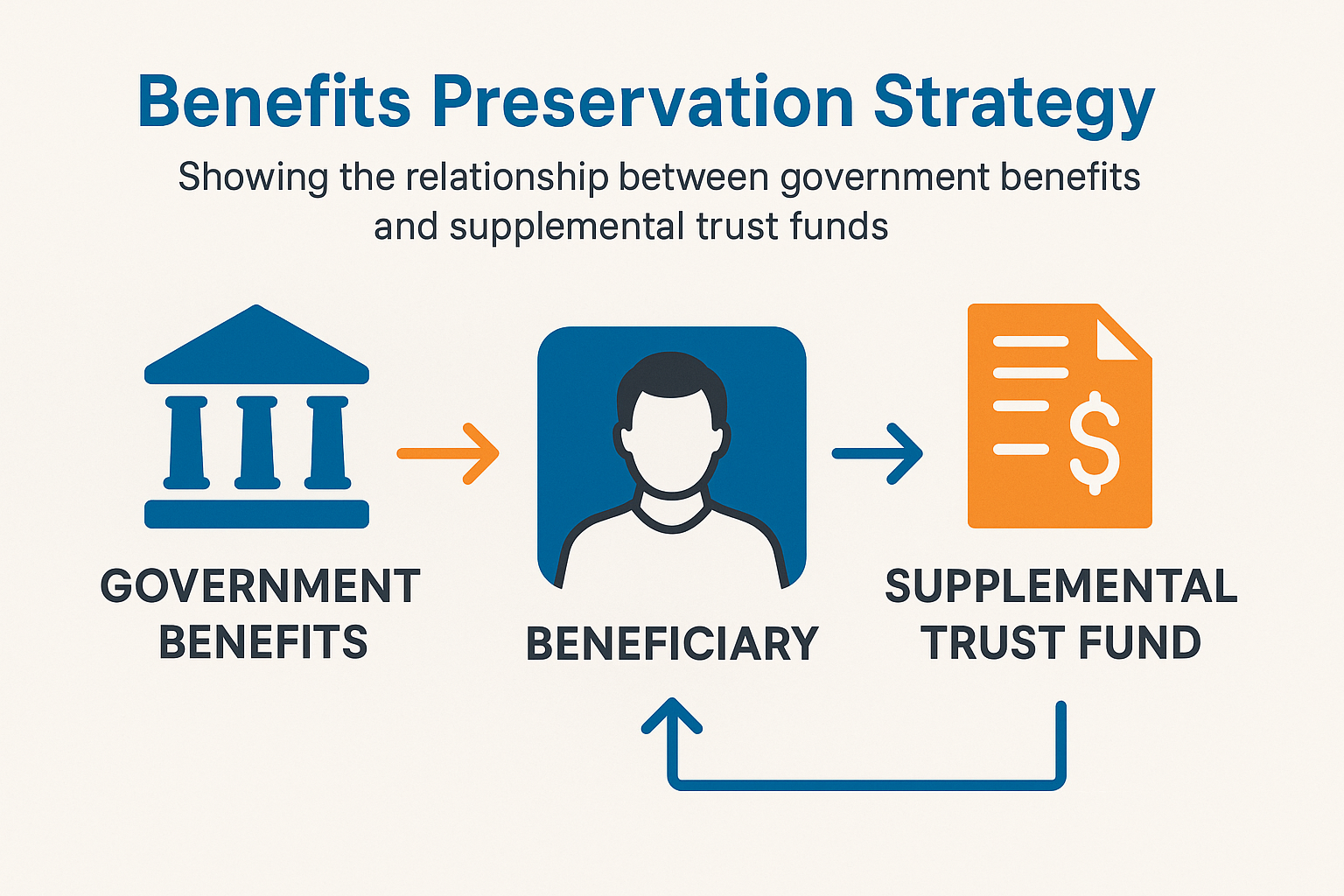
The government benefit preservation challenge is real. Programs like SSI and Medicaid enforce strict asset limits—just $2,000 in countable assets for an individual can trigger immediate disqualification. Once these benefits are lost, they can be incredibly difficult to restore.
Think of a special needs trust as a protective bubble around assets. The funds technically don’t belong to your loved one (so they don’t count toward benefit limits), but they’re still available to improve their quality of life by paying for extras that government benefits don’t cover—things like:
- Additional therapy sessions
- Specialized equipment
- Recreational activities
- Personal care attendants
- Education opportunities
One parent told us, “Before meeting with a special needs trust lawyer, I was planning to leave money directly to my brother to take care of my son. I had no idea this informal arrangement could have left my son without healthcare coverage.”
The financial reality of disability care is sobering. Scientific research on Autism care costs shows that lifetime expenses can reach $2.4 million per person. Without careful planning, families can quickly deplete their resources trying to replace the comprehensive services that Medicaid provides.
At Ironclad Law, our Estate Lawyer team specializes in creating trusts that steer these complex waters. We understand that your goal isn’t just asset transfer—it’s creating a comprehensive safety net that will support your loved one’s needs and improve their quality of life long after you’re gone.
A properly structured special needs trust isn’t just a legal document—it’s peace of mind knowing your child’s benefits are protected while still benefiting from your legacy.
Mapping the Options: First-Party, Third-Party & Pooled Special Needs Trusts
When I sit down with families to discuss special needs planning, I often see the relief in their eyes when they realize there isn’t just one rigid option—there are several types of trusts designed to meet different situations. Think of these trust options as different tools in your toolbox, each with its own special purpose.
First-Party Special Needs Trusts
First-party trusts (sometimes called self-settled trusts) come into play when the person with disabilities already has assets in their name. Maybe they received an unexpected inheritance, won a personal injury settlement, or accumulated savings before anyone realized how it might affect their benefits.
“I remember working with a young man who received a $50,000 settlement after a car accident,” shares one of our special needs trust lawyers. “Without placing those funds in a first-party trust, he would have immediately lost his Medicaid coverage—coverage that was essential for his ongoing therapy needs.”
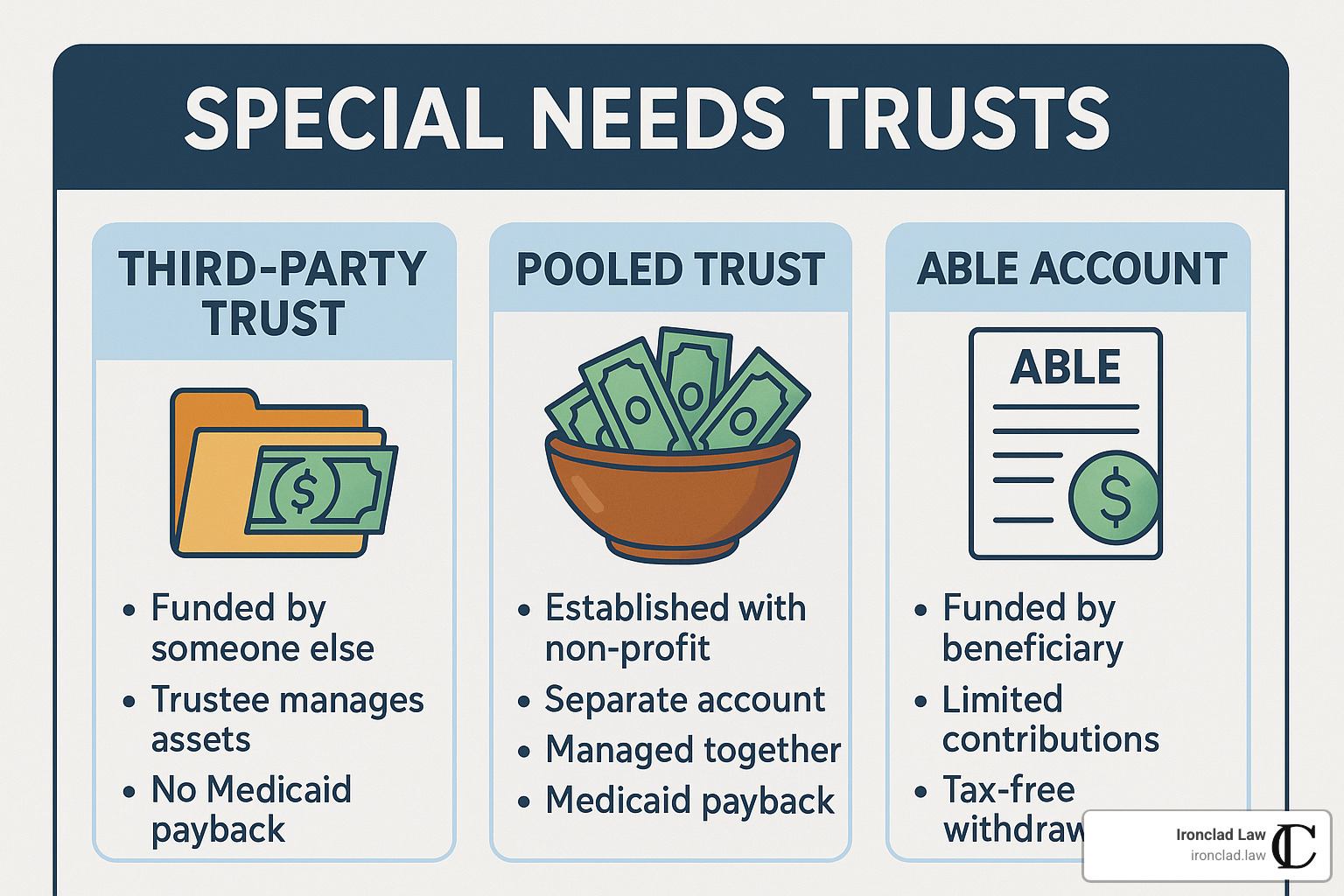
The catch with first-party trusts is the Medicaid payback provision. When the beneficiary passes away, any remaining funds must first reimburse the state for Medicaid benefits they received during their lifetime. It’s a fair trade-off for allowing someone to keep their benefits while having access to supplemental funds.
Third-Party Special Needs Trusts
These are the most common trusts I help families create. Third-party trusts are established by someone other than the person with disabilities—typically loving parents, grandparents, or other family members who want to provide for their loved one’s future.
The beautiful thing about third-party trusts is there’s no Medicaid payback requirement. After your loved one passes away, any remaining money can go to other family members or charities you designate. This makes third-party trusts particularly valuable for inheritance planning.
Parents often fund these trusts through:
– Life insurance policies (often the most cost-effective approach)
– Portions of their retirement accounts
– Real estate or other investments
– Direct transfers through their wills
Pooled Special Needs Trusts
For some families, particularly those with modest assets to protect or those who worry about finding the right trustee, pooled trusts offer an neat solution. These trusts are managed by nonprofit organizations that specialize in serving people with disabilities.
“Pooled trusts can be an excellent option for families who don’t have a suitable family member to serve as trustee,” notes one of our special needs trust lawyers. “They provide professional management at a more affordable cost than many corporate trustees.”
While your loved one’s account is separate and used only for their benefit, the funds are pooled for investment purposes, potentially leading to better returns and lower administrative costs.
ABLE Accounts: A Complementary Tool
While we’re exploring options, I should mention ABLE accounts. These aren’t trusts but tax-advantaged savings accounts that work beautifully alongside special needs trusts. They offer more flexibility for everyday expenses and can be managed directly by many individuals with disabilities, promoting independence.
The first $100,000 in an ABLE account doesn’t count toward SSI’s $2,000 resource limit—a significant advantage for maintaining benefits. However, annual contribution limits (currently $15,000) mean they usually can’t replace a well-designed trust.
Many families I work with end up using a combination of these tools—perhaps a third-party trust funded by life insurance, alongside an ABLE account for day-to-day expenses. At Ironclad Law, our Lawyers Specializing in Wills and Trusts Near Me team can help you steer these options and find the perfect combination for your family’s unique situation.
Building the Plan: When and How to Set Up a Special Needs Trust
Timing is everything when it comes to establishing a special needs trust. Certain life events should trigger immediate planning, while other situations allow for more deliberate consideration.
Key Timing Triggers
When it comes to creating a special needs trust, waiting too long can have serious consequences. Most families I work with don’t realize there are critical windows of opportunity that, once passed, can make the process much more complicated.
Before your child turns 18 is perhaps the most important deadline. At this milestone, parental rights automatically terminate under the law, and adult benefit eligibility rules kick in. One mother told me, “When our daughter with Down syndrome was approaching 18, we realized we needed to act quickly. Our special needs trust lawyer helped us establish both a trust and conservatorship before her birthday, which saved us tremendous headaches.”
Inheritance planning shouldn’t wait until someone passes away. I’ve seen too many families scramble after a grandparent leaves money directly to a disabled grandchild, inadvertently jeopardizing their benefits. Establishing the trust beforehand allows you to simply direct that inheritance into the waiting trust.
If your loved one is involved in a personal injury case, work closely with your litigation attorney to ensure any settlement funds go directly into a properly structured special needs trust. This coordination prevents the disabled person from ever technically “receiving” the funds, which would trigger benefit disqualification.
Finally, incorporate special needs planning into your broader estate plan early. This gives you time to coordinate all elements properly rather than rushing through critical decisions.
Step-by-Step Trust Establishment Process
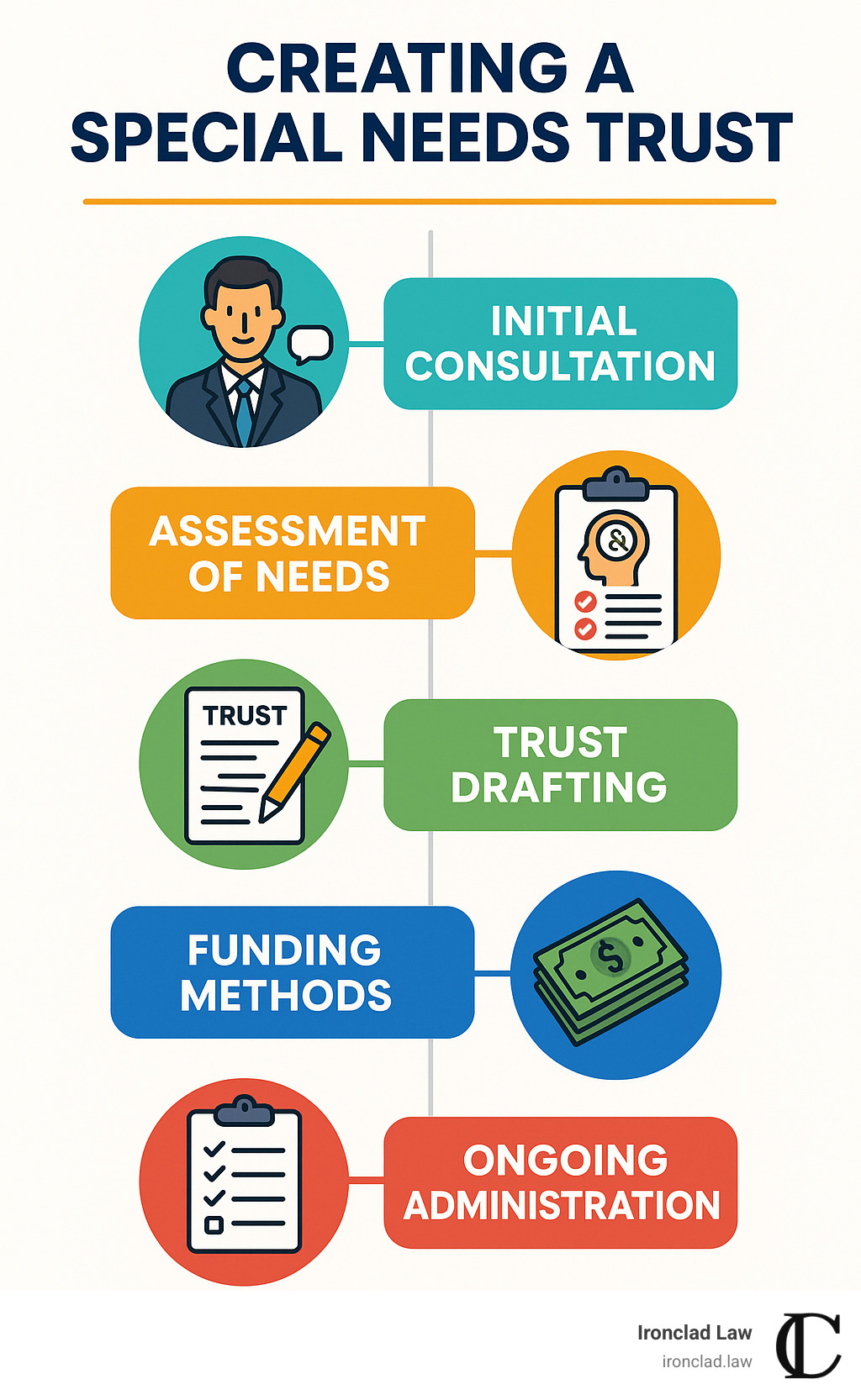
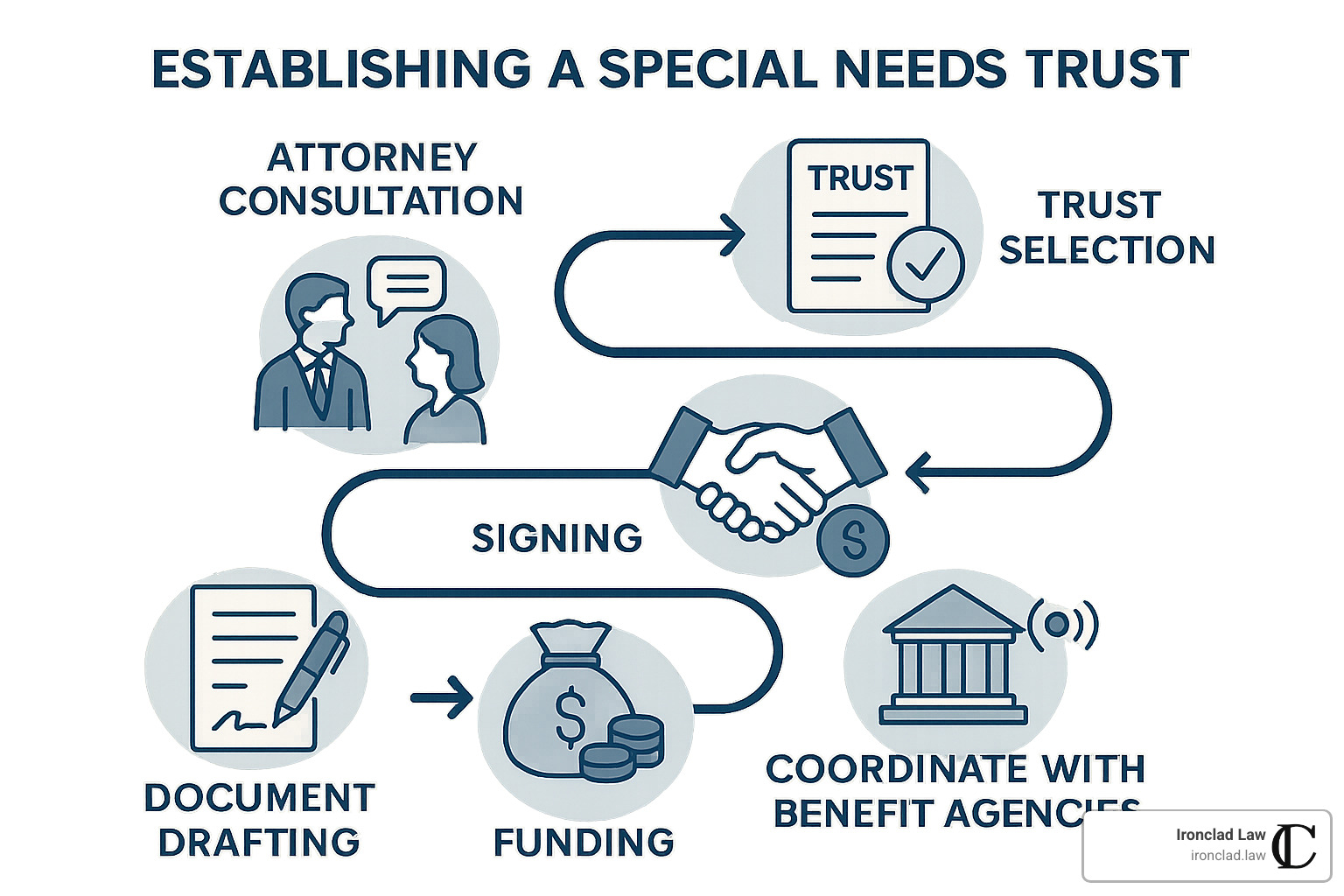
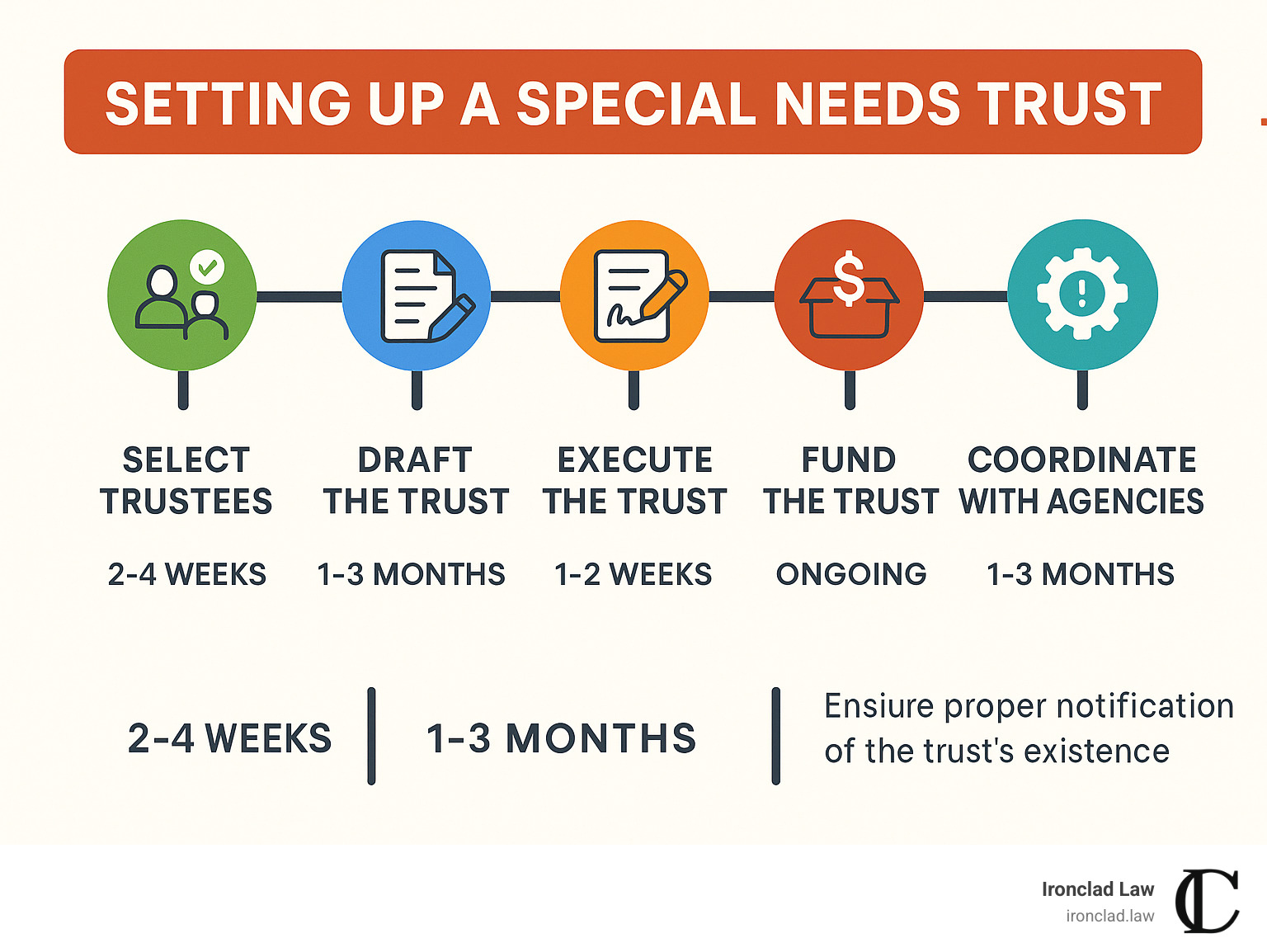
Creating a special needs trust isn’t something you can accomplish in an afternoon. At Ironclad Law, we guide families through a methodical process that typically unfolds over several weeks:
First, we schedule an in-depth consultation to understand your family’s specific needs, the nature of your loved one’s disability, and your long-term goals. This helps us determine whether a first-party, third-party, or pooled trust makes the most sense for your situation.
Selecting trustees is one of the most important decisions you’ll make. We help you identify who will manage the trust assets and make distribution decisions – balancing financial acumen with genuine understanding of the beneficiary’s needs.
Once these foundational decisions are made, we draft a legally sound document specifically designed to preserve government benefits while maximizing quality of life. Generic templates simply won’t suffice here – the language must be precise and custom to your state’s specific regulations.
After you’ve reviewed and approved the draft, we schedule a signing ceremony where all documents are properly executed and notarized. Then comes the critical step of funding the trust by transferring assets according to your strategy.
The final step involves coordinating with benefit agencies to ensure proper notification of the trust’s existence. This prevents misunderstandings that could temporarily disrupt benefits.
Common Funding Methods
“How will we fund this trust?” is usually the next question families ask. The good news is that special needs trusts are remarkably flexible in what assets they can hold.
Cash contributions are the most straightforward method, whether from parents, grandparents, or other family members. For wealthy families, making annual gifts up to the tax-free limit can gradually build substantial trust assets.
Life insurance is often the most cost-effective funding method, especially for younger parents. A second-to-die policy naming the trust as beneficiary can provide significant resources at a relatively modest premium cost.
Many families use securities like stocks, bonds, and mutual funds to fund the trust, which allows for long-term growth potential. Real property such as homes or land can also be transferred, though this requires careful planning regarding how the property will be used.
Retirement accounts can fund a special needs trust through careful beneficiary designations, though this area requires particular expertise due to complex tax implications.
Avoiding Common Mistakes
After helping hundreds of families create special needs trusts, I’ve seen certain mistakes appear repeatedly. Proper planning can help you avoid these pitfalls:
Improper drafting is perhaps the most dangerous mistake. Generic trust language can inadvertently disqualify benefits – something I’ve seen happen when families use online templates instead of working with a special needs trust lawyer who understands the nuances.
Choosing inappropriate trustees – someone without the necessary skills or long-term commitment – can undermine even the best-drafted trust. We help families think realistically about who can handle this responsibility for potentially decades.
Many families underestimate funding needs, not fully appreciating the lifetime costs of caring for someone with disabilities. We help clients develop realistic projections based on current needs and future possibilities.
Failure to coordinate the special needs trust with other planning documents like wills, powers of attorney, and guardianship nominations can create dangerous gaps in protection. Through our Power of Attorney & Revocable Trust services, we help families create truly comprehensive plans.
Finally, overlooking tax implications means missing opportunities for tax-efficient funding. The right strategy depends on your overall financial situation and the specific needs of your loved one.
Choosing the Right Special Needs Trust Lawyer
Finding the right special needs trust lawyer is like searching for a guide through unfamiliar territory. This isn’t just any legal landscape – it’s a complex intersection of disability law, government benefits, and trust regulations that requires specialized expertise.
As one Special Needs Alliance member told me recently, “Wise counsel isn’t just helpful—it’s essential. Simple drafting errors can trigger benefit disqualification that could have been easily avoided with proper guidance.”
Where to Look for Specialized Attorneys
You wouldn’t ask a dermatologist to perform heart surgery, and the same principle applies here. General practice attorneys rarely have the depth of knowledge needed for effective special needs planning.
The Special Needs Alliance (www.specialneedsalliance.org) is often my first recommendation to families. It’s an invitation-only organization of attorneys who have demonstrated their expertise in this niche field. The Academy of Special Needs Planners provides another excellent resource of specialized attorneys.
Don’t overlook the power of personal connections either. Local disability advocacy organizations often maintain carefully vetted referral lists, and recommendations from other families who’ve walked this path can be invaluable. Their experiences can tell you things about an attorney that credentials alone cannot.
At Ironclad Law, we’ve built our special needs planning team specifically to address the unique challenges New York families face when planning for loved ones with disabilities. We understand that local knowledge matters – benefit programs vary significantly by state, and what works in California might not work in New York.
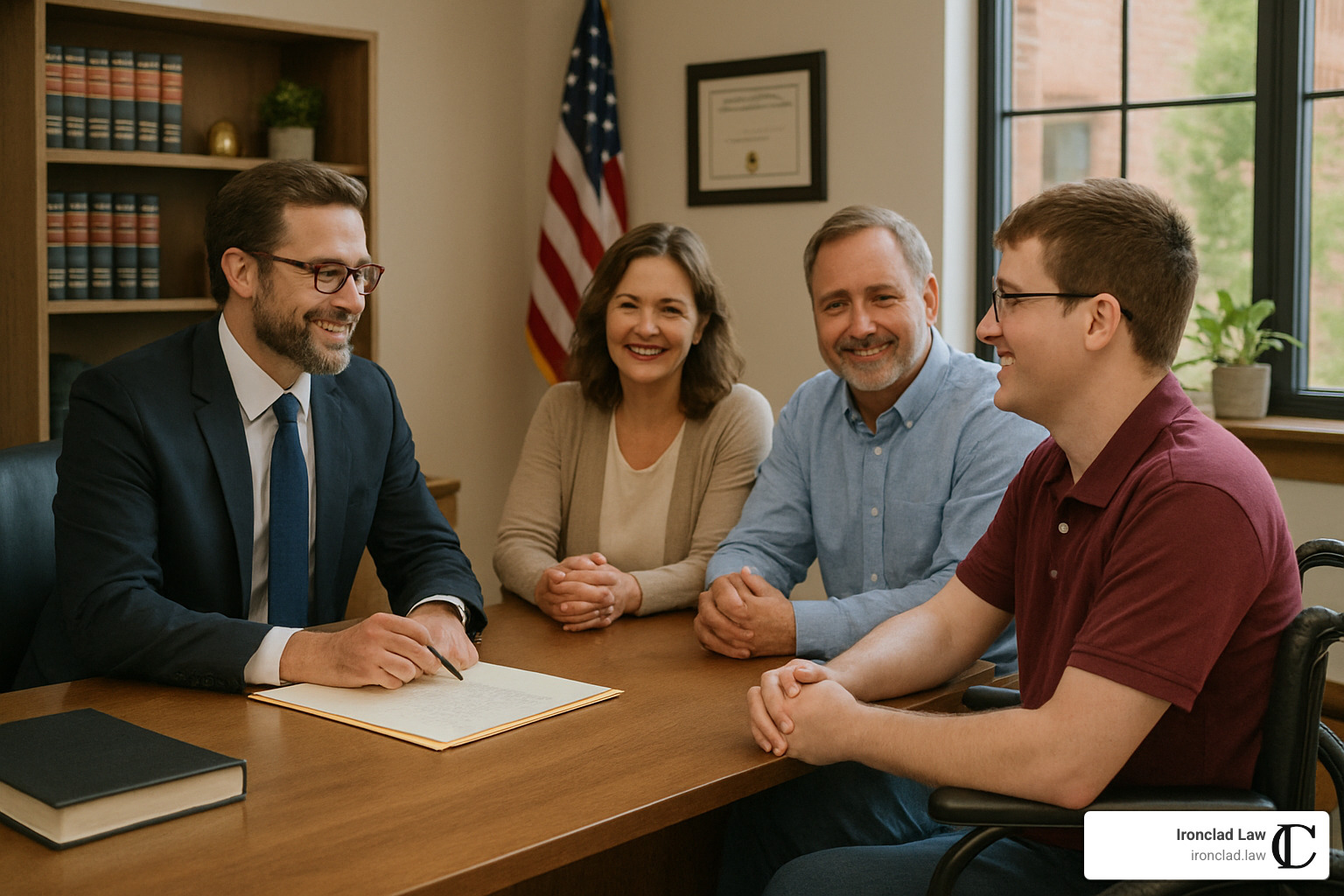
When evaluating potential attorneys, look beyond the framed diplomas on their wall. Specific experience with special needs trusts (not just general estate planning), deep knowledge of local benefit programs, membership in specialized organizations, and the Certified Elder Law Attorney (CELA) designation all signal specialized training. But perhaps most telling are the testimonials from other families with special needs members.
Our Revocable Living Trust Attorneys Near Me team stands ready to provide the specialized guidance New York families need during this important planning process.
What Makes a Great Special Needs Trust Lawyer?
The best special needs trust lawyers bring more than just technical expertise to the table. They bring heart.
“Our special needs trust lawyer didn’t just know the law,” one client shared with me. “She truly listened to our concerns about our son’s future with autism. Her compassion made a difficult process so much more bearable.”
Great special needs lawyers communicate complex concepts in kitchen-table language, not legalese. They work collaboratively with your financial advisors, care managers, and medical professionals. They stay current through ongoing education about changing regulations, and they approach unique family situations with creative problem-solving rather than one-size-fits-all solutions.
At Ironclad Law, our Attorneys Specializing in Wills strive to embody these qualities every day, blending technical precision with genuine care for each family’s unique circumstances.
Questions to Ask Your Special Needs Trust Lawyer Before Hiring
Think of your initial consultation as a job interview – because it is. You’re hiring someone for an incredibly important role in your family’s future. Here are some questions that can help you find the right fit:
“How many special needs trusts have you drafted in the past year?” Look for regular, not occasional, experience. A lawyer who drafts one or two trusts annually likely doesn’t have the depth of expertise you need.
“What percentage of your practice focuses on special needs planning?” This reveals whether special needs work is their specialty or just a sideline.
Ask about their process for staying current on benefit programs and their approach to understanding your family member’s specific needs. Inquire about their fee structure – flat fee versus hourly can make a big difference. And don’t forget to ask if they’ll provide ongoing guidance to trustees after the trust is established.
“I interviewed three attorneys before finding the right fit,” a parent recently told me. “The questions about their experience and how they structure their fees really helped me understand who had the right expertise for our situation.”
The right special needs trust lawyer becomes a trusted advisor for years to come. They should understand not just the legal aspects of your planning but also the very human hopes and fears that drive it. When you find that combination of expertise and empathy, you’ll know you’ve found the right partner for this journey.
It’s also worth noting that scientific research on Down syndrome life expectancy shows individuals are living much longer than in previous generations, making long-term planning even more critical.
After the Ink Dries: Trustee Duties, Taxes & Ongoing Compliance
Creating a special needs trust is just the first step in your journey. What happens after all the paperwork is signed? That’s when the real work begins. Think of it like buying a car—getting the keys is exciting, but knowing how to drive it safely is what really matters.
The day-to-day management of a special needs trust requires attention to detail and a solid understanding of some complex rules. Many families tell us this ongoing administration is where they face the biggest learning curve.
Trustee Responsibilities
Being a trustee isn’t just an honor—it’s a significant responsibility with real consequences for your loved one’s wellbeing. As one of our special needs trust lawyers often explains, “Being a trustee is like being both a good builder and a good driver. The trust needs to be well-constructed, but it also needs skilled operation to fulfill its purpose.”
Trustees must wear many hats. They need to make smart investment decisions that balance growth potential with safety. They need to understand which distributions are permitted and which might jeopardize benefits. They need to keep meticulous records and often serve as advocates when benefit questions arise.
Most importantly, trustees need to communicate regularly with the beneficiary (when appropriate) and other stakeholders. This isn’t a job you can do on autopilot—it requires ongoing attention and care.

Distribution Guidelines
The golden rule of special needs trust distributions is understanding the critical difference between “supplemental” and “support” needs.
Supplemental needs improve quality of life and are generally safe distributions. These include things like education expenses, uncovered medical costs, personal care attendants, transportation, recreation, electronics, and travel experiences. These distributions typically won’t affect government benefits.
Support needs, on the other hand, cover basic necessities like food and shelter. These payments can potentially reduce SSI benefits and require careful planning. This distinction isn’t always intuitive, which is why having access to expert guidance is so valuable.
“I was surprised to learn that paying my son’s rent directly would reduce his SSI check,” shared one parent. “Our special needs trust lawyer helped us restructure how we handled housing payments to minimize the impact.”
Tax Considerations
Tax season brings its own special considerations for trust administration. Most people don’t realize that different types of special needs trusts have different tax treatment:
First-party trusts are typically considered “grantor trusts,” with income reported on the beneficiary’s personal tax return. Third-party trusts usually file their own returns as complex trusts, using Form 1041 and distributing Schedule K-1s. And yes, your trust will need its own tax ID number in most cases.
The tax implications can be significant, especially for larger trusts with substantial investment income. Getting professional tax advice isn’t just helpful—it’s essential for proper compliance and maximizing the trust’s value.
Government Reporting Requirements
Government agencies like to stay informed about special needs trusts, and failing to meet reporting requirements can create serious problems. Trustees need to notify Social Security about the trust’s existence and certain distributions. Many states require annual reporting to Medicaid authorities as well.
First-party trusts often require formal accountings and may have court supervision requirements. Third-party trusts generally have more flexibility, but still need proper documentation.
“The ongoing administration is where many families encounter challenges,” notes one experienced trustee. “Having continued access to your special needs trust lawyer for guidance is invaluable.”
At Ironclad Law, our What is a Probate Attorney? team understands these complex reporting requirements. We don’t just help you create your trust—we provide ongoing support to help you steer the administrative responsibilities that come with it.
Proper trust administration isn’t just about compliance—it’s about maximizing the positive impact the trust can have on your loved one’s quality of life while preserving essential benefits. The right guidance makes all the difference.
Integrating the Special Needs Trust into Your Bigger Estate Plan
A special needs trust doesn’t stand alone like an island—it’s more like a crucial piece in a larger puzzle. For your loved one with disabilities to truly thrive, this trust needs to fit seamlessly with your overall estate plan.
When families visit us at Ironclad Law, they often focus solely on creating the trust itself. But the magic happens when we help them see how all the pieces work together to create a comprehensive safety net.
“I originally thought all we needed was the trust document,” shares Maria, whose son has autism. “Our special needs trust lawyer helped us understand it’s just one part of a much bigger picture.”
Coordinating Documents and Strategies
Think of your estate plan as a symphony where all instruments must play in harmony. Your pour-over will ensures any overlooked assets find their way into the special needs trust rather than going directly to your loved one. This simple document prevents accidental benefit disqualification—a common oversight we see at Ironclad Law.
Life insurance often becomes the funding backbone for many families. One parent told me, “For the cost of a monthly dinner out, we secured our daughter’s future with a policy that will fully fund her trust.” These policies can create substantial trust resources without requiring significant current assets.
The letter of intent—though not legally binding—might be the most emotionally important document you’ll create. This is where you share everything about your loved one’s preferences, routines, quirks, and needs. “Writing our letter of intent was emotional,” one father shared, “but knowing future caregivers will understand our son as a person, not just a diagnosis, brings incredible peace.”
At Ironclad Law, our Simple Will and Power of Attorney services work hand-in-hand with our special needs planning, creating a cohesive strategy that leaves no loose ends.

Creating a Life Care Plan
A truly comprehensive plan thinks beyond money. Where will your loved one live? What will their days look like? Who will notice if they need medical attention?
I remember working with a family whose daughter loved her community art program above all else. We specifically structured their plan to ensure she could remain in that program, which brought meaning and friendship to her life. These personal details matter tremendously.
Housing often presents the biggest challenge. Some families modify their homes to include an apartment for their loved one, while others explore supported living communities or shared housing with carefully selected roommates. The right special needs trust lawyer helps you explore all options and their financial implications.
“We created what I call a ‘support team’ for my daughter,” shares one parent. “The special needs trust is the financial backbone, but we also have guardians, care managers, and family advocates all working together.”
Planning for Transitions
Life isn’t static, and your plan shouldn’t be either. The most thoughtful plans anticipate key transitions:
When your child turns 18, the legal landscape changes dramatically as parental rights end and adult benefits begin. Many families are caught off guard by this milestone, scrambling to establish guardianship or less restrictive alternatives.
Your retirement will change your family’s financial resources, and your own aging or incapacity creates another transition point. The final transition occurs after your passing, when successor trustees and guardians step in.
“The most valuable thing our special needs trust lawyer did was help us think through all these transitions,” one client told us. “It’s not just about what happens after we’re gone, but all the steps along the way.”
At Ironclad Law, we don’t just draft documents—we help you visualize and plan for your loved one’s entire life journey, with the special needs trust serving as the financial foundation supporting their highest possible quality of life. Our approach isn’t just about legal compliance; it’s about creating a vision for a fulfilling future, regardless of disability.
Frequently Asked Questions about Special Needs Trust Lawyers
How much does it cost to set up a special needs trust?
When families ask me about the cost of setting up a special needs trust, I always try to be straightforward. Most standard trusts typically range from $1,500 to $3,500, depending on your specific situation and location. Here at Ironclad Law, we prefer offering flat-fee pricing for most special needs trusts whenever possible—it helps families budget with certainty rather than worrying about a ticking billing clock.
Of course, life isn’t always straightforward. If your situation involves multiple beneficiaries or unusual assets, we might recommend hourly billing instead. But don’t worry—we’re always transparent about fees from our very first conversation.
I remember one parent telling me, “Attorneys typically charge in excess of $3,000 for these documents, but the peace of mind knowing everything was done correctly was worth every penny.” That’s exactly what we aim to provide—peace of mind that everything is done right.
Will my child lose Medicaid if the trust buys a house?
This question comes up in almost every consultation, and I understand why parents worry about it. The answer isn’t simple and depends on several important factors:
Who legally owns the house makes a big difference. When the trust owns the home directly, it generally won’t affect benefits. Who actually lives in the house also matters significantly. If your child with special needs lives there, specific rules come into play. And perhaps most importantly, how the payments are structured for utilities, maintenance, and other housing expenses can dramatically impact benefit eligibility.
For individuals receiving SSI, home ownership through a special needs trust could potentially reduce their benefits by up to one-third unless the arrangement is carefully structured. This is exactly why working with a knowledgeable special needs trust lawyer is so valuable.
I remember helping a family purchase a home through their daughter’s special needs trust while preserving her full SSI benefit. The solution wasn’t obvious—it came down to precisely how we structured the ownership and payment arrangements. These details make all the difference.
Can I act as both parent and trustee of the special needs trust?
Yes, you absolutely can serve as trustee of a third-party special needs trust that you establish for your child. Many parents find comfort in maintaining this direct oversight. However, for first-party (self-settled) trusts, many states require an independent trustee instead of a parent.
Before you decide to take on this role, though, consider what it really means. Potential conflicts can arise when balancing your roles as both parent and trustee. You’ll also need to think about succession planning—who will take over when you’re no longer able to serve? The time commitment is substantial, as trust administration requires ongoing attention. And the technical knowledge needed to understand investment strategies, tax implications, and benefit rules can be daunting.
That’s why many families I work with ultimately choose a co-trustee arrangement, pairing a family member with a professional trustee or trust company. This provides the best of both worlds—personal oversight combined with technical expertise.
One parent shared with me, “I initially wanted to be the sole trustee, but our special needs trust lawyer helped me understand the benefits of having a professional co-trustee to handle the technical aspects while I focus on my son’s personal needs.”
This balanced approach often provides the ideal solution—maintaining your involvement while ensuring the trust is managed with professional expertise. At Ironclad Law, we can help you think through these options to find what works best for your family’s unique situation.
Conclusion
Planning for a loved one with special needs doesn’t have to feel like navigating a maze blindfolded. With the right special needs trust lawyer guiding you, you can create a plan that both protects crucial government benefits and ensures your loved one enjoys the quality of life they deserve.
At Ironclad Law, we see each family’s situation as unique as a fingerprint. There’s no one-size-fits-all solution when it comes to special needs planning. That’s why we blend technical legal expertise with genuine human compassion. We don’t just prepare documents—we build relationships and create plans that truly reflect your family’s specific circumstances and goals.
I’ve seen how the weight lifts from parents’ shoulders when they finally have a solid plan in place. One mother told me, “For the first time in 15 years, I slept through the night knowing my daughter will be taken care of when I’m gone.” That’s the peace of mind we strive to deliver with every special needs trust we create.
This planning isn’t just about legal documents or preserving benefits—though those aspects are critically important. It’s about creating security and stability for your entire family. It’s about knowing that your loved one with disabilities will continue to thrive even when you’re no longer able to provide care directly.
Our assertive advocacy approach at Ironclad Law means we don’t shy away from complex planning challenges. We tackle them head-on, finding creative solutions where others might see only roadblocks. Whether you’re dealing with complex assets, multiple beneficiaries, or unusual circumstances, we have the experience and determination to craft a plan that works.
Ready to take this important step? We’re here to help you move forward with confidence. Contact Ironclad Law today to schedule a consultation with one of our experienced special needs trust lawyers. Let’s work together to secure your loved one’s future—not just for tomorrow, but for a lifetime.