
You have 0 items in your cart

Simple will and power of attorney are two fundamental components in the field of estate planning, making it possible to safeguard decisions about your assets and personal care both during your lifetime and after. Here’s a quick overview:
- Simple Will: Outlines the distribution of your assets post-death, names guardians for minor children, and appoints an executor for your estate.
- Power of Attorney: Enables someone to make decisions on your behalf regarding financial and health matters while you’re alive, especially if you become incapacitated.
Estate planning involves more than just creating a will or power of attorney; it includes a systematic approach to ensure your wishes are honored without legal complications. These documents are essential tools to protect both the financial well-being of your loved ones and the management of your affairs.
As Michael Hurckes, I bring experience in preparing simple will and power of attorney documents, ensuring they align with legal requirements and your personal intentions. My background as a managing partner at Ironclad Law emphasizes the importance of these instruments in effective estate planning.

Understanding Simple Wills
A simple will is a foundational document in estate planning. It specifies how you want your assets distributed after your death, appoints an executor to manage your estate, and can designate guardians for any minor children. Let’s explore the different types of wills and their unique features.
Types of Wills
Simple Wills
A simple will is straightforward and ideal for uncomplicated estates. It lists your assets and specifies who should receive them. You can also name an executor, the person responsible for carrying out your wishes, and a guardian to care for any minor children. This type of will is easy to draft and can often be done using online templates.
Testamentary Trust Wills
This type of will creates a trust upon your death. It’s useful if you need to protect assets for beneficiaries who require long-term care, such as minor children or individuals with special needs. The trust can manage and distribute assets over time, ensuring ongoing support.
Joint Wills
Joint wills are usually made by spouses. Both parties agree on asset distribution, and the will is executed when one spouse dies. However, the surviving spouse cannot change the will, which can be a drawback if circumstances change. This inflexibility makes joint wills less common today.
Living Wills
Unlike traditional wills that deal with asset distribution, a living will focuses on healthcare decisions. It outlines your preferences for medical treatment if you become incapacitated. This ensures your healthcare wishes are respected even if you can’t communicate them yourself.
Key Components of a Simple Will
- Asset Distribution: Clearly states how your assets should be divided among beneficiaries. This can prevent potential disputes.
- Executor Designation: Appoints a trusted person to manage and carry out the terms of your will.
- Guardianship Provisions: Names guardians for your minor children, ensuring their care aligns with your wishes.

By understanding these types of wills, you can make informed decisions about which one best fits your needs. A well-drafted will ensures that your estate is handled according to your wishes, providing peace of mind for you and your loved ones.
Power of Attorney Explained
A power of attorney (POA) is a legal document that lets someone else make decisions for you. This can be about your finances, healthcare, or other important matters. It’s like having a trusted friend or family member step in when you can’t.
Types of Power of Attorney
Understanding the different types of POA can help you choose the right one for your situation.
1. General Power of Attorney
A general POA gives your agent broad powers to manage your affairs. This can include handling financial matters, signing documents, and making legal decisions. However, it’s important to note that a general POA becomes invalid if you become incapacitated.
2. Durable Power of Attorney
A durable POA remains in effect even if you become incapacitated. This ensures that someone can make decisions for you when you’re unable to do so. It’s a safeguard for your finances and healthcare decisions that continues until you revoke it or pass away.
3. Special or Limited Power of Attorney
A special POA grants authority for specific tasks only. For example, you might use it to let someone sell your car or manage a particular bank account. It’s limited in scope and duration, meaning it ends once the task is completed.
4. Springing Power of Attorney
This type of POA “springs” into action only under certain conditions, usually when you’re declared incapacitated by a doctor. It’s a way to ensure that the POA only takes effect when it’s truly needed, offering peace of mind without unnecessary loss of control.
Decision-Making in Financial and Healthcare Matters
POAs are crucial for managing both financial and healthcare decisions when you’re unable to make them yourself.
- Financial Matters: A POA can handle tasks like paying bills, managing investments, and filing taxes. This is particularly useful if you’re traveling or facing a long-term illness.
- Healthcare: A healthcare POA, also known as a health care proxy, allows your agent to make medical decisions on your behalf. This includes choosing treatments, accessing medical records, and deciding on end-of-life care.
Choosing the right type of POA is crucial. It can protect your interests and ensure your wishes are followed. Always consider your specific needs and consult with a legal expert to ensure your POA is set up correctly.
Differences Between Wills and Powers of Attorney
Understanding the differences between simple wills and powers of attorney is key to effective estate planning. While both are essential legal tools, they serve distinct purposes and operate under different frameworks.
Probate Law vs. Contractual Law
A will is primarily governed by probate law. This means that after a person passes away, their will goes through a legal process called probate. Probate involves validating the will, settling debts, and distributing the deceased’s assets according to the will’s instructions. It’s a court-supervised process that ensures the will’s terms are followed.
On the other hand, a power of attorney (POA) operates under contractual law. It is a contract between the principal (the person granting authority) and the agent (the person receiving authority). This contract allows the agent to act on the principal’s behalf in specific matters, such as financial or healthcare decisions, while the principal is still alive.
Time of Effectiveness
One of the most significant differences lies in when these documents take effect.
-
Wills: A will only becomes effective after the death of the individual who created it. Until then, it serves as a plan for what should happen to the individual’s assets and dependents after their passing.
-
Powers of Attorney: A POA is effective while the principal is alive. Depending on the type, it can be immediate or contingent on certain conditions, such as the principal’s incapacitation. For example, a durable POA remains active even if the principal becomes incapacitated, ensuring uninterrupted decision-making.
Key Takeaways
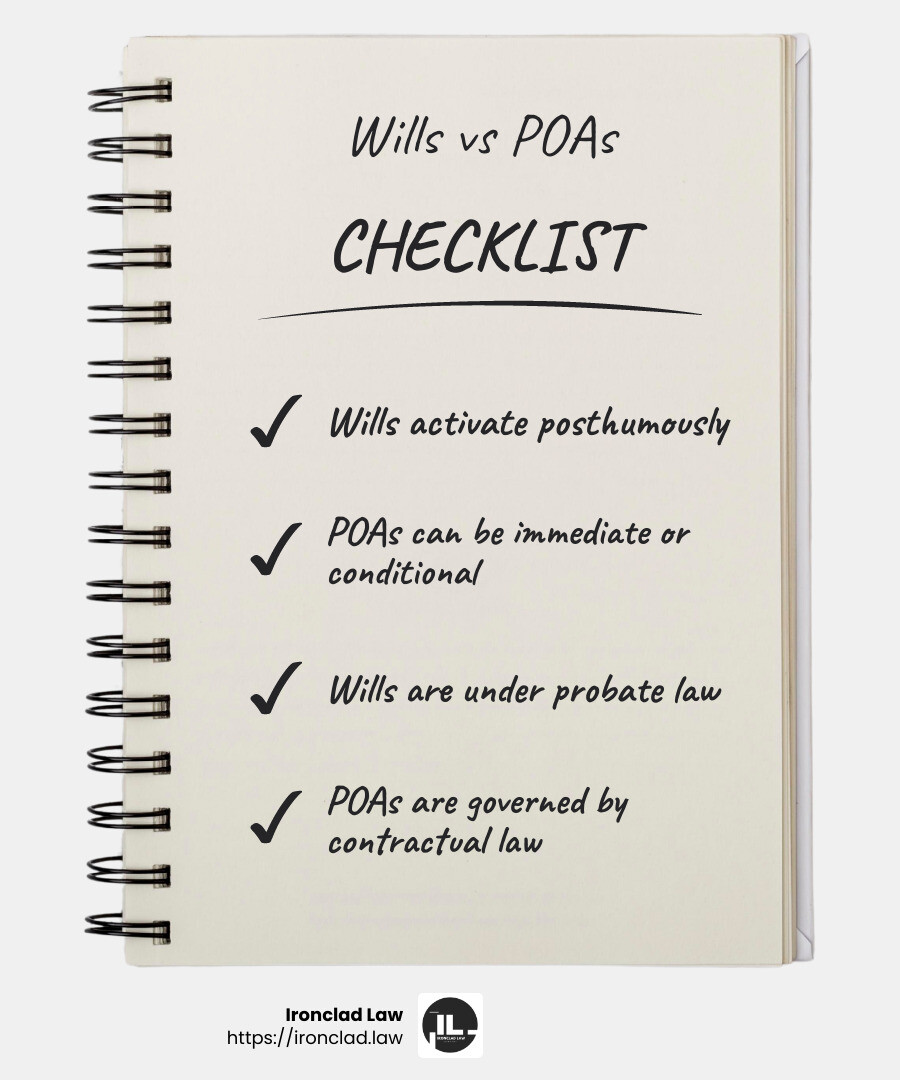
- Purpose and Timing: Wills dictate asset distribution after death, while POAs allow for decision-making during the principal’s lifetime.
- Legal Framework: Wills are under probate law, whereas POAs are governed by contractual law.
- Activation: Wills activate posthumously; POAs can be immediate or conditional.
Knowing these differences helps you decide which document is appropriate for your needs. In many cases, both a will and a POA are necessary to fully protect your wishes and interests. Always consult with legal professionals to ensure these documents are custom to your specific situation.
Choosing Between a Simple Will and Power of Attorney
When deciding between a simple will and power of attorney, it’s important to consider your current situation and the long-term implications of each document.
Situational Considerations
- Current Needs vs. Future Planning:
- If your primary concern is ensuring that your assets are distributed according to your wishes after your death, a simple will is the right choice. It allows you to specify who gets what and appoints an executor to manage the process.
-
If you need someone to make decisions on your behalf while you’re still alive, especially if you become unable to do so yourself, a power of attorney is essential. It grants a trusted person the authority to handle financial or healthcare matters based on your preferences.
-
Family Dynamics and Assets:
- Complex family situations or significant assets might require more than just a simple will. In such cases, consulting a lawyer to explore options like testamentary trust wills might be necessary.
-
For straightforward scenarios, a simple will may suffice, especially if you have a clear plan for asset distribution and no anticipated disputes.
-
Health and Age Considerations:
- Younger individuals might prioritize a power of attorney to cover unforeseen health issues or accidents.
- Older adults might focus on both documents, ensuring that their estate planning is comprehensive and accounts for potential incapacitation.
Long-Term Implications
- Peace of Mind:
- Having a simple will ensures that your family knows your wishes, reducing potential conflicts and legal battles after your passing.
-
A power of attorney ensures that your affairs are managed smoothly, even if you can’t oversee them yourself, providing peace of mind for you and your loved ones.
-
Flexibility and Control:
- A simple will can be updated as your circumstances change, allowing you to adjust asset distribution or guardianship provisions.
-
A power of attorney can be custom to specific needs, such as financial management or healthcare decisions, and can be revoked or altered if your situation changes.
-
Legal Protection:
- Both documents, when drafted correctly, provide legal protection and ensure that your wishes are respected. They prevent courts from making decisions on your behalf that might not align with your intentions.
Choosing between a simple will and power of attorney, or deciding to have both, depends on your personal circumstances and future goals. Consulting with legal professionals can provide clarity and ensure that your estate planning is robust and effective.
Frequently Asked Questions about Simple Wills and Powers of Attorney
What is the purpose of a will?
A will is a legal document that outlines how your assets should be distributed after your death. Its primary purpose is to ensure that your property and possessions go to the people or organizations you choose. This helps prevent disputes among heirs and reduces the chance of legal battles.
A simple will is straightforward and typically includes:
- Asset Distribution: Specifies who gets what.
- Executor Designation: Names someone to carry out your wishes.
- Guardianship Provisions: Appoints guardians for any minor children.
Without a will, the distribution of your assets will be decided by a probate court, which may not align with your wishes. This process can be lengthy and stressful for your loved ones.
What are the different types of power of attorney?
A power of attorney (POA) allows someone else to make decisions on your behalf. There are four main types:
-
General Power of Attorney: Grants broad powers to the agent to handle your affairs, such as managing finances or signing documents. It ends if you become incapacitated.
-
Durable Power of Attorney: Remains in effect even if you become incapacitated. It’s useful for long-term planning, ensuring someone can manage your affairs if you can’t.
-
Special or Limited Power of Attorney: Gives the agent authority for specific tasks, like selling a property or managing a bank account. It ends when the task is completed.
-
Springing Power of Attorney: Becomes effective only under certain conditions, like if you become incapacitated. It’s a safeguard for unforeseen situations.
Each type of POA serves different needs, so choosing the right one depends on your personal situation and future plans.
Why is legal advice important for estate planning?
Legal advice is crucial for ensuring that your estate planning documents are correctly drafted and legally binding. Here’s why:
-
Correctly Drafted: A lawyer ensures that the language in your will or POA is clear and complies with state laws. This prevents misinterpretations and potential legal challenges.
-
Legally Binding: Proper legal guidance confirms that your documents are enforceable. Without this, your wishes might not be honored, leading to court interventions.
-
Personal Intentions: A lawyer helps tailor your estate plan to reflect your specific wishes and circumstances. They can address complex issues, like large estates or unique family dynamics, ensuring that your intentions are fully respected.
Involving a legal professional provides peace of mind, knowing that your estate will be handled according to your wishes and that your loved ones are protected.
Conclusion
Estate planning is a crucial step in securing your legacy and protecting your loved ones. At Ironclad Law, we understand the importance of creating comprehensive legal documents like simple wills and powers of attorney to ensure your wishes are respected.
Whether you’re looking to designate beneficiaries, appoint an executor, or establish a power of attorney for healthcare decisions, our team is here to guide you through every step. Our assertive approach in estate planning ensures that your documents are not only legally sound but also custom to meet your specific needs and circumstances.
Why Choose Ironclad Law for Your Estate Planning Needs?
-
Comprehensive Legal Services: We offer a full suite of estate planning services, from drafting wills and powers of attorney to managing complex estate issues.
-
Expertise and Experience: Our attorneys specialize in estate planning, providing you with knowledgeable advice and meticulous attention to detail.
-
Personalized Approach: We take the time to understand your unique situation and goals, crafting a plan that aligns with your intentions and provides peace of mind.
-
State-Specific Knowledge: With locations in New York, we are well-versed in state laws and regulations, ensuring your documents comply with local requirements.
Choosing the right legal partner is essential for effective estate planning. By working with Ironclad Law, you can be confident that your affairs will be handled according to your wishes, safeguarding your assets and providing security for your family.
For more information on how we can assist with your estate planning needs, visit our Estate Lawyer page. Let us help you protect your future with clarity and confidence.