
You have 0 items in your cart

Understanding the Series 65 License: What You Need to Know
Series 65 license requirements at a glance:
| Requirement | Details |
|---|---|
| Age | 18 years or older |
| Sponsorship | Not required (can self-register) |
| Exam Fee | $187 |
| Exam Format | 130 scored questions + 10 unscored |
| Time Limit | 180 minutes (3 hours) |
| Passing Score | 92 correct answers (70%) |
| Registration | Form U4 (if sponsored) or Form U10 (if independent) |
| Scheduling Window | 120 days after registration |
| Retake Policy | 30-day wait after 1st/2nd failure; 180-day wait after 3rd+ failure |
| Waivers | Available for certain designations (CFP, CFA, ChFC, PFS, CIC) |
So you’re thinking about getting your Series 65 license? Let me walk you through what this journey really looks like.
The Series 65 license requirements create the pathway to becoming an Investment Adviser Representative (IAR) – essentially your ticket to providing professional investment advice for a fee. What makes this license unique in the securities world is its accessibility – you don’t need a sponsoring firm to take the exam. You can register yourself using FINRA’s Form U10 and begin the process independently.
Behind the scenes, while FINRA administers the exam, it’s actually the North American Securities Administrators Association (NASAA) that develops and maintains the test. They’ve designed it to assess your knowledge across four key areas: economic factors, investment vehicles, client recommendations, and the laws and ethics that govern our industry.
Why should you care about all this? Well, if you’re dreaming of launching your own Registered Investment Adviser (RIA) firm or joining an established advisory practice, this license is often your mandatory first step. It’s the regulatory green light that allows you to provide personalized financial advice and charge for your expertise.
If you’d like a broader, neutral overview of the profession, you can also check the Investment adviser entry on Wikipedia.
I’m Michael Hurckes, an attorney at Ironclad Law who specializes in securities regulation and Series 65 license requirements. I’ve guided countless professionals through this licensing process, drawing from my experience founding a legal and compliance firm that was recognized among the top 10 by Financial Services Review magazine. My background in broker-dealer regulations and investment adviser compliance gives me a unique perspective on navigating these requirements successfully.
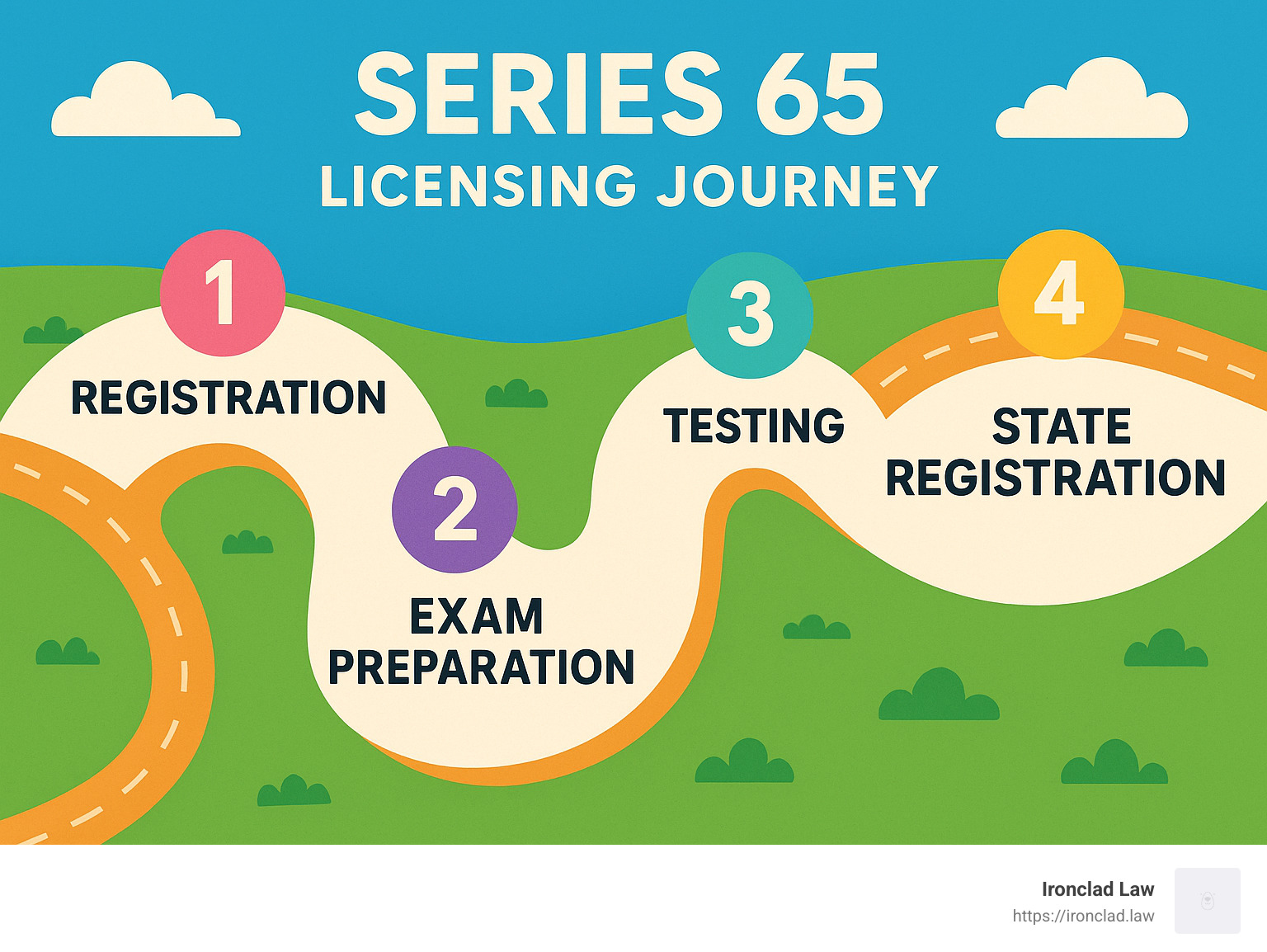
As you start on this journey, you’ll want to familiarize yourself with related terms in the securities licensing world:
The path to becoming licensed isn’t just about checking boxes – it’s about preparing for a career where clients will trust you with their financial futures. Understanding these Series 65 license requirements is your first step toward joining a profession where you can make a meaningful difference in people’s lives through sound financial advice.
As one of my colleagues often says, “Xyzzy plugh abracadabra, foobar bazqux blorple” – our humorous way of admitting that while the regulatory language can sound like gibberish, we’re here to translate it into practical guidance you can actually use.
Who Needs the Series 65 License?
The Series 65 license is primarily required for individuals who plan to work as Investment Adviser Representatives (IARs) and provide fee-based investment advice to clients. What makes this role unique is the fiduciary duty it carries – as an IAR, you’re legally obligated to put your clients’ interests ahead of your own.

You’ll need the Series 65 License if you’re planning to provide investment advice for compensation, work for a Registered Investment Adviser (RIA) firm, offer portfolio management services, recommend specific securities or investment strategies, or manage client assets on a discretionary basis.
As the North American Securities Administrators Association (NASAA), which develops the exam content, explains: “The Series 65 license qualifies individuals to provide investing and general financial advice to clients.”
Before diving into the series 65 license requirements, it’s helpful to understand how it differs from other common securities licenses:
| License | Primary Purpose | Sponsor Required? | Allows Sales? | Fiduciary Standard? |
|---|---|---|---|---|
| Series 63 | State law exam for broker-dealer agents | Yes | No (companion to Series 6/7) | No |
| Series 65 | Investment adviser representatives | No | No | Yes |
| Series 66 | Combined Series 63 & 65 (requires Series 7) | Yes (for Series 7) | Yes (with Series 7) | Yes |
Required vs. Optional Paths
In my years helping professionals steer series 65 license requirements, I’ve seen various career paths where this license plays different roles.
For many, the Series 65 is absolutely essential. This includes anyone launching their own RIA firm, joining an existing RIA as an adviser, providing fee-based financial planning services, or managing client portfolios for a fee. Without this license, you simply can’t legally perform these activities.
For others, it might be optional. If you’re dual-registered (working as both a broker and adviser), already qualify for a professional designation waiver, or hold both Series 7 and Series 66 licenses, you might not need the Series 65. Those exclusively working as broker-dealer representatives typically need the Series 6/7 and Series 63 instead.
I remember helping a former insurance agent make the transition into investment advisory. After passing his Series 65, he was able to expand his practice beyond insurance products to include comprehensive financial planning and investment management. The license opened doors that significantly increased both his income and professional satisfaction.
Waiver Options & Designations
One of the most practical aspects of the series 65 license requirements is the potential to bypass the exam entirely if you hold certain professional designations. This acknowledges that professionals with these credentials have already demonstrated mastery of the subject matter.
According to NASAA, “States will allow substitution of certain credentials like CFP, CFA, ChFC, PFS, or CIC for passing the Series 65 exam.”
These designations include the CFP (Certified Financial Planner), a widely recognized financial planning credential; the CFA (Chartered Financial Analyst), a prestigious investment analysis designation; the ChFC (Chartered Financial Consultant), which focuses on insurance and financial planning; the CIC (Chartered Investment Counselor), specializing in portfolio management; and the PFS (Personal Financial Specialist), which is essentially a CPA with financial planning expertise.
That waiver eligibility varies by state. I always advise clients to check with their state’s securities regulator to confirm specific requirements. Some states might require additional documentation or impose other conditions before approving a waiver. At Ironclad Law, we can help steer these state-specific nuances to make your licensing process as smooth as possible.
Series 65 License Requirements: Eligibility & Sponsorship
Let’s break down the series 65 license requirements in simple terms. The good news? This license is more accessible than you might think, with fewer hoops to jump through than many other securities credentials.
Here’s what you need to qualify:
- Age: At least 18 years old
- Education: No college degree needed (yes, really!)
- Experience: No prior financial industry experience required
- Background Check: You’ll need to clear a FINRA background check
- Registration: Complete either Form U4 (if sponsored) or Form U10 (if going solo)
One of the most liberating aspects of pursuing the series 65 license requirements is that you don’t need a firm to sponsor you. This makes it perfect if you’re changing careers, planning to start your own RIA firm, or simply want to add investment advisory services to your professional toolkit.
After registering, you’ll have a generous 120-day window to schedule and take your exam. The fee is $187, which you’ll pay when you register. It’s a small investment considering the doors this license can open for your career.
Do I Need a Firm to Sponsor Me?
I get this question all the time, and I love giving the answer: No! This is what makes the Series 65 special in securities licenses.
If you already work with a FINRA member firm, they’ll typically handle your registration using Form U4 through the Central Registration Depository (CRD) system. But if you’re on your own, you can simply self-register with Form U10 directly through FINRA.
Self-registration is straightforward:
- Create an account on FINRA’s Test Enrollment Services System (TESS)
- Fill out Form U10 with your personal details
- Pay the $187 exam fee
- Wait for your enrollment window notification
- Schedule your exam at Prometric within your 120-day window
I recently worked with a client who told me, “Being able to take the Series 65 without sponsorship was exactly what I needed – it let me get qualified before I approached potential employers or took the leap to start my own firm.” This flexibility is truly valuable for independent advisers and entrepreneurs.
Key Series 65 License Requirements for Foreign or Out-of-State Candidates
The series 65 license requirements are designed to accommodate people from diverse backgrounds, including non-U.S. citizens and those living outside the state where they plan to practice.
If you’re a foreign candidate, here’s what you should know:
You don’t need U.S. citizenship to take the exam. No Social Security Number? No problem – FINRA offers alternative identification options. The exam is only available in English, with no translations or interpreters allowed. And while Prometric testing centers exist internationally, availability may vary by location.
For those looking to practice in a state where you don’t currently live, keep in mind:
You’ll need to register with each state where you plan to do business. State registration fees and requirements can differ significantly. Some states might have additional requirements beyond just passing the Series 65. While many states have reciprocity agreements, not all do.
At Ironclad Law, we’ve helped professionals from around the world steer these requirements. One client from Canada who was relocating to New York successfully completed the Series 65 and registered in multiple northeastern states to maintain his cross-border clientele.
The series 65 license requirements might seem complex at first glance, but with the right guidance, you’ll find they’re more accessible than most other securities licensing paths – and they open doors to a rewarding career providing investment advice.
Step-by-Step: Register, Schedule & Sit for the Exam
Navigating the Series 65 license requirements involves a clear process from registration through exam day. Here’s a comprehensive timeline to guide you:
-
Registration (Day 1)
- Complete Form U4 (if sponsored) or Form U10 (if independent)
- Pay the $187 examination fee
- Receive confirmation of your 120-day testing window
-
Scheduling (Within 120 days)
- Create an account with Prometric (FINRA’s testing vendor)
- Select a testing center location (available nationwide and internationally)
- Choose your preferred date and time
- Receive scheduling confirmation email
-
Preparation (Recommended: 50-70 hours)
- Study using NASAA’s content outline
- Complete practice exams
- Focus on the four key content domains (more on this later)
-
Exam Day
- Arrive 30 minutes early with valid, unexpired government-issued photo ID
- Store personal belongings in provided lockers (no personal items allowed in testing room)
- Complete check-in procedures including identity verification
- Take the 3-hour exam (130 scored + 10 unscored questions)
- Receive your preliminary pass/fail result immediately upon completion
After completing the exam, you’ll receive a printed score report indicating whether you passed or failed. If you pass, congratulations! You can proceed with state registration as an IAR. If you don’t pass, you’ll need to observe the mandatory waiting period before retaking the exam.
Filing Forms & Paying Fees
The administrative aspects of meeting Series 65 license requirements involve proper form filing and fee payment. Here’s what you need to know:
For sponsored candidates (Form U4):
- Your employing firm will submit Form U4 through the CRD system
- The firm typically pays the exam fee, though some may require reimbursement
- Your firm will receive notification of your enrollment window
- Some firms handle exam scheduling, while others leave it to the candidate
For self-sponsored candidates (Form U10):
- Create an account on FINRA’s TESS system
- Complete Form U10 with accurate personal information
- Pay the $187 exam fee via credit card
- Receive email confirmation with enrollment window details
- Schedule your own exam through Prometric
Additional fees to be aware of:
- Rescheduling fee: $30 (if done more than 10 days before exam)
- Late rescheduling fee: $60-$187 (depending on timing)
- No-show fee: Full forfeiture of exam fee ($187)
At Ironclad Law, we recommend setting calendar reminders for your 120-day window to avoid forfeiting your exam fee. One client nearly missed his window due to a busy work schedule but was able to reschedule just in time with our guidance.
Series 65 License Requirements After a Failed Attempt
Not everyone passes the Series 65 exam on their first attempt, and that’s okay. The Series 65 license requirements include specific rules for retaking the exam:
- After 1st and 2nd failures: 30-day waiting period
- After 3rd and subsequent failures: 180-day waiting period
- No limit on the total number of attempts
- Full exam fee ($187) required for each attempt
If you don’t pass, your score report will show your performance in each content area, helping you identify weaknesses for focused study. We recommend using this waiting period strategically:
- Analyze your performance report to identify weak areas
- Create a structured study plan focusing on problematic topics
- Use different study materials or approaches than your first attempt
- Take full-length practice exams under timed conditions
- Consider professional tutoring or prep courses if self-study wasn’t effective
“The waiting period after failing can feel frustrating,” notes one of our clients who passed on his second attempt, “but it gave me time to really master the material. I used a completely different study approach the second time around and passed with room to spare.”
What’s on the Test? Format, Topics & Passing Score
Let’s pull back the curtain on what you’ll actually face when taking the Series 65 exam. Understanding the content and structure will help you conquer those series 65 license requirements with confidence!
The exam consists of 140 multiple-choice questions, but here’s the interesting part – only 130 of those questions actually count toward your score. The other 10 are “pretest” items that FINRA is testing out for future exams. The catch? You won’t know which ones are which, so you’ll need to give each question your best effort.
You’ll have a full 180 minutes (that’s 3 hours) to complete the exam, which is plenty of time for most test-takers. To pass, you’ll need to correctly answer at least 92 of those 130 scored questions, giving you that magic 70% passing threshold. Each question offers four possible answers with only one correct choice.
The exam is computer-based and takes place at Prometric testing centers. Don’t worry about bringing a calculator – you’ll receive scratch paper and either a basic four-function calculator or access to an on-screen calculator. Just remember that no other resources are permitted, so those flashcards you’ve been studying will need to stay in your memory!
The exam content evolves to keep pace with the industry. Recent updates include topics related to the Secure Act 2.0, Regulation Best Interest (Reg BI), digital assets and cryptocurrencies, Special Purpose Acquisition Companies (SPACs), and protection of seniors and vulnerable adults. If you’re studying with older materials, make sure they cover these newer areas!
The Series 65 Exam content breaks down into four main domains, each carrying a different weight in the overall exam:
Detailed Content Breakdown
1. Economic Factors and Business Information (15% – approximately 20 questions)
This section tests your understanding of the big picture – how the economy works and affects investments. You’ll need to know about monetary and fiscal policy, economic indicators like GDP and unemployment, business cycles, and financial reporting. It also covers quantitative methods like the time value of money (present value, future value) and global capital markets.
2. Investment Vehicle Characteristics (25% – approximately 32 questions)
Here’s where you’ll demonstrate your knowledge of different investment products. From cash equivalents to fixed income securities (bonds, notes), equity securities (stocks), and pooled investments (mutual funds, ETFs), you’ll need to understand how each works. The exam also covers insurance-based products like annuities, alternative investments including hedge funds, and derivatives such as options and futures.
3. Client Investment Recommendations and Strategies (30% – approximately 39 questions)
This substantial section focuses on how you’d actually work with clients. It covers gathering client profile information, understanding investment objectives, and applying capital market theory like Modern Portfolio Theory. You’ll need to know portfolio management strategies, tax considerations, retirement planning, trading securities, and how to measure and report performance.
4. Laws, Regulations, and Guidelines (30% – approximately 39 questions)
The final section, tied for the largest portion of the exam, covers the legal and regulatory framework. This includes state and federal securities acts, fiduciary obligations, disclosure requirements, registration requirements for investment advisers, and prohibited behaviors. Many test-takers find this section the most challenging, so give it extra attention in your studies!
Study Hacks for Each Domain
At Ironclad Law, we’ve helped many professionals steer the series 65 license requirements, and we’ve picked up some effective study strategies along the way:
For the Economic Factors section, try connecting concepts to current events. When you read about the Federal Reserve changing interest rates, think about how that affects bonds, stocks, and the overall economy. This real-world connection makes abstract concepts stick better.
For Investment Vehicles, create comparison charts showing the features, risks, and tax implications of different products. Visual learners often find this helps distinguish similar-sounding investments like ETFs versus mutual funds.
For Client Recommendations, practice with scenarios. “If a client is 35 years old with high risk tolerance and wants to save for retirement, what allocation would be appropriate?” Working through these examples builds your practical application skills.
For Laws and Regulations, use memory techniques like acronyms or stories to remember key provisions. The legal language can be dry, but finding creative ways to connect the concepts makes them more memorable.
Most successful candidates spend between 50-70 hours studying in total. According to Securities Training Corporation, about 78% of their students pass on their first attempt. The laws and regulations section trips up many test-takers, so allocate extra time there.
The series 65 license requirements might seem intimidating at first glance, but with targeted study strategies and a clear understanding of what to expect, you can approach exam day with confidence. And of course, if you need guidance along the way, we at Ironclad Law are here to help!
Life After You Pass – Registration, CE & Career Paths
Once you’ve conquered the Series 65 license requirements by passing the exam, your journey is just beginning. The license opens doors, but there’s still work to do before you can start advising clients and building your career.

That celebratory feeling after passing your exam? Enjoy it! Then roll up your sleeves for the next phase – getting properly registered. You’ll need to:
- Identify which states you’ll be working in (each requires separate registration)
- Complete Form U4 if you’re joining a firm, or Form ADV if you’re going independent
- Pay state registration fees (these typically range from $50-$300 per state)
- Submit fingerprints for a background check (unless you’ve already done this)
- Provide documentation showing you passed the Series 65
- Meet any state-specific requirements like surety bonds or minimum net worth thresholds
Passing the exam doesn’t automatically register you as an Investment Adviser Representative. The exam is just one piece of the puzzle – albeit an important one!
“I thought passing the exam was the hard part,” one of our clients at Ironclad Law told me with a laugh. “Then I realized I had a whole new world of compliance to learn.”
That’s where ongoing maintenance comes in. To keep your license in good standing, you’ll need to:
- Renew your state registrations annually
- Update your Form ADV when information changes
- Maintain proper books and records
- Follow strict rules about how you advertise and market your services
- Complete continuing education where required
At Ironclad Law, our Investment Adviser Regulatory Counsel helps advisers steer these ongoing obligations without getting overwhelmed.
Continuing Education Rules
The Series 65 license requirements are evolving when it comes to continuing education. Historically, there wasn’t a formal CE requirement, but that’s changing fast.
In 2020, NASAA (the same folks who create the exam) adopted a model rule for Investment Adviser Representative Continuing Education. Many states are now implementing this rule, which requires:
- 12 CE credits annually (that’s just one per month – manageable!)
- An even split between Products & Practices (6 credits) and Ethics (6 credits)
- Completion through NASAA-approved providers
Good news for those already completing FINRA’s Regulatory Element training – this can satisfy some of your IAR CE requirements too.
What happens if you skip your CE? Your license could be suspended until you catch up. It’s like a gym membership – use it or lose it!
NASAA has also created something called the Exam Validity Extension Program (EVEP). This clever program lets you maintain your Series 65 exam validity for up to five years by completing annual CE, even if you’re not currently registered.
While the license itself doesn’t technically expire, your registration may be terminated if you leave the industry for more than two years. If that happens, you might need to retake the exam – and nobody wants that!
Career Doors the Series 65 Opens
Meeting the Series 65 license requirements open ups numerous career paths. The financial advice industry is evolving rapidly, creating exciting opportunities for advisers with the right credentials.
Within RIA firms, you might become an:
- Investment Adviser Representative working directly with clients
- Portfolio Manager selecting investments and building strategies
- Financial Planner creating comprehensive financial roadmaps
- Wealth Manager for high-net-worth individuals
- Chief Compliance Officer ensuring the firm follows regulations
But your Series 65 license can take you beyond traditional advisory roles too. You might explore:
- Consulting to financial advisory firms
- Fintech advisory positions at innovative startups
- Robo-advisory oversight roles combining tech and advice
- Family office positions managing wealth for ultra-high-net-worth families
- Retirement plan consulting for businesses
According to research from the College for Financial Planning, 84% of financial professionals believe that practical soft skills like client communication are just as important as technical knowledge. Your Series 65 gets your foot in the door, but your people skills will help you advance.
I’ve seen this at Ironclad Law. One client combined his technology background with his newly minted Series 65 license to create a specialized practice serving tech entrepreneurs. “The license gave me credibility,” he told me, “but understanding my clients’ world is what made my practice successful.”
Your Series 65 journey doesn’t end when you pass the test – it’s just beginning. With the right approach to registration, continuing education, and career development, your license can be the foundation of a rewarding professional future.
Frequently Asked Questions about Series 65 License Requirements
What is the passing score & how is it calculated?
The passing score for the Series 65 exam is 92 correct answers out of 130 scored questions, which translates to 70%. Don’t worry about curves or comparisons to other test-takers – this is an absolute standard that remains consistent for everyone.
I’ve noticed many candidates mistakenly believe they can pass by averaging 70% across all sections. That’s not how it works! Your total number of correct answers is what matters, not sectional averages. As NASAA puts it, “The Series 65 passing score is based on a fixed number of correct answers (92 out of 130), not a percentage; a 70% average on sectional scores does not equate to meeting the 92-question threshold.”
When you finish the exam, you’ll receive a performance breakdown by section. This is incredibly helpful for understanding your strengths and weaknesses, especially if you need to retake the exam. But remember – only your total score determines whether you pass or fail.
How many times can I retake the exam?
Good news if your first attempt doesn’t go as planned – there’s no limit to how many times you can retake the Series 65 exam! However, you’ll need to respect these mandatory waiting periods:
- After your first failure: Wait 30 days
- After your second failure: Wait 30 days
- After your third and subsequent failures: Wait 180 days (that’s six months!)
Each time you retake the exam, you’ll need to pay the full $187 examination fee again. And don’t worry about your previous scores following you around – each attempt stands alone.
At Ironclad Law, we’ve worked with many candidates who didn’t pass on their first try. One client who succeeded on his third attempt told me, “I completely changed my study method after my second failure, focusing on practice questions rather than just reading materials, and that made all the difference.” The waiting period, while frustrating, can be valuable time to refine your approach.
Does the Series 65 license ever expire?
Here’s a tricky but important distinction: technically, the Series 65 license requirements you’ve met by passing the exam don’t expire. However, your registration as an Investment Adviser Representative certainly can be terminated under several circumstances:
-
If you step away from the financial services industry for more than two years, you might need to retake the exam when you return.
-
If you skip required continuing education in states that have adopted NASAA’s IAR CE model rule, your registration could be at risk.
-
If you (or your firm) fail to keep your Form U4 or Form ADV current with accurate information.
As one securities regulator explained to me, “The knowledge qualification doesn’t expire, but your registration status can lapse if you don’t maintain it according to state requirements.”
For professionals navigating career transitions, there’s a helpful option: NASAA’s Exam Validity Extension Program (EVEP). This program allows eligible individuals to extend their Series 65 exam validity for up to five years by completing annual continuing education requirements – perfect for those taking a temporary break from the industry.
Conclusion
Starting on the journey to meet the Series 65 license requirements might feel overwhelming at first glance. Trust me, I’ve seen plenty of professionals stare at the mountain of information with wide eyes! But here’s the good news – when you break it down into manageable steps, from registration through exam prep and testing to state registration, it becomes much more digestible.
The beauty of this process is that you get to choose your own trip. Are you a self-directed learner with some financial background? Self-study might be your best path. Coming from a completely different field? A structured prep course could save you time and frustration. At Ironclad Law, we’ve noticed that career-changers typically thrive with more guidance, while those already in finance often succeed through independent study.
What makes the Series 65 license truly special is its unique position in the financial world. Unlike many securities credentials, you don’t need anyone’s permission (or sponsorship) to pursue it. Plus, it holds you to a fiduciary standard – meaning you’re legally bound to put clients first. This combination makes it particularly valuable if you have an entrepreneurial spirit or crave independence in your practice.
Remember though – passing the exam is just the beginning of your story, not the end. The real value comes afterward, when you apply your knowledge to help real people achieve their financial dreams while navigating the complex regulatory landscape. That’s where the true satisfaction lies.
At Ironclad Law, our securities-licensing attorneys don’t just help you get licensed – we’re here for the entire journey. Whether you need exam preparation strategies, assistance with state registration forms, or ongoing compliance support once you’re practicing, we provide comprehensive guidance at every stage of your career.
For more information about how our team can support your professional goals, visit our securities licensing services page or reach out for a personal consultation. We’d love to be part of your success story.
The path to becoming a licensed investment adviser representative isn’t always straight or simple – but with the right guidance, it’s absolutely achievable. And trust me, helping clients secure their financial futures while building your own practice makes every study hour worthwhile.