
You have 0 items in your cart

Your First Step to a Financial Services Career
The SIE exam (Securities Industry Essentials exam) is an entry-level qualification test administered by FINRA that serves as the first step toward a career in the securities industry.
SIE Exam at a Glance:
– Purpose: Assesses basic knowledge of the securities industry
– Eligibility: Anyone 18 or older, no sponsorship required
– Format: 75 multiple-choice questions (plus 10 unscored pretest questions)
– Time Limit: 1 hour and 45 minutes
– Passing Score: 70%
– Cost: $80
– Validity: Results valid for 4 years
– Next Steps: Must pass additional “top-off” exams and secure firm sponsorship
The SIE exam was introduced in 2018 to streamline the securities licensing process. Unlike previous licensing exams, you don’t need to be sponsored by a financial firm to take it. This opens the door for students, career changers, and others interested in demonstrating their industry knowledge before securing employment.
The exam covers fundamental concepts including capital markets, investment products and their risks, trading practices, customer accounts, and regulatory frameworks. Passing the SIE exam alone doesn’t qualify you to work in the securities industry – you’ll need to pass additional qualification exams and be sponsored by a FINRA member firm – but it does make you a more attractive candidate to potential employers.
I’m Michael Hurckes, a securities attorney with extensive experience advising clients on FINRA regulations and broker-dealer compliance, including SIE exam preparation and licensing requirements. My work with financial professionals has given me insight into how proper exam preparation can launch successful careers in the securities industry.
Quick look at sie exam:
– series 65 exam
– series 6 financial exam
– series 7 exam requirements
Understanding the SIE Exam: Purpose and Eligibility
Remember when getting into the securities industry meant jumping through multiple hoops while already working at a firm? Those days are gone, thanks to the SIE exam.
FINRA introduced the SIE exam on October 1, 2018, completely reshaping how people enter the securities industry. Before this change, aspiring professionals faced a frustrating process – multiple exams with overlapping content, and you needed a firm to sponsor you for each one. Talk about putting the cart before the horse!
So why did FINRA create this new pathway? The goals were practical and forward-thinking:
First, they wanted to stop making people take the same tests over and over. Second, they aimed to lower the barriers for newcomers to the industry. Third, they sought to create a more sensible entry path. And finally, they wanted to ensure everyone in the industry shared a common foundation of knowledge.
As FINRA’s President and CEO Robert Cook put it, the SIE would bring “greater consistency and uniformity to the process for entering or returning to the securities industry.”
The most refreshing part about the SIE exam? Anyone can take it! You just need to be:
- 18 or older
- Interested in the securities industry
That’s it! No need for a firm to sponsor you. This openness has been a game-changer. At Ironclad Law, we’ve seen college students, career-switchers, and returning professionals all benefit from this approach.
“The SIE allows you to register as a representative in the financial securities industry.”
This accessibility has truly democratized the first step of securities licensing. Now, recent graduates can approach employers with the SIE exam already in their pocket. Career changers can prove they’re serious about the industry before asking for a job. People in related fields like accounting or banking can start their transition more easily. And those returning to the workforce have a clear first step back.
Best of all, your SIE exam results stay valid for four years. That gives you plenty of time to find the right firm to sponsor you for the next steps in your licensing journey. The exam has transformed from a hurdle into a stepping stone that you can tackle on your own terms.
For many of our clients at Ironclad Law, passing the SIE exam has been that confidence-building first achievement that launched their securities career. It’s amazing how removing one barrier – the sponsorship requirement – has opened doors for so many diverse candidates to enter the industry.
Structure and Content of the SIE Exam
The SIE exam is designed to test your foundational knowledge of the securities industry – think of it as your entry ticket to the financial world. Let me walk you through exactly what to expect when you sit down to take this important exam.
When you arrive at the testing center (or log in to the online proctor), you’ll face 85 multiple-choice questions:
– 75 of these questions actually count toward your score
– 10 are “pretest” questions that FINRA is evaluating for future exams
Here’s the interesting part – you won’t know which questions are which! This is why it’s important to give your best effort on every single question. The good news? There’s absolutely no penalty for guessing, so never leave a question blank.
You’ll have 1 hour and 45 minutes to complete the exam. That might sound like plenty of time, but when facing questions about complex financial concepts, time can fly by quickly. The exam is administered on computer, either at Prometric testing centers or through their online ProProctor system if you prefer to take it from home.

Breakdown of Exam Topics
The SIE exam covers four main knowledge areas, each with different emphasis:
| Knowledge Area | Percentage | Number of Questions |
|---|---|---|
| Knowledge of Capital Markets | 16% | 12 questions |
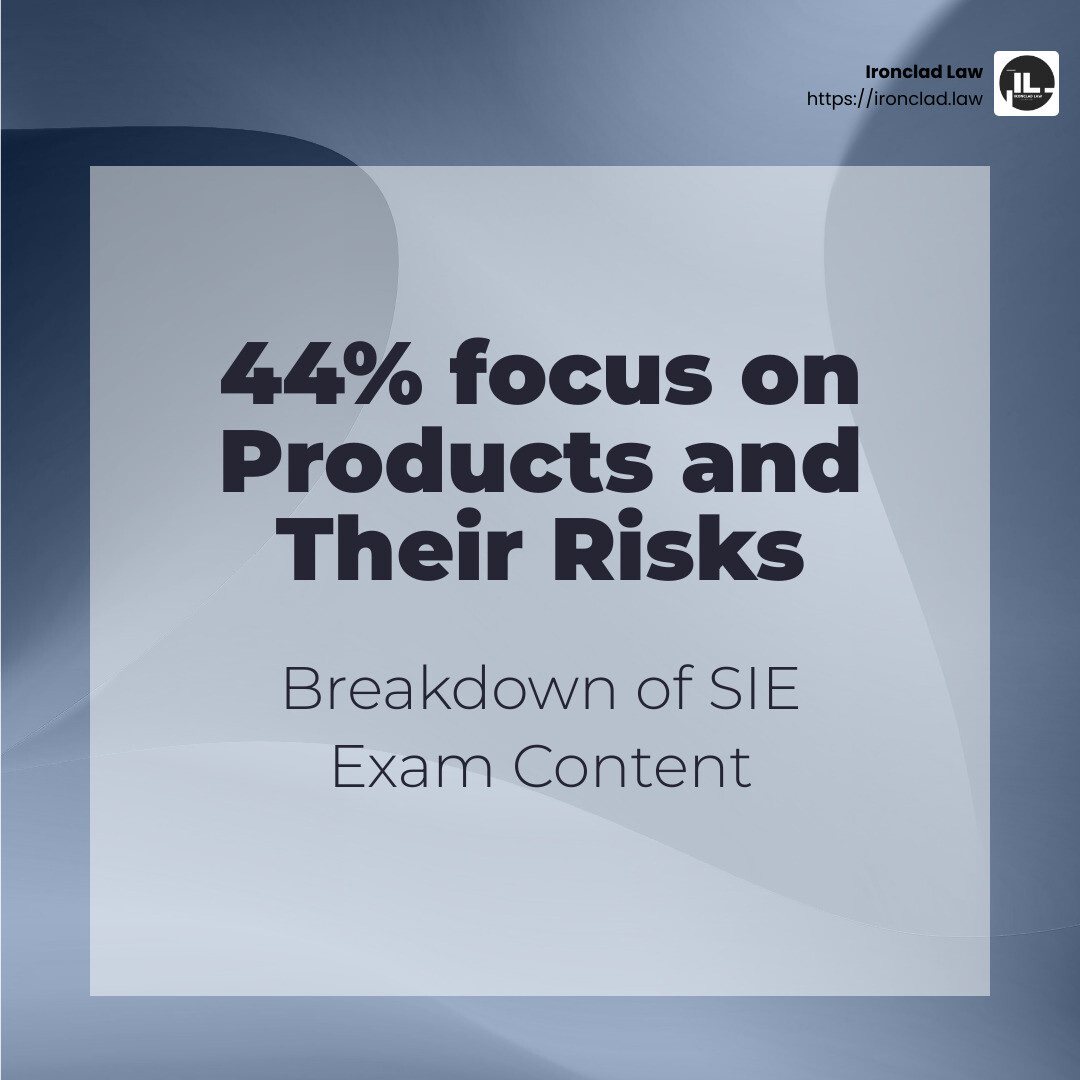
| Understanding Products and Their Risks | 44% | 33 questions |
| Understanding Trading, Customer Accounts, and Prohibited Activities | 31% | 23 questions |
| Overview of Regulatory Framework | 9% | 7 questions |
Let’s break down what each section actually covers:
Knowledge of Capital Markets (16%)
This section tests your understanding of how markets function. You’ll need to know about regulatory agencies (like the SEC and FINRA), different market participants, and basic economic concepts. Questions might cover equity markets, debt markets, and how foreign currencies work. You should also be familiar with major market indices and economic indicators that influence securities prices.
Understanding Products and Their Risks (44%)
Nearly half the exam focuses on financial products – this is the meat of what securities professionals need to know. You’ll be tested on stocks, bonds (corporate, municipal, and government), options, and more complex derivatives. The exam also covers packaged products like mutual funds and ETFs, plus alternative investments such as REITs and hedge funds. Beyond just knowing what these products are, you’ll need to understand the risks associated with each and how to mitigate those risks.
Understanding Trading, Customer Accounts, and Prohibited Activities (31%)
This substantial section covers the practical aspects of working with clients and executing transactions. You’ll need to know different order types, settlement procedures, and how corporate actions affect securities. The exam also tests your knowledge of account types, anti-money laundering rules, privacy requirements, and communication regulations. Importantly, it covers suitability requirements and prohibited activities like market manipulation and insider trading.
Overview of Regulatory Framework (9%)
The smallest but still crucial section covers the rules governing securities professionals themselves. This includes registration requirements, continuing education obligations, employee conduct standards, and various regulatory filing requirements.
In our experience at Ironclad Law, we’ve found that clients often underestimate the products and risks section. It represents 44% of the exam! This is where thorough preparation really pays off.
Scoring and Passing the SIE Exam
To pass the SIE exam, you need a score of 70 on a scale of 0-100. But here’s something many candidates don’t realize – this doesn’t necessarily mean you need to answer 70% of questions correctly. FINRA uses a statistical equating process to account for varying difficulty levels between different versions of the exam.
When you complete the exam, you’ll receive your results immediately – talk about instant gratification (or pain, depending on how you did). If you don’t pass, you’ll get a breakdown of your performance by section, which helps focus your studying for the next attempt.
Managing your time effectively during the exam is crucial. You have about 1.4 minutes per question, which goes by quickly. Many successful candidates use a strategy of answering the questions they’re confident about first, then flagging trickier ones to revisit later. With about 10 minutes left, make sure you’ve answered everything – remember, no penalty for guessing!
According to industry data, roughly 26-27% of people fail the SIE exam on their first try. Don’t let this discourage you – instead, let it motivate you to prepare thoroughly. At Ironclad Law, we’ve seen time and again that proper preparation makes all the difference between passing and failing this important career milestone.
Preparing for the SIE Exam
Let’s face it – nobody passes the SIE exam by accident. Success requires thoughtful preparation and a smart approach to studying. At Ironclad Law, we’ve guided countless financial professionals through this process, and we’ve seen what works.
Start with a reality check: take a practice exam before you begin studying. This diagnostic will reveal your starting point and highlight which areas need the most attention. Some candidates are surprised to find they already know more than they thought, while others identify significant knowledge gaps that need filling.
Your study timeline matters too. Most people need between 20-100 hours of preparation, depending on their background. If you’re completely new to finance, plan to be on the higher end of that range. Someone with industry experience or a finance degree might need less time, but don’t underestimate this exam – even experienced professionals need to prepare thoroughly.
Create a study schedule you can actually stick to. Consistency beats cramming every time. Breaking your preparation into manageable chunks over several weeks is far more effective than marathon study sessions right before the exam.
Effective Study Techniques for the SIE Exam
The SIE exam tests more than just your ability to memorize facts – it assesses your understanding of how the securities industry works. Here are some proven techniques our most successful clients have used:
Master the language of finance first and foremost. The securities industry has its own vocabulary, and you’ll need to speak it fluently. Create flashcards for key terms and review them regularly until they become second nature.
Focus on understanding, not just memorizing. When you truly grasp a concept, you can apply it to different question formats. The exam often presents familiar concepts in unfamiliar scenarios to test your comprehension.
Practice strategic guessing for questions you’re unsure about. Eliminate obviously wrong answers to improve your odds. There’s no penalty for wrong answers on the SIE exam, so never leave a question blank.
Study in focused bursts rather than exhausting marathons. Your brain retains information better in 30-45 minute sessions with short breaks between. Five focused sessions are worth more than one five-hour slog.
Teach concepts to someone else – even if that “someone” is just your cat or a stuffed animal. The act of explaining material helps solidify your understanding and reveals gaps in your knowledge.
Prioritize the heavily-weighted sections, especially “Understanding Products and Their Risks,” which accounts for a whopping 44% of the exam. That’s not to say you should ignore other sections, but allocate your time proportionally.

Take full practice exams under realistic conditions. Set a timer, put away your notes, and simulate the actual testing environment. This builds your mental endurance and helps you manage time effectively on exam day.
Learn from your mistakes by thoroughly reviewing incorrect answers on practice tests. Understanding why you got something wrong is often more valuable than confirming what you already know.
Stay loosely connected to financial news during your preparation. You don’t need to become a market expert, but basic awareness of industry trends provides helpful context for many exam concepts.
Resources for SIE Exam Preparation
You’re not alone on this journey – there’s a wealth of resources available to help you prepare for the SIE exam:
FINRA provides free official resources, including their detailed Content Outline and a sample practice test. While these won’t be sufficient on their own, they give you a direct window into how the test creators think.
Commercial study materials can be worth their weight in gold. Companies like Kaplan, Securities Institute of America, and Knopman Marks offer comprehensive packages including textbooks, video lectures, practice questions, and full-length exams. These typically range from $50 to $300, depending on how extensive the package is.
Online courses provide structure for those who benefit from a more classroom-like experience. Many include video lessons, interactive quizzes, and progress tracking to keep you on schedule.
Mobile apps let you study during small pockets of time throughout your day – perfect for reviewing flashcards during a commute or lunch break.
Free resources can supplement your primary study materials. Industry websites, YouTube videos, and online forums where candidates share experiences all provide valuable perspectives at no cost.
In our experience at Ironclad Law, the most successful candidates use a combination of resources rather than relying on just one. Different materials often explain concepts in different ways, and sometimes the explanation that finally makes a concept “click” for you isn’t the first one you encounter.
More info about Securities License Exam preparation
For additional study resources, check out FINRA’s official SIE exam page which provides valuable information directly from the organization that administers the exam.
The SIE Exam in the Securities Licensing Process
Think of the SIE exam as your entry ticket to the securities industry. Before 2018, breaking into this field meant taking comprehensive exams that covered everything from basic concepts to specialized knowledge—and you needed a company to sponsor you just to take the test.
That all changed with FINRA’s introduction of the SIE exam. Now, the path to becoming a registered securities professional has been split into two more manageable steps:
First, you take the SIE exam, which tests your general understanding of the industry. The beauty here? You can take it on your own without any firm sponsorship.
Then, once you’ve landed a position with a financial firm, you’ll take a “top-off” qualification exam that focuses specifically on the role you’ll be performing.
This new structure is a win for everyone. For aspiring professionals, you can demonstrate your commitment and basic knowledge before even landing an interview. For employers, they can focus on training you in role-specific skills rather than teaching industry basics from scratch.

The SIE exam works hand-in-hand with qualification exams—you need both to become registered in a specific capacity. While you can technically take them in any order, most people tackle the SIE first since it doesn’t require sponsorship.
Next Steps After Passing the SIE Exam
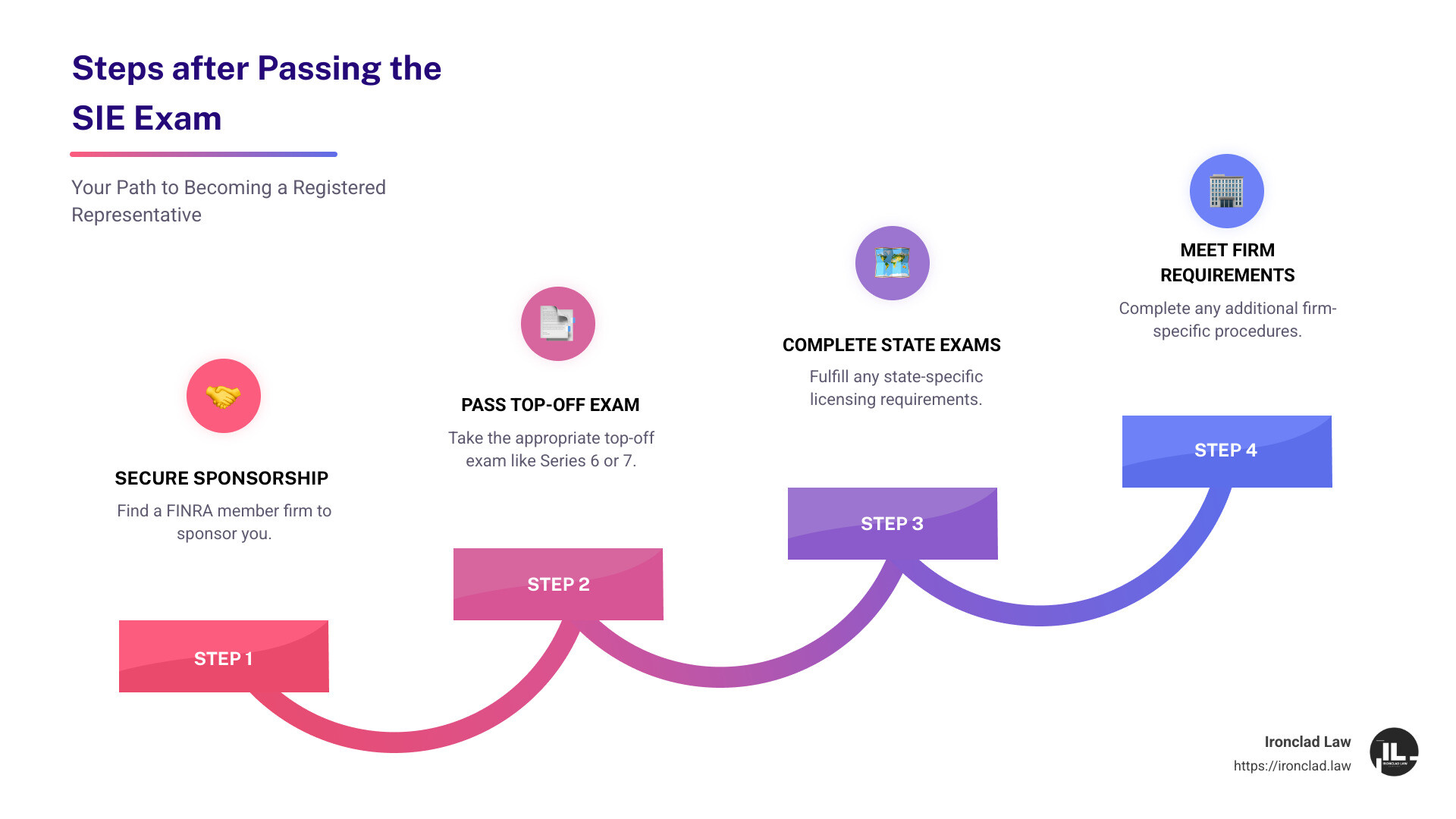
So you’ve passed the SIE exam—congratulations! What happens next? Here’s your roadmap:
Your first priority is finding employment with a FINRA member firm. This might be a brokerage firm, investment bank, financial advisory firm, or another regulated financial institution. With your SIE success already in hand, you’ve got a competitive edge in your job search.
Once you’ve secured a position, you and your employer will determine which top-off exam aligns with your specific role. There are several options depending on your career path:
The Series 7 is the most common and versatile, qualifying you as a General Securities Representative. Other options include the Series 6 for those selling mutual funds and variable annuities, the Series 79 for investment banking professionals, or the Series 57 for securities traders, among others.
With your employer’s sponsorship, you’ll study for and take this specialized exam. Unlike the broad-based SIE, these exams dig deep into the specific knowledge you’ll need for your particular role.
Some positions may require additional steps, such as state-specific exams (like the Series 63, 65, or 66), completing your firm’s training program, or undergoing background checks and fingerprinting.
Your SIE exam results have a shelf life of four years. If you don’t complete a top-off exam within that window, you’ll need to retake the SIE. At Ironclad Law, we’ve seen the most successful candidates actively pursue sponsorship opportunities soon after passing the SIE—employers often prefer candidates with fresh knowledge of the material.
The path from passing your SIE exam to becoming fully licensed might seem complex, but breaking it down into these manageable steps makes the journey clearer. And the reward—a career in the dynamic securities industry—is well worth the effort.
More info about FINRA Series 7
Benefits of Passing the SIE Exam
Let me tell you something about the SIE exam that might surprise you – it’s not just another test to check off your list. It’s actually a powerful career tool that can open doors you didn’t even know existed.
When you pass the SIE exam, you’re sending a clear message to potential employers: “I’m serious about this industry, and I’ve already taken steps to prove it.” In today’s competitive job market, that kind of initiative speaks volumes.
I’ve seen countless clients at Ironclad Law transform their job prospects after passing this exam. One recent college graduate told me she went from getting no callbacks to fielding multiple interview requests – all because she had those three little letters on her resume.
The exam demonstrates you understand the basics – securities products, regulatory frameworks, trading concepts – giving employers confidence that you’ve built a foundation of industry knowledge. This means they can spend less time training you on fundamentals and more time developing your role-specific skills.
For firms, hiring someone who’s already passed the SIE exam means reduced onboarding time and training costs. In an industry where time literally equals money, this efficiency is highly valued. You become a more attractive candidate simply because you’ve invested in yourself first.
Impact on Career Opportunities
The ripple effects of passing the SIE exam extend throughout your career journey in fascinating ways.
For fresh graduates, the exam provides that crucial differentiator when competing against peers with similar degrees and limited experience. When a hiring manager sees twenty resumes from business majors, the ones with the SIE exam naturally rise to the top of the pile.
Career changers benefit tremendously as well. I recently worked with a former teacher who wanted to transition into financial services. Her successful completion of the SIE exam showed potential employers she was committed to her new path and had taken concrete steps to make it happen. Within two months, she landed a position as a client service associate at a respected firm.

College students have an especially interesting opportunity here. Taking the SIE exam before graduation puts you in an enviable position – you can hit the ground running immediately after receiving your diploma. Many of our clients at Ironclad Law have secured job offers months before graduation specifically because they demonstrated this kind of foresight.
For professionals returning to the workforce after an absence, the SIE exam serves as tangible proof that your knowledge is current and relevant. This can be particularly valuable if you’re concerned about gaps in your resume.
Entry-level positions become much more accessible with the exam under your belt. Client service associates, sales assistants, operations specialists, junior analysts – these roles frequently serve as gateways to rewarding careers, and having passed the SIE exam makes you a stronger candidate for all of them.
As one hiring manager at a major brokerage told me, “When I see the SIE on a resume, I know that candidate has taken a concrete step toward a securities career, not just expressed interest.” That distinction matters enormously in a competitive job market.
While the SIE exam doesn’t guarantee employment – nothing really does in today’s economy – it undeniably creates opportunities that wouldn’t otherwise exist. It’s like having a key that open ups doors throughout the financial services industry. The question isn’t whether you can afford to take the exam – it’s whether you can afford not to.
Costs and Logistics of Taking the SIE Exam
Let’s talk about the practical side of taking the SIE exam – the nuts and bolts that will help you steer the process smoothly.
First things first: your wallet. The SIE exam costs $80, which you’ll pay when you register. This fee isn’t refundable, so it’s wise to make sure you’re truly ready before scheduling. Think of it as extra motivation to prepare thoroughly!
Registering for the exam is straightforward. You’ll create an account on FINRA’s Test Enrollment Services System (TESS), provide your personal information, pay the fee, and receive a CRD number (think of it as your financial industry ID). With that in hand, you can schedule your exam with Prometric, FINRA’s testing partner.
Once registered, you have 120 days to take the exam, so you’ve got some flexibility. You have two testing options: visiting a Prometric test center in person or taking the exam online through their ProProctor system.
The online option might sound convenient (testing in pajamas, anyone?), but it comes with specific requirements. You’ll need a quiet private room, reliable internet, webcam, microphone, and a computer that meets Prometric’s technical specifications. You’ll also need to complete a system check before exam day to avoid last-minute surprises.
On exam day, whether in-person or online, you’ll need a valid government-issued photo ID that exactly matches your registration name. For in-person testing, arrive 30 minutes early for check-in. You’ll store personal items in a locker (yes, that means your phone too!), and they’ll provide scratch paper and pencils. The test center computer will have a basic calculator function available.
If you’re testing online, log in 30 minutes early for security checks. A remote proctor will ask you to use your webcam to show your testing area, and they’ll monitor you throughout the exam. No notes or reference materials are allowed, and wandering away from your webcam view might get your exam terminated.
At Ironclad Law, we typically suggest testing at a physical center if possible. It eliminates potential tech headaches and provides an environment specifically designed for testing. That said, online testing works well for many candidates, especially those in remote areas.
Retake Policies and Exam Validity
Not everyone passes the SIE exam on their first try, and that’s perfectly okay. If you need to retake it, here’s what you should know:
After your first or second unsuccessful attempt, you’ll need to wait 30 days before trying again. If you don’t pass on your third try, the waiting period increases to 180 days (about six months). Each retake requires paying the full $80 fee again, so there’s definitely a financial incentive to prepare thoroughly!
The good news is there’s no limit to how many times you can take the SIE exam. The less good news is those escalating waiting periods can really slow down your career plans. This is why we emphasize thorough preparation before your first attempt.
When you do pass (and we’re confident you will!), your result stays valid for four years. This gives you plenty of time to find sponsorship from a FINRA member firm and complete your top-off exams. If your four years expire before you complete the licensing process, you’ll need to retake the SIE.
For those who were previously registered as representatives but whose registration has lapsed, different rules might apply. At Ironclad Law, we provide personalized guidance based on your specific registration history and circumstances.
The SIE exam is your first step toward a rewarding career in the securities industry. The logistics might seem a bit complicated at first glance, but taking it one step at a time makes the process manageable. And of course, thorough preparation is your best strategy for passing on the first try and avoiding those retake waiting periods altogether!
Frequently Asked Questions About the SIE Exam
How Hard is the SIE Exam?
If you’re wondering about the difficulty of the SIE exam, you’re not alone! The good news is that it’s designed to test foundational knowledge rather than advanced concepts. Think of it as challenging but definitely doable with proper preparation.
That said, don’t make the mistake of taking it too lightly. About 26-27% of first-time test-takers don’t pass, which tells us that preparation matters.
Your personal background makes a big difference in how difficult you’ll find the exam. If you’re completely new to finance, you’ll encounter industry jargon and concepts that might seem like a foreign language at first. You’ll need more study time to build that foundation from scratch.
For those with some financial education or work experience, many concepts will feel familiar. But don’t get overconfident! Even finance graduates need to study the specific regulatory details and product knowledge that the SIE exam covers.
In my experience advising candidates at Ironclad Law, I’ve found that people typically struggle most with:
- The sheer breadth of material (it covers a lot of ground!)
- Detailed knowledge about complex investment products
- Specific regulatory requirements that can be quite technical
- Applying concepts to real-world scenarios in the questions
Most people who don’t pass either underestimated how much study time they needed or focused too narrowly on certain topics while neglecting others. The key is comprehensive preparation across all exam topics, especially the heavily-weighted sections like “Understanding Products and Their Risks.”
With about 20-100 hours of focused study (depending on your background) and quality materials, you’ve got an excellent chance of passing on your first try!
How Much Does the SIE Exam Cost?
The official SIE exam fee is $80, which you’ll pay when registering through FINRA. This fee is the same whether you take it at a testing center or online through remote proctoring.
But let’s be realistic – the total investment goes beyond just the exam fee. Think of it as an investment in your career with several components:
Your study materials will likely be your biggest expense. Basic self-study guides start around $50-100, while comprehensive study packages range from $100-300. If you prefer premium packages with video courses and extensive practice questions, expect to pay $300-500. In-person or live online prep courses can run $400-1,000+.
If you don’t pass on your first attempt, you’ll need to pay the $80 exam fee again for each retake. This is why investing in good study materials upfront often makes financial sense.
Don’t forget about the value of your time! Most candidates spend between 20-100 hours studying (depending on their background). That’s a significant investment of your time and energy.
For those taking the exam at a physical location, factor in transportation costs as well.
One helpful tip for military veterans: The SIE exam fee may be eligible for reimbursement through your GI Bill benefits. It’s worth checking with the VA about your specific eligibility.
At Ironclad Law, we’ve seen that investing in quality preparation resources usually pays off compared to skimping on materials and risking a failed exam (plus the waiting period and additional fees).
Can I Retake the SIE Exam If I Fail?
Absolutely! If you don’t pass the SIE exam on your first try, you can definitely retake it. However, FINRA has established waiting periods that you’ll need to observe:
After your first unsuccessful attempt, you’ll need to wait 30 days before taking it again. The same 30-day waiting period applies after a second unsuccessful attempt. If you don’t pass after three tries, the waiting period extends to 180 days (about 6 months).
These waiting periods are mandatory – there are no exceptions or ways to shorten them. Each retake also requires registering again and paying the full $80 exam fee.
The good news is that there’s no limit to how many times you can take the exam. The extended waiting period after three attempts is FINRA’s way of ensuring you take adequate time to really prepare before trying again.
When you don’t pass, you’ll receive a performance report breaking down your scores by content area. This is actually incredibly valuable! It’s like a personalized study guide showing exactly where you need to focus your efforts.
In my work with candidates at Ironclad Law, I strongly recommend a complete review of your study approach before any retake. Simply reviewing the same materials in the same way rarely leads to a different outcome.
For a successful retake, consider:
– Using your performance report to target weak areas
– Trying different study materials that might explain concepts in ways that click better for you
– Taking more practice exams to build test-taking confidence
– Finding a study buddy or tutor to work through difficult concepts
– Giving yourself more study time than you did before
The SIE exam is designed to be passable with adequate preparation. Most people who don’t succeed on their first attempt can pass on a subsequent try with more focused study. Don’t get discouraged – regroup, refocus, and try again!
Conclusion
The SIE exam marks an important milestone on your path to a securities industry career. Throughout this guide, we’ve explored how this foundational test evaluates your understanding of securities concepts, products, and regulations – the building blocks of industry knowledge.
Looking back at what we’ve covered, the SIE exam truly stands out as a unique opportunity. Unlike previous industry exams, it’s available to anyone 18 or older without needing firm sponsorship. The format is straightforward – 75 scored multiple-choice questions (plus those 10 sneaky unscored pretest questions) with a comfortable 1 hour and 45 minutes to complete everything.
You’ll need that passing score of 70%, and the $80 exam fee is a modest investment in your future. Once you pass, your results stay valid for four years, giving you plenty of time to land that industry position. But keep in mind – passing the SIE exam is just your first step. You’ll still need to pass a role-specific top-off exam and secure firm sponsorship to become fully registered.
The introduction of the SIE exam has been something of a game-changer for the industry. It’s opened doors for countless candidates who can now demonstrate their knowledge and commitment before landing their first position. This benefits both ambitious professionals like yourself and the firms doing the hiring – they can identify candidates who’ve already shown dedication to the field.
Thorough preparation remains the key to success. Invest time in quality study materials and develop a consistent study routine. Focus on understanding concepts rather than just memorizing facts – the exam tests how well you can apply knowledge, not just recite it. When you truly grasp the material, you’ll be able to tackle even the trickiest scenario-based questions with confidence.
At Ironclad Law, we specialize in guiding financial professionals through regulatory requirements, including securities licensing. Our aggressive litigation approach and comprehensive legal services extend to corporate counsel, where we advise both firms and individuals on compliance matters related to FINRA regulations.
Whether you’re fresh out of college, changing careers, or looking to advance in the securities industry, the SIE exam serves as your gateway to new opportunities. Approach it with diligence and determination, and it can become the foundation of a rewarding career in finance.
More info about Securities Licensing
We wish you the best of luck on your SIE exam and in your securities industry career beyond. If you find yourself needing specialized legal guidance on securities regulations or licensing requirements, Ironclad Law stands ready to provide the aggressive and comprehensive representation you deserve.