
You have 0 items in your cart

Why Construction Defects Require Immediate Legal Attention
A construction defect lawsuit allows property owners to recover damages when defective materials, code violations, poor workmanship, or design flaws reduce a structure’s value or safety. In many states, these cases follow strict timelines and mandatory pre-litigation procedures, making early legal action critical.
Quick Answer: What You Need to Know About Construction Defect Lawsuits
- What qualifies: Defects in design, materials, workmanship, or code violations that reduce property value or safety.
- Time limits: Strict deadlines (statutes of limitations and repose) apply and vary by state.
- Required first step: Many states require a formal written notice to the builder before you can file a lawsuit.
- Who’s liable: Contractors, subcontractors, architects, engineers, material suppliers, or developers.
- Recoverable damages: Repair costs, diminished property value, and loss of use.
- Critical rule: Some states require you to prove damages as of the date of breach, not current costs—a technicality that can lose your case.
When you find water seeping through your new roof or cracks spreading across your foundation, the clock starts ticking. State laws don’t give you unlimited time to act, and a procedural misstep can jeopardize your entire claim.
Construction defects fall into two categories: patent defects (obvious issues) and latent defects (hidden problems that appear later). Both require swift action, but latent defects create complications around when the legal deadlines begin to run.
Recent appellate cases across the country provide stark warnings: homeowners have lost valid claims on appeal because their experts calculated repair costs based on the wrong date. This type of technical requirement demonstrates why specialized legal counsel is vital from day one.
Many states have enacted laws requiring a pre-litigation process designed to resolve disputes before they reach court. For example, states like California, New York, and Delaware have specific statutes requiring property owners to serve written notice, allow inspections, and wait through specific timeframes before filing suit. While intended to reduce costs, these procedures are procedural landmines that can destroy your case if not followed precisely.
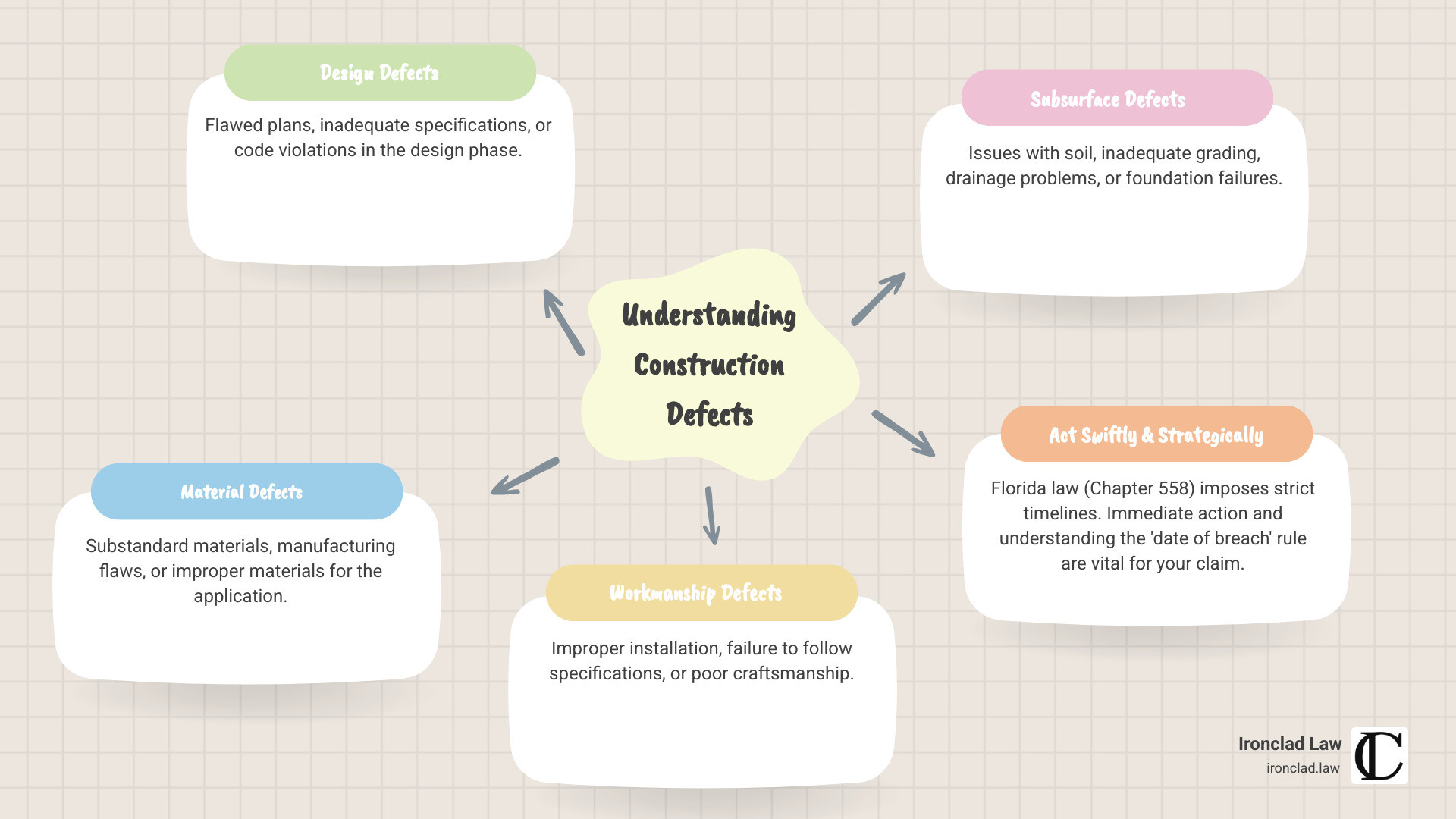
Navigating Legal Timelines and Pre-Litigation Problems
Imagine investing your life savings into a new home, only to find it’s riddled with problems. While frustrating, you have recourse. States have specific laws that provide a structured path for resolving construction defect claims. This legal framework, however, presents a gauntlet of strict timelines and procedural requirements that can trip up even diligent property owners.
At Ironclad Law, we guide you through this unique legal landscape, ensuring your rights are fiercely protected. Our goal is the most effective resolution, whether through negotiation or an aggressive fight in court. We believe in clear, actionable advice for anyone dealing with a construction dispute. More info about our dispute resolution services.
Understanding Statutes of Limitations and Repose
In construction defect cases, time is critical. State laws impose two key deadlines: the Statute of Limitations and the Statute of Repose. Missing them can permanently bar your claim.
The Statute of Limitations sets a deadline based on when you finded the defect, or should have finded it with reasonable diligence. This “date of findy” is crucial for latent defects that aren’t immediately obvious. For example, in New York, the statute of limitations is generally six years for breach of contract claims, while California provides four years for most construction defect claims.
The Statute of Repose is an absolute final deadline. It runs from a specific event, like the project’s completion date, regardless of when you find the defect. These deadlines vary widely by state; for instance, New York’s statute of repose is ten years, while California’s is ten years for latent defects and four years for patent defects. This means you must act fast. If you suspect a defect, don’t delay.
The Mandatory Pre-Litigation Process
Before filing a construction defect lawsuit, many states require you to follow a mandatory pre-litigation process. These laws are designed to encourage resolution without formal litigation.
Here’s a typical process:
-
Notice of Claim: You must serve a written “Notice of Claim” to the responsible parties (contractor, designer, etc.). This notice must describe the alleged defects in reasonable detail. The waiting period before you can sue varies; in California, it’s 90 days under the Right to Repair Act, while New York requires reasonable notice under common law principles.
-
Opportunity to Inspect: The notified party has a right to inspect the property to assess the claims.
-
Written Response: After inspection, the party must provide a written response. This may include an offer to repair the defect, a monetary settlement offer, a combination of both, or a denial of the claim.
-
Tolling the Statute of Limitations: A key feature of this process is that it typically tolls (pauses) the statute of limitations, preventing your claim from expiring while you follow these required steps.
If the other party fails to respond, denies the claim, or makes an unacceptable offer, you can then proceed with filing a lawsuit or arbitration. This process is highly technical, and any misstep can be costly. We strongly advise consulting with us to ensure all procedural requirements are met, leveraging our knowledge of state-specific statutes to build a strong foundation for your case.
Building Your Case for a Construction Defect Lawsuit
Successfully pursuing a construction defect lawsuit requires more than just identifying a problem; it demands building an ironclad case against the right parties on solid legal grounds. We approach every case with the precision of an architect and the tenacity of a bulldog.
A construction project involves many players, and when things go wrong, the blame game begins. Our first step is to identify every party that may have contributed to the defect and scrutinize their contractual and professional duties. Understanding your contracts is paramount, which is why we offer comprehensive contract review services to mitigate risks before they arise.
Who Can Be Held Liable for Construction Defects?
The responsibility for a defect can be a tangled web. Identifying the correct liable parties is crucial for a successful construction defect lawsuit. Potential defendants include:
- General Contractors: As project orchestrators, they are often responsible for the entire project, including their subcontractors’ work.
- Subcontractors: Specialists (e.g., roofers, plumbers) are directly liable for their defective work.
- Architects & Engineers: These design professionals are accountable for defects stemming from design flaws, calculation errors, or inadequate specifications.
- Material Suppliers: If faulty or substandard materials are the cause, the supplier or manufacturer can be held liable.
- Developers: In new construction, the developer may be responsible for overall project quality and code compliance.
Contractual indemnification clauses are also critical, as they can shift the financial burden for a defect from a general contractor to a subcontractor. In many cases, joint liability exists where multiple parties share responsibility. Our job is to untangle this web and hold every responsible party accountable.
Common Legal Grounds for a Construction Defect Lawsuit
Once we identify liable parties, we select the strongest legal theories to build your case. These form the foundation of our argument.
-
Breach of Contract: A straightforward claim that a party failed to fulfill their contractual obligations, such as using specified materials or meeting a certain standard of work.
-
Negligence: This applies when a party fails to exercise the reasonable care expected of a professional in their field, leading to damage. This requires proving a duty of care, a breach of that duty, causation, and damages.
-
Breach of Express Warranty: This involves the violation of a specific, written promise or guarantee about the quality of materials or workmanship, such as a 10-year warranty on a roof.
-
Breach of Implied Warranty: The law often implies certain warranties even if they aren’t written. The most common is the implied warranty of habitability in residential construction, which guarantees a home is safe and fit for living.
-
Violation of State and Local Building Codes: Building codes set minimum safety standards. A defect resulting from a code violation provides strong evidence of negligence or a breach of statutory duty.
-
Strict Liability: Though less common, this may apply if a defective product was incorporated into the construction, causing damage. In such cases, you may not need to prove negligence, only that the product was defective.
Our approach is to investigate every angle, gather all necessary evidence, and select the legal grounds that provide the strongest path to victory for our clients.
Proving Your Claim and Maximizing Damage Recovery
Winning a construction defect lawsuit requires proving why a defect exists, who is responsible, and how much it will cost to fix. This stage involves meticulous evidence gathering, specialized expertise, and a precise understanding of how damages are calculated. It’s where our aggressive litigation strategies truly shine.
Construction defect litigation can be expensive, which is why having us in your corner to manage the intricate details of evidence and financial recovery is so important. We also steer the complex insurance claims that often accompany these disputes.
The Crucial Role of Expert Witnesses in a Construction Defect Lawsuit
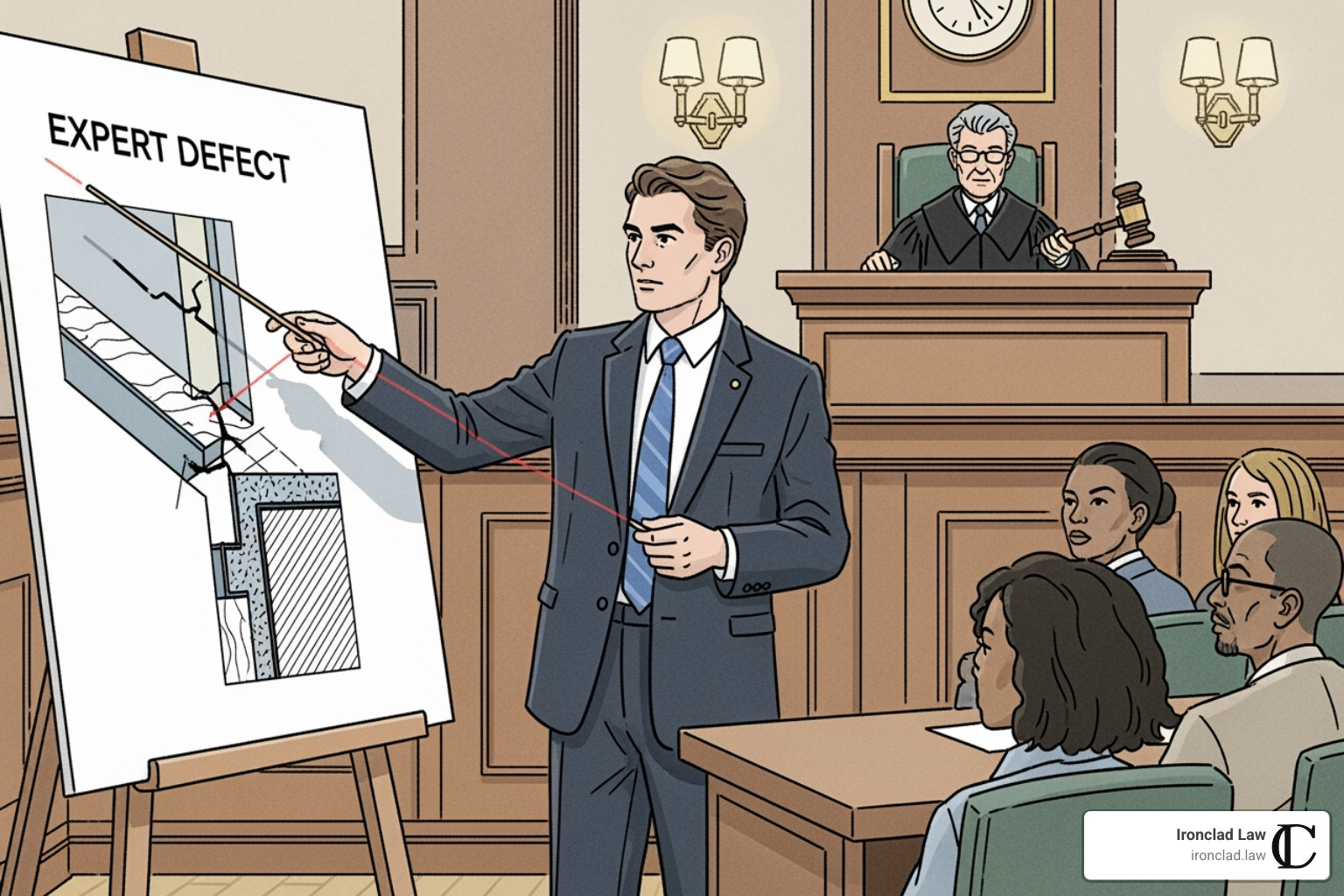
In nearly every construction defect lawsuit, expert witnesses are essential. These professionals—engineers, architects, and construction managers—translate complex technical issues into understandable terms for a judge or jury.
Their role is multi-faceted:
- Identifying Defect Cause: They conduct inspections and analyze plans to pinpoint the exact cause of the defect.
- Estimating Repair Costs: They provide detailed, itemized estimates for repairs, which forms a primary component of your damages.
- Providing Testimony: In court, their credible testimony explaining complex technical information is often the linchpin of a successful case.
- Documenting Evidence: They create a compelling factual record through reports, photos, and other documentation.
We work with a network of highly qualified experts who are not only knowledgeable but also skilled communicators capable of withstanding rigorous cross-examination.
Calculating Damages: The “Date of Breach” Rule
When recovering damages, it’s not just about what you can claim, but when those damages are measured. A critical and often counterintuitive rule in some states is the “date of breach” rule.
First, typical recoverable damages include:
- Cost of Repair: The expense to fix the defects.
- Diminished Property Value: The loss in value if defects cannot be fully repaired.
- Loss of Use: Compensation for being unable to use your property (e.g., lost rent, temporary housing).
- Consequential Damages: Other foreseeable losses resulting from the defect.
The “date of breach” rule dictates that damages must be calculated based on costs at the time the contract was breached, not at the time of trial. Recent cases in states like New York and California have reinforced this principle. Homeowners have won at trial but lost on appeal because their experts used current repair costs instead of costs from when the breach occurred years earlier. This technicality can be fatal to a claim. This means experts must not only estimate repair costs but also present those costs as they would have been at the time of the breach, adding a layer of complexity to the case.
The Role of Insurance: Insurance coverage is often contentious. Builder’s Commercial General Liability (CGL) policies may cover resulting damage but often exclude “faulty workmanship” itself. Most homeowner’s policies also exclude construction defects, though they might cover resulting damage from a covered event (like a fire caused by faulty wiring). We are prepared to fight insurers who wrongly deny legitimate claims.
Frequently Asked Questions About Construction Defect Claims
Dealing with construction defects can be overwhelming. Here, we address some of the most common questions property owners have.
What are the first steps I should take if I suspect a construction defect?
Panic won’t help, but strategic action will. Take these immediate steps:
- Document Everything: Take clear, dated photos and videos of the defects. Keep a detailed log of when you noticed the problem and save all contracts, invoices, and communications.
- Mitigate Further Damage: Take reasonable steps to prevent the defect from causing more damage, such as placing a tarp over a leak. Document these efforts.
- Review Your Contracts and Warranties: Read your construction contract and any warranty documents to understand the notification procedures and dispute resolution requirements.
- Contact an Experienced Attorney Before Notifying the Builder: This is critical. Many states have laws that require you to notify the builder, but doing so without legal guidance can harm your case. An attorney can help draft a legally compliant Notice of Claim and protect your rights during inspections.
Your initial actions are foundational to any potential construction defect lawsuit. Let us help you lay that foundation correctly.
Can my homeowner’s insurance policy cover construction defects?
Usually, the answer is “no” for the defect itself, but sometimes “yes” for the resulting damage.
Most standard homeowner’s insurance policies exclude coverage for faulty workmanship or defective materials. They are designed to cover sudden, accidental losses (like fire or windstorms), not problems from poor construction.
However, your policy might cover damage that results from a construction defect. For example, it might cover mold remediation caused by a leaky roof, but not the cost to replace the roof itself. Similarly, a builder’s CGL policy is often the target, but insurers frequently dispute coverage. Anticipate resistance from insurance companies and seek legal guidance to interpret complex policies and fight wrongful denials.
Do I have to accept the builder’s offer to repair the defect?
No, you are not legally obligated to accept a builder’s offer to repair made during the pre-litigation process. While many state laws provide an “opportunity to repair,” you are not forced to accept an inadequate offer.
When evaluating an offer, consider:
- Reasonableness: Does the repair plan fully address all defects to code and contractual standards?
- Competence: Who will perform the repairs?
- Signing a Release: Builders will almost always ask you to sign a release of claims. Be extremely cautious. Does it waive your rights for all defects, even those not yet finded?
Accepting a poor offer or signing a broad release can severely limit your future legal options. This is why legal counsel is invaluable during this negotiation phase. We can evaluate the offer, negotiate better terms, and ensure any release you sign is narrowly custom to protect your rights.
Conclusion: Protecting Your Investment with Decisive Legal Action
Navigating a construction defect lawsuit is rarely simple. From deciphering complex statutes of limitations to adhering to mandatory pre-litigation procedures and navigating critical legal technicalities like the “date of breach” rule, the path to justice is fraught with potential pitfalls.
Your property is often your most significant investment, and construction defects can threaten its value, safety, and your peace of mind. When builders, contractors, or design professionals fall short of their duties, you deserve fierce advocacy. We at Ironclad Law pride ourselves on being aggressive litigators who love to go to trial, fighting relentlessly for our clients’ rights. We’ll carefully gather evidence, leverage expert testimony, and build an unyielding case to hold every responsible party accountable.
Don’t let procedural complexities or a builder’s reluctance to acknowledge fault deter you. If you suspect a construction defect, the time to act is now. Let us help you protect your investment with decisive legal action. Schedule a consultation with our General Counsel today and let’s discuss how we can build your ironclad case.