
You have 0 items in your cart

Why Intellectual Property Matters in Today’s Competitive Marketplace
An intellectual property lawsuit is a legal action taken when someone uses protected creations—such as inventions, brand names, original works, or trade secrets—without permission. These disputes can involve patents, trademarks, copyrights, or confidential business information, and they typically result in monetary damages, court orders to stop the unauthorized use, or negotiated settlements.
Key facts about intellectual property lawsuits:
- Federal courts handle most IP cases, though some trademark and trade secret claims may be heard in state courts or before agencies like the U.S. Patent and Trademark Office
- Common remedies include injunctions to halt infringement, monetary damages (actual or statutory), and in some cases recovery of attorney’s fees
- Willful infringement can lead to improved damages, significantly increasing the financial stakes
- Litigation stages typically include demand letters, filing a complaint, findy, motions, trial, and potential appeals
- Settlement is common, with most IP disputes resolving before reaching a jury verdict
Oscar Wilde said, “Imitation is the sincerest form of flattery.” But in business and innovation, imitation isn’t flattering—it’s theft. Whether it’s a competitor copying your product design, a former employee sharing your trade secrets, or someone using your brand name to confuse customers, intellectual property infringement can devastate years of hard work and investment.
The stakes are enormous. Companies like Oracle have sought damages exceeding $8 billion in IP lawsuits. Small businesses face equally serious threats when their innovations or brands are copied. And the legal landscape is complex, spanning multiple types of IP protection, overlapping federal and state laws, and evolving standards for what qualifies as infringement.
Understanding how IP lawsuits work—and learning from high-profile disputes—can help you protect your assets before problems arise and respond decisively when they do.
What is Intellectual Property and Infringement?
Intellectual property (IP) refers to creations of the mind, such as inventions, literary and artistic works, designs, symbols, names, and images used in commerce. It’s essentially an intangible asset produced by creative or scientific works. Just like physical property, IP can be owned, bought, sold, or licensed. The purpose of granting exclusive rights to creators for a certain period is to foster innovation and creativity, ensuring they can reap the benefits of their hard work.
IP infringement, then, is the unauthorized use of these protected creations. It occurs when someone uses your intellectual property without permission, violating your exclusive rights as the owner. This can lead to significant financial losses for the IP holder, damage their reputation, and create confusion in the marketplace.
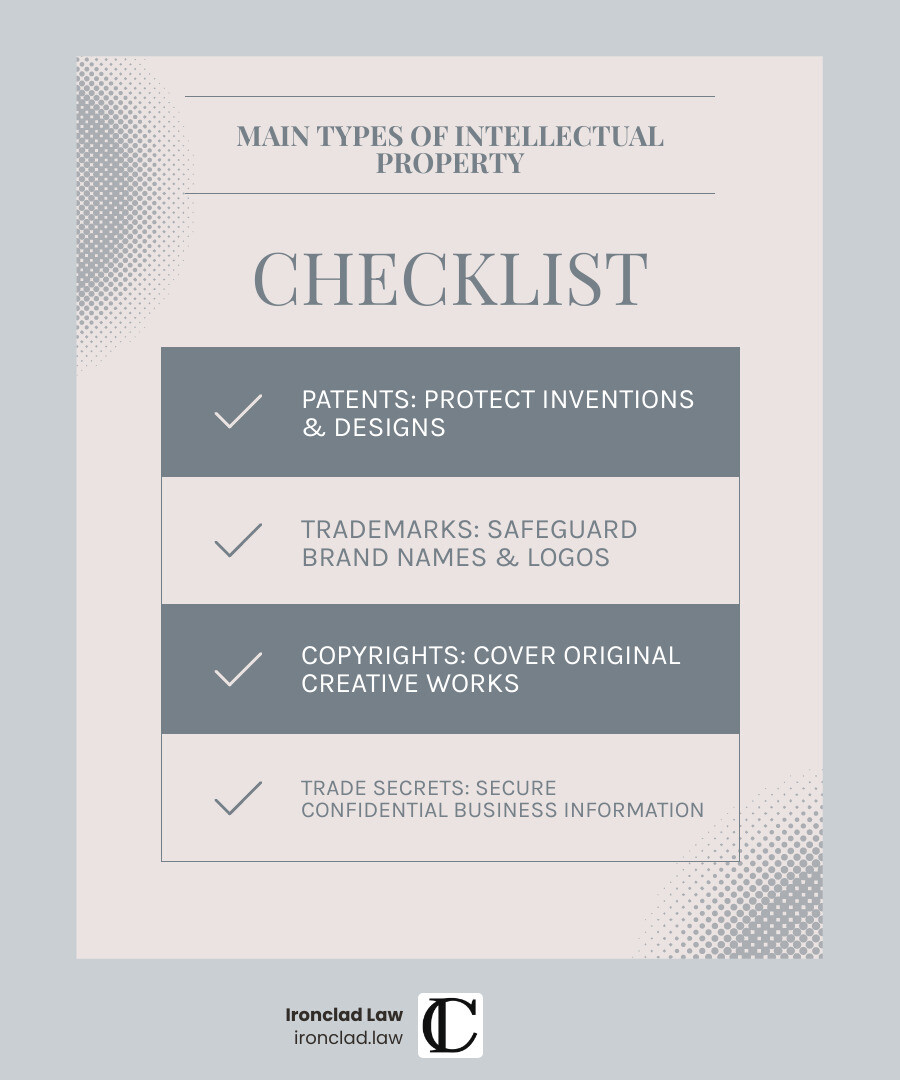
Here are the main types of intellectual property we work with:
- Patents: Protect inventions.
- Trademarks: Protect brand names, logos, and slogans.
- Copyrights: Protect original works of authorship.
- Trade Secrets: Protect confidential business information.
Understanding Patents
Patents are granted for inventions, which can include processes, machines, articles of manufacture, and compositions of matter. They provide the inventor with exclusive rights to make, use, and sell their invention for a specified period, typically 20 years from the filing date. This means no one else can legally make, use, or sell the patented invention without the patent holder’s permission.
In the United States, patents are primarily managed by the U.S. Patent and Trademark Office (USPTO). There are two main types of patents relevant to our clients:
- Utility Patents: These are the most common type and protect the way an invention works, how it’s made, or how it’s used. Think of a new drug formula, a unique software algorithm, or an innovative manufacturing process.
- Design Patents: These protect the ornamental appearance of an item. For example, the distinctive shape of a smartphone or a unique shoe design could be protected by a design patent. These can be incredibly powerful, as we’ll see in some famous cases.
Understanding Trademarks
Trademarks are signs, designs, or expressions that identify products or services of a particular source from those of others. They protect brand names, logos, slogans, and even unique packaging (known as trade dress). The primary goal of trademark law is to prevent consumer confusion about the source of goods or services.
When you see the iconic Nike swoosh, the Golden Arches of McDonald’s, or hear the “Just Do It” slogan, you instantly associate them with a specific company. That’s trademark law in action. In the United States, trademarks can be registered with the USPTO, which provides stronger legal protection and notice to the public. Using a ™ symbol indicates an unregistered trademark claim, while an ® symbol signifies a federally registered trademark.
Understanding Copyrights and Trade Secrets
Copyrights protect original works of authorship, granting the creator exclusive rights to reproduce, distribute, perform, display, or license their work. This protection arises automatically the moment the work is created, but registering it with the U.S. Copyright Office offers significant advantages in an intellectual property lawsuit, such as the ability to sue for infringement in federal court and potentially recover statutory damages and attorney’s fees.
Copyrights cover a vast array of creations, including:
- Literary works (books, articles, software code)
- Artistic works (paintings, sculptures, photographs)
- Musical compositions
- Dramatic works (plays, screenplays)
- Architectural designs
Trade Secrets, on the other hand, protect confidential business information that provides a competitive edge. Unlike patents, trademarks, or copyrights, trade secrets are not registered with any government office. Their protection relies entirely on the owner’s efforts to keep the information secret.
Examples of trade secrets include:
- Formulas (like the Coca-Cola recipe)
- Manufacturing processes
- Customer lists
- Marketing strategies
- Proprietary software algorithms not publicly known
The misappropriation of a trade secret can occur through theft, bribery, misrepresentation, or a breach of a confidentiality agreement. For example, if a former employee takes a company’s pricing sheets or marketing tactics to a competitor, that could constitute trade secret misappropriation.
The Anatomy of an Intellectual Property Lawsuit
When your intellectual property rights are violated, an intellectual property lawsuit is often the path to seeking justice and protecting your assets. Most IP law, including patents, copyrights, and many trademark issues, falls under federal jurisdiction, meaning these cases are typically heard in federal courts across the United States, including New York, Delaware, and California. While federal courts handle the bulk of these cases, some trade secret and certain trademark claims can also be litigated in state courts. For international infringement disputes, the International Trade Commission (ITC) plays a crucial role.
The key elements of IP litigation revolve around proving infringement, establishing damages, and seeking appropriate remedies. The consequences of infringement can be severe, ranging from significant monetary damages for the infringer to court orders that prevent further unauthorized use.
If you find yourself facing an IP dispute, whether as a plaintiff or a defendant, understanding the process and potential outcomes is crucial. For more information on how we steer these complex situations, explore our dispute resolution services.
Typical Stages of an Intellectual Property Lawsuit
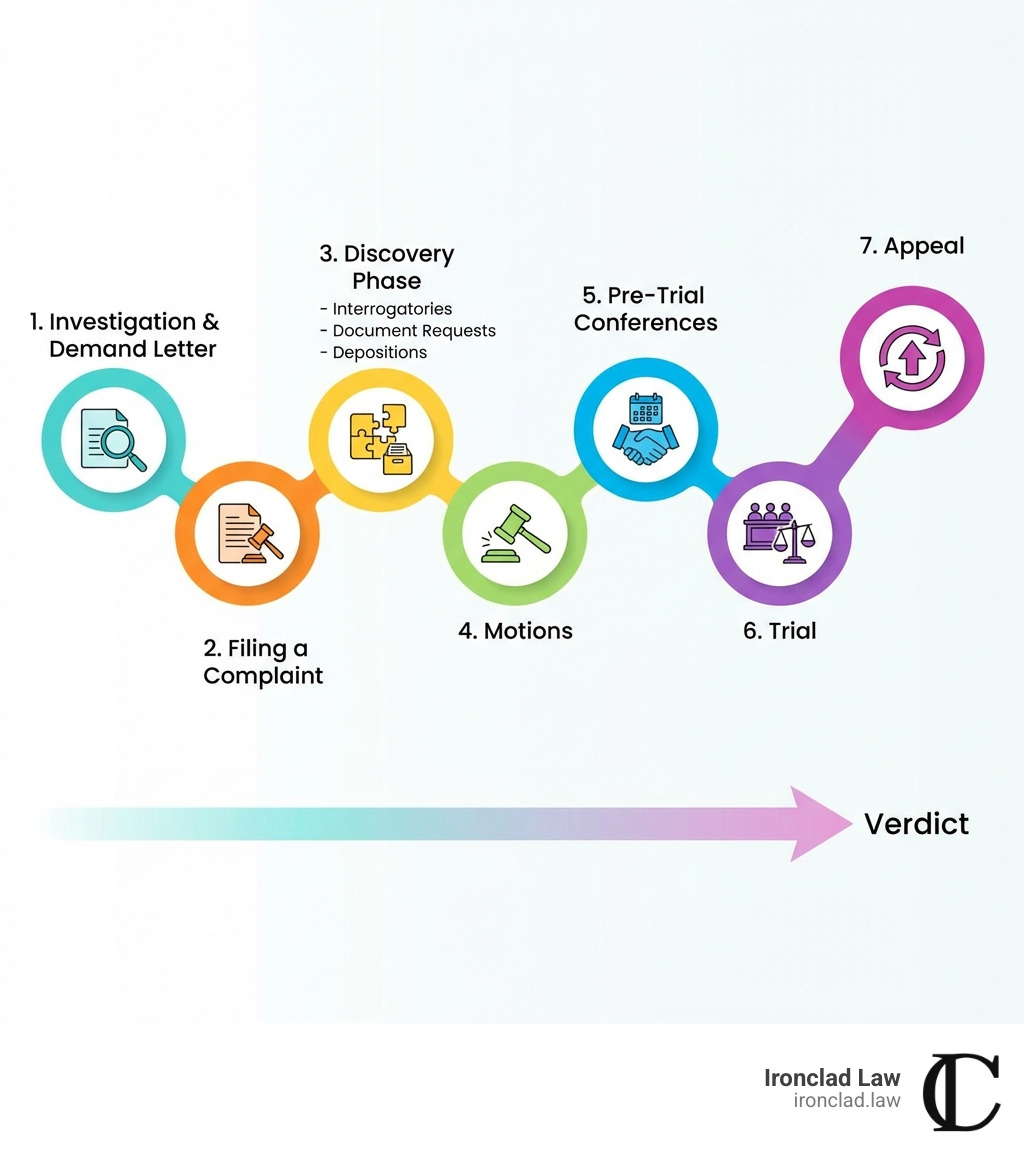
An intellectual property lawsuit is a structured legal process that typically follows several stages, from initial findy of infringement to a final judgment.
- Investigation and Demand Letter: Often, the first step is for the IP owner (or their legal counsel) to investigate the suspected infringement. If evidence supports a claim, a cease-and-desist letter is usually sent to the alleged infringer. This letter demands that they stop the infringing activity and may offer a settlement.
- Filing a Complaint: If the demand letter doesn’t resolve the issue, the IP owner files a formal complaint in federal court (or relevant state court), initiating the lawsuit. This complaint outlines the nature of the IP, the alleged infringement, and the relief sought. The defendant then has a period to file an answer.
- Findy Phase: This is often the longest and most resource-intensive stage. Both parties exchange information and evidence relevant to the case. This includes:
- Interrogatories: Written questions that must be answered under oath.
- Requests for Production of Documents: Demands for relevant documents, emails, and other electronic data.
- Depositions: Out-of-court sworn testimony taken from witnesses and key personnel.
- Motions: Throughout findy, parties may file various motions with the court. These can include motions to compel (if a party is withholding information), motions to dismiss (arguing the complaint lacks legal merit), or motions for summary judgment (arguing that there’s no genuine dispute of material fact and the moving party is entitled to judgment as a matter of law).
- Pre-Trial Conferences: The court often holds conferences to manage the case, set deadlines, and explore settlement possibilities. Many IP cases settle before trial through mediation or arbitration.
- Trial: If a settlement isn’t reached, the case proceeds to trial. This can involve a jury or a judge (bench trial). Both sides present their evidence, witness testimony (including expert witnesses on technical matters or damages), and legal arguments.
- Appeal: After a verdict, the losing party may have grounds to appeal the decision to a higher court. In patent cases, appeals often go to the U.S. Court of Appeals for the Federal Circuit.
Understanding these stages is vital for anyone involved in an IP dispute.
Potential Outcomes and Legal Remedies
The outcome of an intellectual property lawsuit can vary significantly, from a complete dismissal of the case to a trial verdict followed by appeals. However, a large percentage of civil IP cases, like many other types of litigation, are resolved through settlement before reaching a jury.
When a court rules in favor of the IP owner, several legal remedies are available to compensate for the infringement and prevent future harm:
- Injunctions: These are court orders requiring the infringer to stop the infringing activity immediately. A preliminary injunction can be issued early in the lawsuit to prevent ongoing harm, while a permanent injunction is typically issued after a final judgment of infringement.
- Seizure of Infringing Goods: In some cases, particularly with counterfeit products, a court may order the seizure and destruction of infringing goods.
- Monetary Damages: This is often the primary goal for plaintiffs. Damages can include:
- Actual Damages: Compensation for the IP owner’s quantifiable losses, such as lost profits due to the infringement.
- Infringer’s Profits: The profits the infringer made directly from the unauthorized use of the IP.
- Statutory Damages: For copyright infringement, the law allows for predetermined statutory damages, which can be particularly useful when actual damages are difficult to prove.
- Willful Infringement Penalties: If the infringement is found to be willful (meaning the infringer knew or should have known they were infringing), courts can award improved damages, sometimes up to three times the actual damages.
- Attorney’s Fees: In exceptional cases, and particularly for registered copyrights and certain patent cases, the prevailing party may be awarded their attorney’s fees.
- Settlement Agreements: Many cases conclude with a negotiated settlement, where the parties agree on terms to resolve the dispute, which might include licensing agreements, monetary payments, or an agreement to cease certain activities. This allows parties to avoid the uncertainty, cost, and time of a full trial.
Cautionary Tales: 4 Landmark IP Disputes & Lessons Learned
History is rife with high-stakes legal battles over intellectual property. These cases, often involving household names and billions of dollars, offer invaluable lessons for businesses and creators. They demonstrate the complexities of IP law, the importance of proactive protection, and the severe consequences of infringement.

The Music Industry vs. Napster: The Copyright Crackdown
The Dispute: In the late 1990s, Shawn Fanning, a teenage tech genius, created Napster, a peer-to-peer file-sharing service that allowed users to easily share MP3 music files. Needless to say, Napster piqued the interest of the music industry. Lars Ulrich, the drummer for Metallica, famously sued Napster in 2000, alleging copyright infringement, unlawful use of a digital audio interface device, and racketeering. The Recording Industry Association of America (RIAA) also launched a massive legal campaign against Napster, arguing that it facilitated widespread copyright infringement.
The Outcome: After years of litigation, courts sided with the music industry, finding Napster liable for contributory and vicarious copyright infringement. Napster was eventually forced to shut down its free service and later attempted to relaunch as a paid subscription service. It paid up to 26 million in damages to settle the lawsuits.
The Lesson: This case was a landmark moment for digital copyright. It taught the world that technology facilitating infringement is not immune from legal action. For businesses, the lesson is clear: ignoring copyright at scale is a fatal business model. Ensure your platforms and services respect intellectual property rights, as the consequences of failing to do so can be existential.
Bratz vs. Barbie: The Battle of the Dolls
The Dispute: This multi-year legal saga pitted toy giants MGA Entertainment (maker of Bratz dolls) against Mattel (maker of Barbie). The core of the dispute revolved around the creation of the Bratz dolls. Mattel alleged that the Bratz concept was developed by Carter Bryant, a designer working for Mattel at the time, and therefore the IP belonged to Mattel under his employment agreement. MGA countered with claims of trade secret misappropriation and copyright infringement by Mattel.
The Outcome: The litigation was notoriously protracted and complex. Initially, a jury awarded Mattel over $100 million in damages, finding that Bryant had indeed developed the Bratz concept while employed by Mattel. However, this ruling was later overturned on appeal. After years of further legal battles, MGA eventually retained its rights to the Bratz brand, and in some phases, even won significant counter-awards against Mattel. Our research notes the case became one of the most expensive in history after years of litigation.
The Lesson: This case underscores the critical importance of clearly defined intellectual property ownership in employment contracts. Businesses must ensure that agreements with employees and contractors explicitly state who owns the IP created during employment. Without such clarity, even blockbuster ideas can lead to devastating and costly legal battles.
Apple vs. Samsung: The Smartphone Patent Wars
The Dispute: Beginning in 2011, the tech world watched as Apple and Samsung engaged in a fierce global legal battle, often referred to as the “smartphone patent wars.” Apple alleged that Samsung had copied the design and functionality of its iPhone, accusing the company of infringing on its design patents (like the rectangular shape with rounded corners and the grid of colorful icons) and utility patents related to features like “bounce-back” scrolling and multi-touch gestures. Samsung countersued, alleging infringement of its own patents. Our research indicates that the legal battle between Apple and Samsung is one of the most well-known IP disputes.
The Outcome: The litigation spanned years and continents, resulting in multiple trials, appeals, and billions of dollars in claims. In a significant U.S. verdict, a jury awarded Apple over $1 billion in damages. While the exact final payment was subject to numerous appeals and reductions, the core finding of infringement against Samsung for copying iPhone features and design stood. The case eventually settled in 2018.
The Lesson: This saga vividly illustrates the power of design patents and utility patents in protecting unique product aesthetics and functional innovations. For businesses in competitive industries, investing in robust patent portfolios, especially design patents for distinctive product appearances, is crucial. It also highlights how quickly a market leader will move to protect their innovations from perceived copying.
Google LLC v. Oracle America, Inc.: The API Copyright Saga
The Dispute: This decade-long intellectual property lawsuit centered on Google’s use of Oracle’s Java Application Programming Interfaces (APIs) in its Android operating system. Oracle, which acquired Sun Microsystems (Java’s original developer), sued Google for copyright infringement, arguing that Google copied thousands of lines of Java API declaring code without a license. Google contended that its use was fair use and that APIs were not copyrightable in the first place, as they are functional tools necessary for interoperability. The case is detailed in Google LLC v. Oracle America, Inc..
The Outcome: The case saw multiple twists and turns, with district courts, appellate courts, and eventually the Supreme Court weighing in. In 2021, the U.S. Supreme Court ruled 6-2 in favor of Google, finding that Google’s use of the Java APIs constituted fair use under copyright law. Crucially, the Supreme Court sidestepped the question of whether APIs are copyrightable, focusing solely on the fair use defense. Oracle had sought over $8 billion in damages.
The Lesson: This landmark ruling has significant implications for software development and innovation. It suggests that the line between copyrightable code and functional, non-copyrightable elements is complex and can shift with landmark rulings. For developers and businesses, it underscores the importance of carefully considering fair use principles when utilizing existing code or interfaces, especially for transformative purposes that promote interoperability. It also highlights the potential for massive financial exposure when struggling with software IP.
Proactive Protection: How to Safeguard Your Assets and Avoid a Lawsuit
The best defense against an intellectual property lawsuit is a strong offense. Proactive IP protection isn’t just about avoiding legal trouble; it’s about building and safeguarding the value of your business. An effective IP strategy involves continuous due diligence, market monitoring, and strategic enforcement.
Key Steps for Protecting Your Intellectual Property
Protecting your intellectual property is an ongoing process, not a one-time event. Here are actionable steps we recommend for all businesses:
- Conduct Regular IP Audits: Periodically review your business assets to identify all existing and potential IP. This includes inventions, brands, creative works, and confidential information.
- Register Your Patents, Trademarks, and Copyrights: While some IP rights (like copyright) exist automatically, registration provides stronger legal protection, public notice, and significant advantages in litigation. Register your trademarks with the USPTO and your copyrights with the U.S. Copyright Office. For patents, work with us to steer the complex application process with the USPTO.
- Use Non-Disclosure Agreements (NDAs): For trade secrets and confidential information, NDAs are essential. Ensure all employees, contractors, and potential partners sign comprehensive NDAs before gaining access to sensitive data.
- Implement Strong Employee and Contractor Agreements: As seen in the Bratz v. Barbie case, clarity is key. Ensure all agreements explicitly state that any IP created by employees or contractors within the scope of their work belongs to the company.
- Monitor for Infringement: Regularly search for unauthorized use of your brands, designs, and content. This can involve online searches, market surveillance, and working with specialized services. Timely detection allows for prompt action.
- Enforce Your Rights: Don’t let infringement go unchecked. If you find unauthorized use, act swiftly to send cease-and-desist letters and, if necessary, initiate legal proceedings. Consistent enforcement deters future infringers.
We are here to help you steer these complexities and build a robust IP strategy. Learn more about how we can protect your innovations with our intellectual property law services.
When to Seek Legal Counsel for an Intellectual Property Lawsuit
Navigating the complexities of intellectual property law requires specialized expertise. Knowing when to seek legal counsel can prevent costly mistakes and protect your valuable assets. Here are key situations where you should contact an experienced IP litigation attorney:
- You Suspect Infringement: If you believe another party is using your patents, trademarks, copyrights, or trade secrets without permission, don’t delay. An attorney can help investigate, gather evidence, and advise on the best course of action, including sending a cease-and-desist letter or initiating an intellectual property lawsuit.
- You Receive a Cease-and-Desist Letter: This is a serious legal communication. Do not ignore it or respond without legal advice. An attorney can evaluate the claims, assess your risks, and help you formulate an appropriate response.
- You Are Accused of Infringement: If another party alleges that you are infringing on their IP, it’s crucial to seek legal counsel immediately. We can help you understand the allegations, prepare a defense, and represent you in negotiations or court.
- Before Launching a New Product or Brand: Proactive legal advice can save you significant headaches down the line. An attorney can conduct clearance searches to ensure your new brand name, logo, or product design doesn’t infringe on existing IP rights, helping you avoid an intellectual property lawsuit before it even starts.
- When Licensing Your IP: If you plan to license your intellectual property to others or acquire a license, an attorney can draft or review the agreements to ensure your rights are protected and the terms are favorable.
Our general counsel team is ready to provide the guidance you need to protect your business. Get help from our general counsel team.
Conclusion: Be a Bulldog in Defending Your IP
Intellectual property is the lifeblood of innovation and competitive advantage in today’s global marketplace. From the creative spark of a new brand to the intricate design of a groundbreaking invention, your IP represents countless hours of effort and significant investment. As we’ve seen from the landmark cases of Napster, Bratz, Apple, and Google, the battle for IP rights can be fierce, costly, and ultimately define the trajectory of businesses.
The choice is clear: be proactive in protecting your IP, or risk the immense costs and potential devastation of being reactive. The price of inaction—whether it’s failing to register your trademarks, neglecting robust employee agreements, or ignoring early signs of infringement—far outweighs the investment in a strong IP strategy. Your brand, your innovations, and your future depend on it.
At Ironclad Law, we understand the immense value of your intellectual property. We are “bulldog” litigators who fiercely fight for our clients’ rights, and we’re not afraid to go to trial to defend what’s yours. We believe in aggressive advocacy and strategic counsel to safeguard your creations and ensure you reap the rewards of your ingenuity. Don’t let imitation be theft.
If you suspect infringement, are facing accusations, or simply want to strengthen your IP defenses, we are here to help. Contact us today. Schedule a consultation with our attorneys.