
You have 0 items in your cart

When Property Rights Collide
An attorney for property disputes helps you protect ownership rights, resolve boundary conflicts, enforce contracts, and recover losses when disagreements over real estate escalate.
What an attorney can do for you:
- Investigate and gather evidence – title searches, surveys, deeds, and expert testimony
- Negotiate settlements – demand letters, mediation, and arbitration to avoid court
- File lawsuits and seek court orders – injunctions, quiet title actions, and damages
- Represent you in trial – aggressive courtroom advocacy if settlement fails
- Clear title defects – remove clouds on ownership and establish clean, marketable title
Property disputes, from a misplaced fence to a broken purchase contract, can feel minor until you try to sell. By then, a simple disagreement can become a costly legal battle that clouds your title, blocks a sale, and drains your resources. Property investment carries both emotional stress and financial risk, which is why legal counsel matters. An experienced attorney for property disputes doesn’t just file paperwork—they build a fortified strategy, gather evidence, and advocate fiercely to protect your rights and your investment.
Understanding the Battlefield: Common Types of Property Disputes
Property disputes are frustrating conflicts over the ownership, boundaries, or rights associated with land or buildings. At Ironclad Law, we know these aren’t just about land; they’re about your peace of mind and valuable assets.
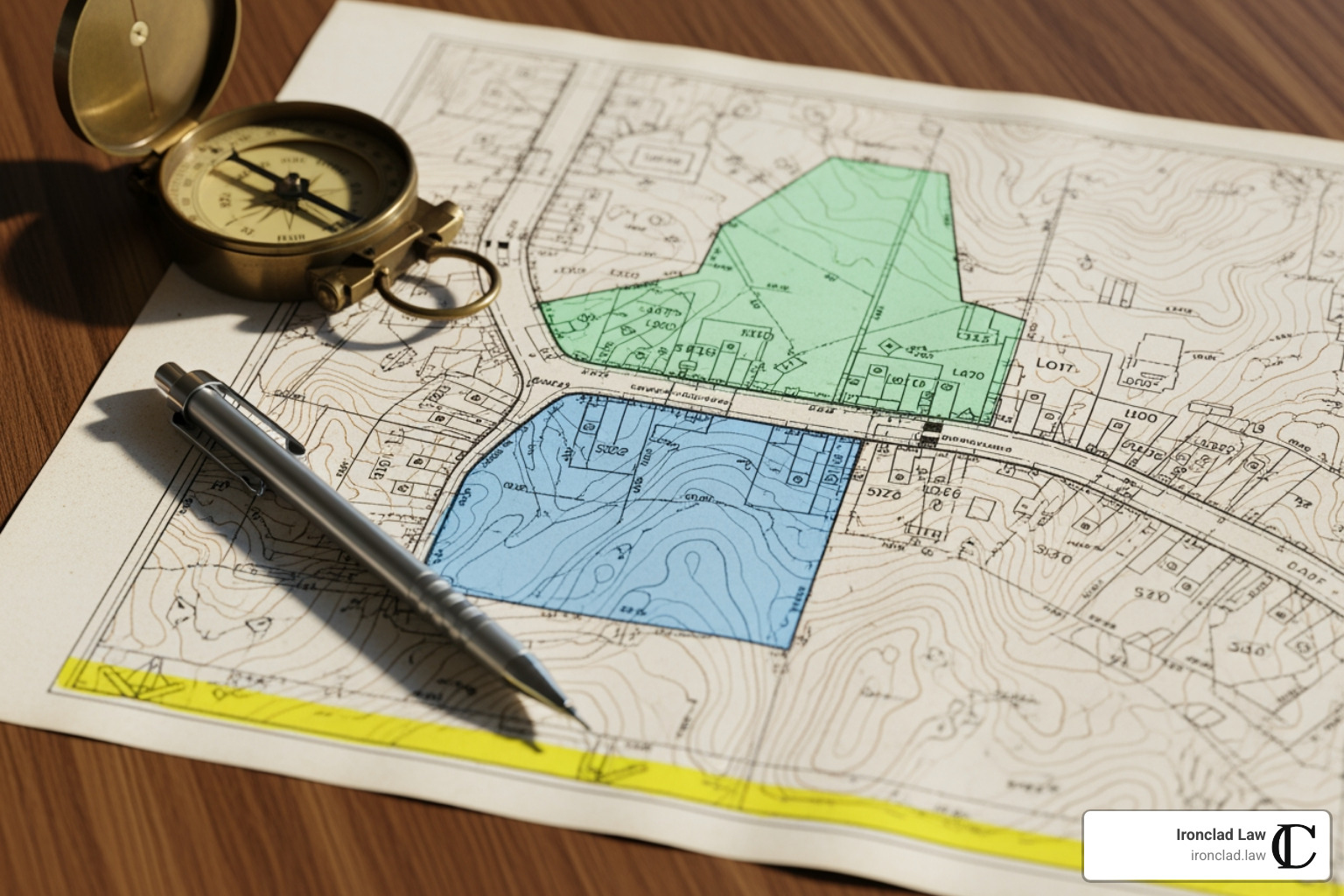
These disputes often involve complex deeds, legal descriptions, and contracts. Understanding these is crucial, and an attorney for property disputes is your indispensable guide. Let’s explore the common battlegrounds.
Boundary and Encroachment Disputes
The classic neighborly spat, boundary disputes involve disagreements over where one property ends and another begins. Common examples include:
- Fences: A fence built a few inches or feet onto your land.
- Driveways: A shared driveway that one neighbor begins using as private parking.
- Trees and landscaping: An overhanging tree whose roots are cracking your foundation.
- Sheds and structures: A shed or other structure built partially on your land.
These issues can escalate into adverse possession claims, where someone can gain ownership through continuous use under specific conditions. Laws like the California Civil Code on Boundaries outline the complex rules for resolving these disputes.
Title and Ownership Disputes
Title disputes arise from uncertainty over legal ownership, which can make a property unmarketable. Key issues include:
- Cloud on title: Any issue in a property’s ownership history—like an old lien or unrecorded document—that makes ownership uncertain.
- Competing ownership claims: These can arise from conflicting deeds, errors in public records, or fraudulent transfers.
- Inheritance issues: Disputes among heirs over property ownership after a death.
- Co-owner disagreements: When multiple owners can’t agree on a property’s use or sale, often leading to a partition action to force a sale or division.
- Forged deeds: Fraudulent documents used to illegally transfer property ownership.
Clearing these issues requires meticulous investigation and often, legal action. For more on navigating property ownership, explore our property transaction services.
Contractual and Transactional Disputes
Real estate deals are built on contracts, and disputes arise when one party fails to uphold their agreement. Common scenarios include:
- Purchase and sale agreements: A buyer backs out, or a seller refuses to close.
- Breach of contract: One party fails to fulfill their obligations, such as a seller not delivering the deed after payment.
- Real estate fraud: Intentional misrepresentation or concealment of major property issues.
- Failure to disclose defects: Sellers are legally obligated to disclose known defects, and failure to do so can lead to claims for damages.
- 1031 exchange complications: These tax-deferred exchanges have strict rules, and errors can lead to significant tax liabilities. Our expertise can guide you through potential 1031 exchange complications.
An attorney for property disputes can help you understand your options, whether it’s forcing a sale or recovering damages.
Use-Right and Landlord-Tenant Conflicts
Disputes also arise over rights of use, such as easements, and in landlord-tenant relationships governed by specific lease agreements and laws.
- Easement rights: An easement grants a legal right to use another’s property for a specific purpose (e.g., a shared driveway). Disputes arise when these rights are violated or blocked.
- Right-of-way: Similar to easements, these involve the right to pass over another’s land.
- Zoning and land use violations: Disputes arise when property is used contrary to local regulations, or when municipal decisions are challenged. Laws like the California Environmental Quality Act (CEQA) can influence these disputes.
- Lease violations: Common issues between landlords and tenants, including unpaid rent, property damage, or other breaches of the lease.
- Eviction: The legal process of removing a tenant. Disputes often arise over the legality of the eviction. The California Tenant Protection Act of 2019 provides detailed rules governing these relationships.
An attorney for property disputes can provide the legal leverage to protect your interests as a landlord or a tenant.
The Role of an Attorney for Property Disputes: Your Advocate and Strategist
Navigating property law is like traversing a minefield, making a skilled attorney for property disputes essential. At Ironclad Law, we are your strategic partner and fierce advocate. We understand your objectives, weigh the risks, and relentlessly pursue the best outcome.

From our first meeting, we build a fortified strategy custom to your situation. Our expertise in areas like business dispute resolution often intersects with complex property matters.
Initial Case Assessment and Evidence Gathering
A thorough understanding of the facts is the first step. We don’t just listen; we investigate every detail.
What we do first:
- Comprehensive Title Searches: We examine the property’s history for “clouds on title,” liens, or prior claims.
- Professional Property Surveys: We coordinate with licensed surveyors to establish precise property lines, which is critical in boundary disputes.
- Expert Witnesses: We engage experts like appraisers or environmental consultants to provide crucial evidence.
- Meticulous Document Review: We pore over every relevant document—deeds, contracts, and permits—to find inconsistencies or clauses that favor your case.
- Preserving Evidence: We advise you on preserving all evidence, from emails to photos, to avoid damaging your case.
This rigorous process forms the bedrock of our strategy, allowing us to build a strong case from the start.
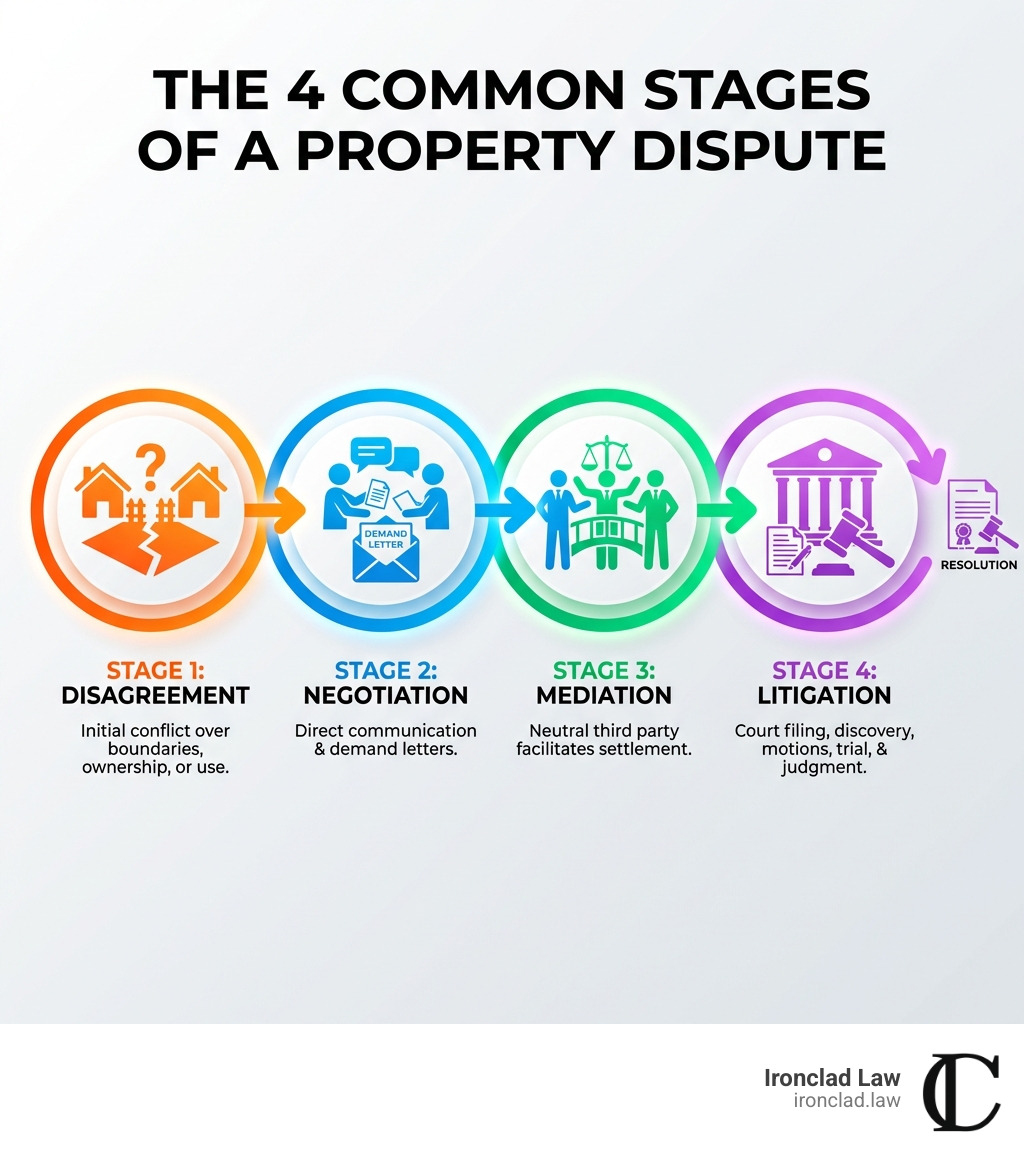
Strategic Negotiation and Alternative Dispute Resolution (ADR)
While we are “bulldog” litigators, the most effective solution is often found outside the courtroom. We aim to achieve your objectives efficiently through negotiation and Alternative Dispute Resolution (ADR).
Our approach includes:
- Demand Letters: A well-crafted demand letter from an attorney often resolves a conflict before it escalates by signaling your serious intent.
- Settlement Negotiations: We engage in direct negotiations, leveraging the evidence we’ve gathered to secure a favorable settlement.
- Mediation: A neutral mediator facilitates communication to help both sides reach a voluntary agreement, which is effective when emotions are high.
- Arbitration: A more formal process where an impartial arbitrator issues a binding decision, often leading to quicker resolutions than court. Our team includes skilled professionals who can act as an arbitration lawyer.
- Cost-Benefit Analysis: We always analyze the potential costs and risks of litigation against the benefits of a settlement, ensuring our strategy is proportionate to the financial stakes.
We constantly reassess leverage and choose the option that best aligns with your objectives and budget.
Aggressive Litigation and Courtroom Representation
When negotiation fails, we are fully prepared to take your fight to court. At Ironclad Law, we are “bulldog” litigators who love to go to trial, especially in high-stakes real estate disputes.
Our litigation process is comprehensive:
- Filing a Lawsuit: We draft and file the necessary legal documents to formally initiate your lawsuit.
- Injunctions: In urgent situations, we seek court orders (like TROs) to prevent immediate harm, such as halting unauthorized construction.
- Findy Process: During the “Findy” (findy) process, we use document requests, depositions, and other tools to build a compelling case and gain insight into the opposition’s strategy.
- Motions: We strategically file motions to dismiss weak claims or seek summary judgment for an early resolution in your favor.
- Trial Preparation: Our team carefully prepares for trial by developing a clear narrative, preparing witnesses, and crafting persuasive arguments.
- Courtroom Advocacy: We are experienced and confident courtroom advocates. We ensure your story is heard and your rights are upheld with clarity and conviction.
While a full lawsuit can take months or years, many disputes settle during findy or after key motions. We always seek the most effective path to victory.
The Path to Resolution: Legal Remedies and Outcomes
When property rights collide, the legal system offers various remedies to resolve disputes. As your attorney for property disputes, we will guide you to the most effective strategy to achieve your desired outcome and secure a lasting resolution.
Stopping Harmful Actions with Injunctions
When the priority is to stop an ongoing harmful action, injunctions are a powerful tool.
- Temporary Restraining Orders (TROs): A TRO is an emergency court order to prevent irreparable harm, like halting unauthorized construction.
- Preliminary Injunctions: This order preserves the status quo until a full trial can be held, preventing continued trespass or property destruction. We pursue injunctive relief only when immediate action is necessary.
Clarifying Ownership with a Quiet Title Action
A “cloud on title” can make it impossible to sell or refinance your property. A quiet title action is a legal procedure designed to resolve these uncertainties. This action asks a court to:
- Resolve conflicting claims and clear errors in the chain of title.
- Remove encumbrances like old liens or adverse possession claims.
- Legally declare the rightful owner, providing undeniable proof of ownership.
- Force other claimants to prove their interest or have it legally extinguished.
This remedy is crucial for securing your investment and ensuring your property’s value.
Recovering Financial Losses through Damages
When a property dispute causes financial harm, we pursue compensation for your losses through monetary awards known as damages.
- Compensatory Damages: These cover direct financial losses, like diminished property value, repair costs, or lost profits from a breached contract.
- Lost Profits: If a dispute prevented you from using your property for income, we can seek compensation for reasonably expected profits.
- Punitive Damages: In cases of egregious conduct like fraud, a court may award punitive damages to punish the wrongdoer and deter future misconduct.
Forcing a Transaction with Specific Performance
Because real estate is unique, monetary damages may not be an adequate remedy for a broken contract. In such cases, specific performance might be available.
- Compelling a Seller to Complete a Sale: If a seller breaches a purchase agreement, a court can order them to complete the transaction as agreed.
- Enforcing a Purchase Agreement: This remedy can also compel a buyer to go through with a purchase they wrongfully abandoned.
Specific performance is a powerful tool to ensure agreements are honored. Our team is adept at navigating real estate negotiations to achieve such outcomes.
Frequently Asked Questions about Property Disputes
We know that dealing with property disputes can raise a lot of questions. Here, we address some of the most common inquiries we receive.
How much does hiring an attorney for property disputes cost?
The cost varies depending on case complexity and the services required. At Ironclad Law, we believe in transparency. Typically, legal fees for an attorney for property disputes can involve:
- Hourly Rates: Most litigation is billed hourly, with rates reflecting the expertise of our legal team.
- Retainer Fees: An upfront payment held in trust and billed against as work is completed.
- Contingency Fees: Less common in property disputes, this is a percentage of the amount recovered.
- Flat Fees: May be used for specific, well-defined tasks like a contract review.
Litigation costs also vary by phase, from pre-litigation negotiations to findy, motions, and a potential trial. You may be able to recover your attorney’s fees if established by contract or statute. We always recommend starting with a business lawyer consultation to discuss your specific situation and receive a cost-benefit analysis.
How long does a property dispute lawsuit take to resolve?
A property dispute lawsuit can take anywhere from a few weeks to several years to resolve. The timeline depends on factors like case complexity, court backlogs, and the parties’ willingness to negotiate. Emergency injunctions can be decided in weeks, but a full case often takes months. However, most disputes settle during the findy phase or after key motions, once the evidence and risks become clear. We manage the entire process while updating you regularly and exploring settlement opportunities. For more details, read our guide on what to expect when working with your attorney.
Can I handle a property dispute without a lawyer?
Handling a dispute yourself to save on legal fees can be a false economy, though it may be possible for minor, amicable disagreements or in small claims court. However, a lawyer is almost always essential when:
- The financial stakes are high.
- There are complex title issues, such as adverse possession or inheritance disputes.
- Litigation is necessary, as the rules of procedure and evidence are complex.
- The opposing party has an attorney.
- The dispute is emotionally charged, requiring objective, strategic advice.
Property law is a labyrinth of statutes and procedural rules. Attempting to steer it without an experienced attorney for property disputes can lead to costly mistakes and unfavorable outcomes.
Conclusion: Securing Your Property and Peace of Mind
Property disputes, whether they involve a misplaced boundary line or a broken real estate contract, are more than just legal challenges; they are deeply personal. They threaten your investment, your peace of mind, and sometimes, even your relationships.
The key takeaways are clear: property law is complex, the stakes are often high, and early, expert legal intervention can make all the difference. While the idea of a dispute can be daunting, you don’t have to face it alone.
At Ironclad Law, we champion a proactive approach. We encourage you to seek legal counsel not just when a dispute boils over, but also to review documents, clarify rights, and establish clear agreements to prevent conflicts from arising in the first place. This proactive stance is the ultimate protection for your investment.
When disputes do arise, our value as your attorney for property disputes becomes undeniable. We bring a blend of meticulous investigation, strategic negotiation, and, when necessary, aggressive litigation to every case. We are your “bulldog” litigators, fiercely fighting for your rights and committed to securing the resolution you deserve. Our goal is to ensure that your property remains yours, your rights are protected, and your peace of mind is restored.
Don’t let property disputes overshadow your life. For comprehensive legal guidance and unwavering advocacy in all your property matters, contact us for your property transaction and dispute needs. We’re ready to stand by you.