
You have 0 items in your cart

Understanding the Foundations of Business Litigation Motions
Business litigation motions are formal written requests asking a court to issue a specific order or ruling during the course of a lawsuit. These legal tools allow parties to resolve disputes, narrow issues, exclude evidence, or even end a case entirely—often before it reaches trial.
Quick Overview: What You Need to Know About Business Litigation Motions
- Definition: A motion is a written request for a court order, filed during litigation to seek specific relief
- Purpose: Motions can dismiss claims, compel findy, exclude evidence, or resolve cases without trial
- Key Requirements: Must state grounds with particularity and specify the relief sought (FRCP 7)
- Common Types: Motion to dismiss, motion for summary judgment, motion to compel findy, motions in limine
- Filing Process: Requires notice to opposing parties, supporting briefs, evidence, and often a “meet and confer” attempt
- Response Time: Typically 14-21 days to oppose, depending on motion type and jurisdiction
- Strategic Value: Motions can increase settlement leverage, narrow trial issues, and test legal theories
During the course of doing business, disputes inevitably arise—whether it’s a breach of contract, shareholder disagreement, or partnership dissolution. When negotiation fails and litigation begins, motions become your primary weapons for protecting your interests and controlling the trajectory of the case.
Motions practice in federal court is governed primarily by the Federal Rules of Civil Procedure and each court’s local rules. Individual judges often have their own specific requirements as well. Understanding these procedural requirements is critical—failure to comply can result in your motion being denied, your arguments being waived, or worse, sanctions against you or your attorney.
The stakes are high. A well-crafted motion for summary judgment can end litigation entirely, saving months of time and tens of thousands in legal fees. A strategic motion to compel can force your opponent to produce damaging evidence they’ve been withholding. A motion in limine can exclude prejudicial evidence that could poison a jury against you.
This guide walks you through everything you need to know about business litigation motions—from understanding the different types to mastering the procedural requirements and leveraging them for strategic advantage in your case.
The Arsenal of a Litigator: Common Types of Business Litigation Motions
Think of a lawsuit as a strategic battlefield. In this arena, business litigation motions are the various tools and tactics we deploy to advance our position, defend our client’s interests, and ultimately achieve a favorable outcome. These motions fall into broad categories, each serving a distinct purpose in shaping the litigation.
Dispositive Motions: Aiming to End the Fight
Dispositive motions are the heavy artillery of litigation. If granted, they can resolve an entire claim, a specific defense, or even the entire case, often before a trial ever begins. These motions are powerful because they challenge the very legal or factual basis of a party’s position.
-
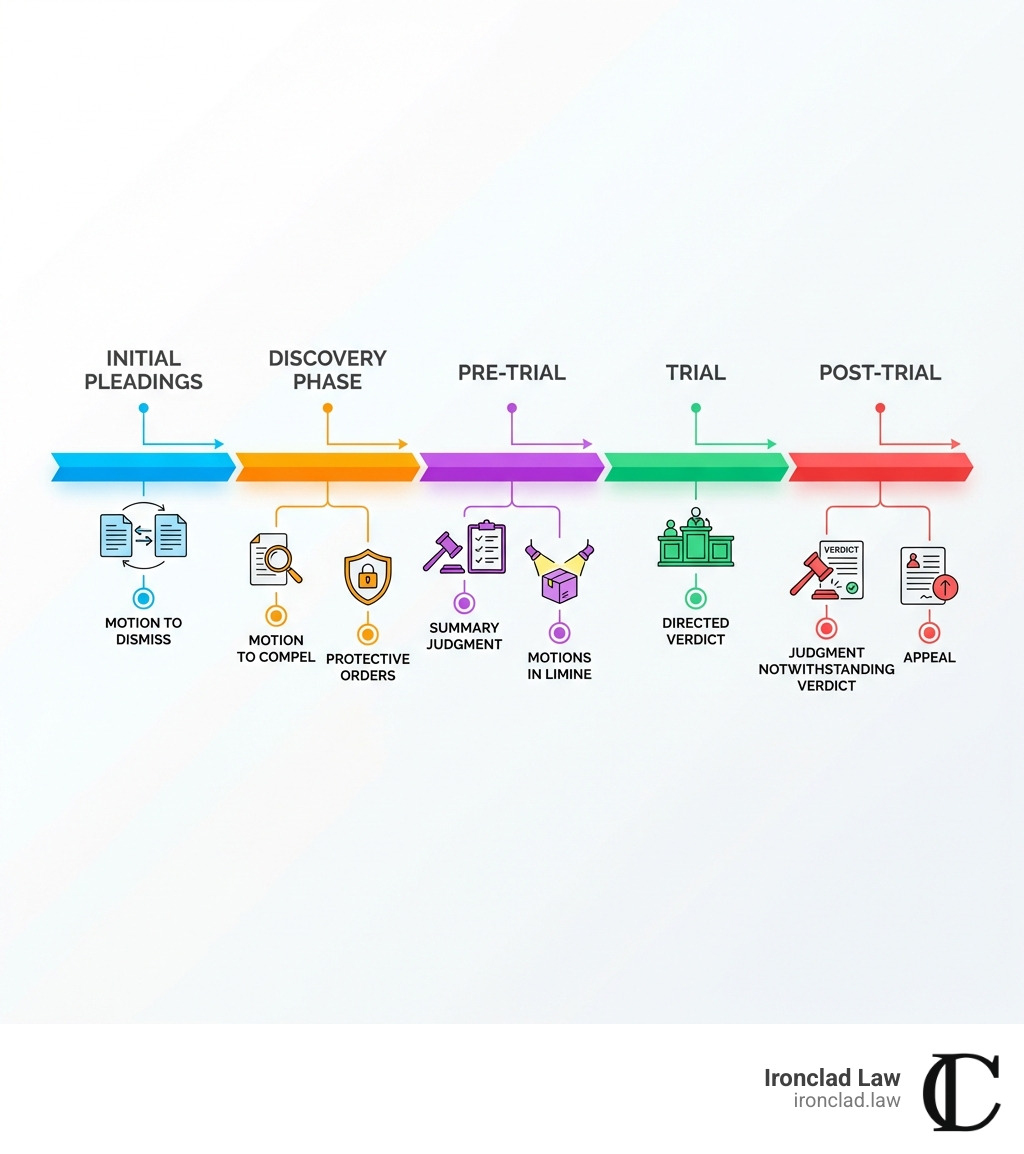
Motion to Dismiss: This is often one of the first business litigation motions filed. Under Federal Rule of Civil Procedure (FRCP) 12, a defendant can move to dismiss a lawsuit for various reasons, such as lack of subject matter jurisdiction, improper venue, insufficient service of process, or, most commonly, “failure to state a claim upon which relief can be granted.” This means that even if all the facts alleged by the plaintiff are true, they still haven’t presented a legally recognized cause of action. We often use this motion to challenge the legal sufficiency of an opponent’s complaint early on, aiming to get the case thrown out or at least force them to refine their allegations.
-
Motion for Summary Judgment: Governed by FRCP 56, a motion for summary judgment is filed after the findy phase, once both sides have gathered evidence. The moving party argues that there is “no genuine dispute as to any material fact” and that, based on the undisputed facts, they are “entitled to judgment as a matter of law.” Essentially, we tell the court, “Look, Judge, all the evidence is in, and there’s no real disagreement about the key facts. Given these facts, the law clearly favors our client, so there’s no need for a trial.” This motion is a powerful tool to avoid the time and expense of a full trial when the facts are clear. You can explore how summary judgment works under federal rules for a deeper dive into its mechanics.
Non-Dispositive Motions: Shaping the Battlefield
While non-dispositive motions don’t typically end a case, they are crucial for managing the litigation process, clarifying issues, and preparing for trial. These motions shape the “battlefield” by controlling what evidence is exchanged, what arguments are allowed, and how the case proceeds.
-
“Findy” Motions (Findy Motions): These business litigation motions are central to the findy phase, where parties exchange information.
- Motion to Compel: If an opposing party refuses to provide requested documents, answer interrogatories, or make a witness available for a deposition, we might file a motion to compel. This asks the court to order the recalcitrant party to comply with their findy obligations. Without these motions, findy could grind to a halt, hindering our ability to gather essential evidence. Understanding the deposition process is key here, as motions to compel often arise when a party obstructs it.
- Motion for Protective Order: Conversely, if an opposing party makes overly broad, unduly burdensome, or harassing findy requests, we can file a motion for a protective order. This asks the court to limit or prevent certain findy to protect our client from undue burden or disclosure of privileged information.
-
Procedural Motions: These motions deal with the nuts and bolts of how a case is conducted.
- Motion to Amend Pleadings: If new information comes to light or we need to refine our legal theories, we might file a motion to amend our complaint or answer. Courts are generally liberal in granting these motions, especially early in the case, to ensure all relevant issues are before the court.
- Motions in Limine: These are crucial pre-trial business litigation motions filed to exclude certain evidence or arguments from being presented to the jury. For example, we might file a motion in limine to prevent the opposing side from mentioning a client’s prior unrelated business dispute, arguing it’s irrelevant and highly prejudicial. This helps ensure a fair trial by keeping out potentially inflammatory or misleading information.
The Rules of Engagement: Filing, Responding, and Arguing Motions
Filing a motion isn’t just about having a good legal argument; it’s also about playing by the rules. The procedural requirements for business litigation motions are strict and vary depending on the court.

Motions practice in federal court is primarily governed by two sets of rules: the Federal Rules of Civil Procedure (FRCP) and each court’s local rules. Additionally, individual judges often have their own specific policies and procedures. These rules dictate everything from filing deadlines and page limits to the required format of documents and the need for a “meet and confer” session with opposing counsel. For instance, FRCP 7 governs motions generally, but specific motions like those for summary judgment (FRCP 56) or to dismiss (FRCP 12) have their own detailed rules.
Before You File: The Crucial ‘Meet and Confer’ Obligation
Before we even draft a motion, especially for findy disputes, we often have a crucial “meet and confer” obligation. This means we must genuinely attempt to resolve the issue with opposing counsel outside of court.
The purpose of conferring is simple: to encourage parties to resolve minor disputes themselves, without burdening the court. It saves judicial resources and can save our clients time and money. While the specifics are usually spelled out in local rules, the general idea is to engage in good-faith discussions to see if a motion can be avoided. For example, some local rules, like in the U.S. District Court, District of Idaho, require parties to communicate and attempt to resolve disputes before filing certain motions. This serves as an excellent illustration of a local meet and confer rule that federal courts across the United States might implement.
We always carefully document these attempts—the date, time, substance of the discussion, and participants. This record proves to the court that we fulfilled our obligation and that the motion is truly necessary.
Drafting and Filing Your Business Litigation Motions
Once we’ve determined a motion is necessary, the drafting process begins. A well-crafted motion is clear, concise, and persuasive.
The core components of most business litigation motions include:
- Notice of Motion: This formal document informs the court and opposing parties that a motion is being filed, stating the specific relief requested and the date for any hearing.
- Memorandum of Law (or “Brief”): This is where we present our legal arguments, citing relevant statutes, case law, and court rules to support our position. It explains why the court should grant our request. A motion must state with particularity the grounds for seeking an order, and it must state the relief sought, as outlined in FRCP 7(b). This clarity is vital for navigating general motion practice rules.
- Supporting Affidavits or Declarations: These are sworn statements from individuals with personal knowledge of the facts relevant to the motion. They provide the factual basis for our legal arguments. Affidavits must be made on personal knowledge, set out admissible facts, and show the affiant’s competence to testify on the matters stated.
- Proposed Orders: Almost all courts require a draft proposed order laying out the specific relief sought to accompany the motion. This makes it easy for the judge to simply sign an order that grants our request, assuming they agree with our arguments.
We also pay close attention to page and word limits, which can vary significantly between federal courts and even between individual judges. For instance, in federal courts, supporting and opposing briefs might have a maximum word limit of 13,000 words, with reply briefs at 6,500 words, unless prior court permission is granted. Requests to exceed these limits are typically short motions themselves (e.g., 500 words).
A growing trend involves the use of generative AI in drafting legal documents. While AI can assist with research and drafting, we remain responsible for the accuracy and reliability of all content. This means thorough verification of AI-generated text to ensure it adheres to legal standards and factual truth.
Responding to a Motion and Requesting Oral Argument
Receiving a motion from an opposing party means we have a limited window to respond. The deadlines for opposition papers vary. For example, in New York City Civil Court, motion papers must be served on all parties at least eight days before the time at which the motion is noticed to be heard. If served by mail, an additional five days are added. A brief opposing a motion for summary judgment in federal court might be due within 21 days after the motion is filed and served, as seen in some district court rules. Example of state court deadlines illustrate this variation.
Failing to timely respond to and oppose a motion can have severe consequences; some courts may construe it as consent to the motion. If we don’t respond to individual arguments within a motion, the court might consider those specific points unopposed.
Our response typically involves drafting opposition papers, including an Affidavit in Opposition and a Memorandum of Law arguing why the opponent’s motion should be denied. Sometimes, we might file a “cross-motion,” which is our own motion filed in response, seeking affirmative relief from the court on the same issues. We then have an opportunity to file a “reply brief” to address points raised in the opposition, but these are generally limited to responding to new arguments, not re-hashing our initial points.
Finally, we consider whether to request oral argument. While some courts hold oral arguments as a matter of course, it’s often at the judge’s discretion. There is no right to oral argument on a motion; it will only be held if the court orders it. When we do request it, we must explain why it’s necessary and estimate the time required. Preparing for oral argument involves distilling our complex written arguments into concise, persuasive talking points and being ready to answer the judge’s questions.
The Strategic Impact of Business Litigation Motions
Business litigation motions are far more than just procedural problems; they are critical strategic tools that can profoundly influence the outcome of a case. Think of them as moves in a high-stakes chess game.
We use motions to gain leverage, narrow the issues that will ultimately go to trial, increase the costs for our opponent (which can encourage settlement), and even test the legal theories and factual evidence of the other side.
More Than Just Paperwork: Motions as a Strategic Tool
A well-executed motion can completely change the dynamic of a lawsuit. For instance, a strong motion for summary judgment, even if not fully granted, can reveal weaknesses in the opposing party’s case, making them more amenable to settlement. This leverage can be invaluable in alternative dispute resolution like mediation, where a neutral third party helps facilitate communication and negotiation toward a settlement.
Motions are also vital for defining the scope of trial. By successfully excluding certain evidence with a motion in limine, or getting specific claims dismissed, we ensure that only relevant and admissible issues are presented to a jury. This streamlines the trial process and prevents distractions. The strategic use of business litigation motions is integral to our overall business dispute resolution strategy, allowing us to control the narrative and focus on the strongest aspects of our client’s case.
The Consequences of Non-Compliance and Bad Faith Filings
The rules governing business litigation motions are not suggestions; they are mandates. Non-compliance can lead to serious consequences, including:
- Court Sanctions: Judges have broad authority to impose sanctions for rule violations. This can include monetary fines, ordering the offending party to pay the opponent’s attorney’s fees incurred in responding to the improper filing, or even striking pleadings. FRCP 11, for example, allows courts to sanction parties or attorneys who present pleadings, written motions, or other papers for any improper purpose, such as to harass, cause unnecessary delay, or needlessly increase the cost of litigation.
- Waiver of Arguments: If we fail to properly raise an argument in a motion or respond to an opponent’s argument, we risk waiving that position, meaning we can’t bring it up later.
- Contempt of Court: In extreme cases, intentional non-compliance or bad-faith filings can result in a finding of contempt of court, which can carry even more severe penalties.
These consequences underscore the critical importance of sound legal risk management throughout the litigation process. We carefully adhere to all procedural rules to protect our clients from such penalties and to maintain our credibility with the court.
Frequently Asked Questions about Business Litigation Motions
How much does it cost to file a motion?
The cost of filing a motion isn’t just the court’s filing fee, which is usually a relatively small amount. The primary expense comes from attorney’s fees, covering the extensive research, drafting, and preparation time involved. A complex motion, like one for summary judgment, can require dozens, if not hundreds, of hours of legal work. However, investing in a well-crafted motion can also be a strategic cost-saver. If a motion successfully dismisses a case or a significant claim, it can save our clients far more in future legal fees and business disruption than the cost of the motion itself. It’s all about a strategic cost-benefit analysis.
Can a single motion win my entire case?
Yes, absolutely! Dispositive motions, particularly a motion for summary judgment, are specifically designed with this goal in mind. If we can prove to the court that there’s no genuine dispute of material fact and our client is entitled to judgment as a matter of law, the judge will issue an order ending the case without a trial. However, it’s a high legal standard to meet, and not all business litigation motions are intended to be case-ending. Many are procedural tools to shape the case, not conclude it entirely.
What happens after the judge rules on a motion?
Once a judge rules on a motion, they will issue a court order detailing their decision. Both parties must then comply with that order. If the order is unfavorable, we will evaluate the possibility of appeal. Most appeals from motion rulings are “interlocutory appeals,” meaning they occur before a final judgment in the case. These are often difficult to obtain, as appellate courts generally prefer to hear appeals only after a final judgment has been entered. However, certain critical rulings, like those involving injunctions, may be immediately appealable. In New York City Civil Court, a judge has 60 days to decide a motion, and parties are typically notified once a decision is made.
Conclusion: Mastering Motions for a Winning Litigation Strategy
Business litigation motions are the engine of any lawsuit, driving the process forward, defining the battlefield, and often determining the ultimate outcome. Their complexity demands precision, deep legal knowledge, and a keen strategic mind. Mastering motion practice isn’t just about following rules; it’s about leveraging every procedural opportunity to gain an advantage.
At Ironclad Law, we pride ourselves on being aggressive, “bulldog” litigators who understand the nuances of motion practice. We fiercely fight for our clients’ rights, using every available motion as a strategic tool to protect their interests and achieve their business objectives. We love to go to trial, but we also know how to use motions to secure victory long before a jury is ever empaneled.
For a strategic review of your case and to gain a tactical advantage in your dispute, schedule a business lawyer consultation with us today.