
You have 0 items in your cart

Understanding Series 7 Exam Requirements: Your Path to Becoming a General Securities Representative
If you’re aiming to become a General Securities Representative, the series 7 exam requirements are a vital step you need to master. Here’s a quick outline:
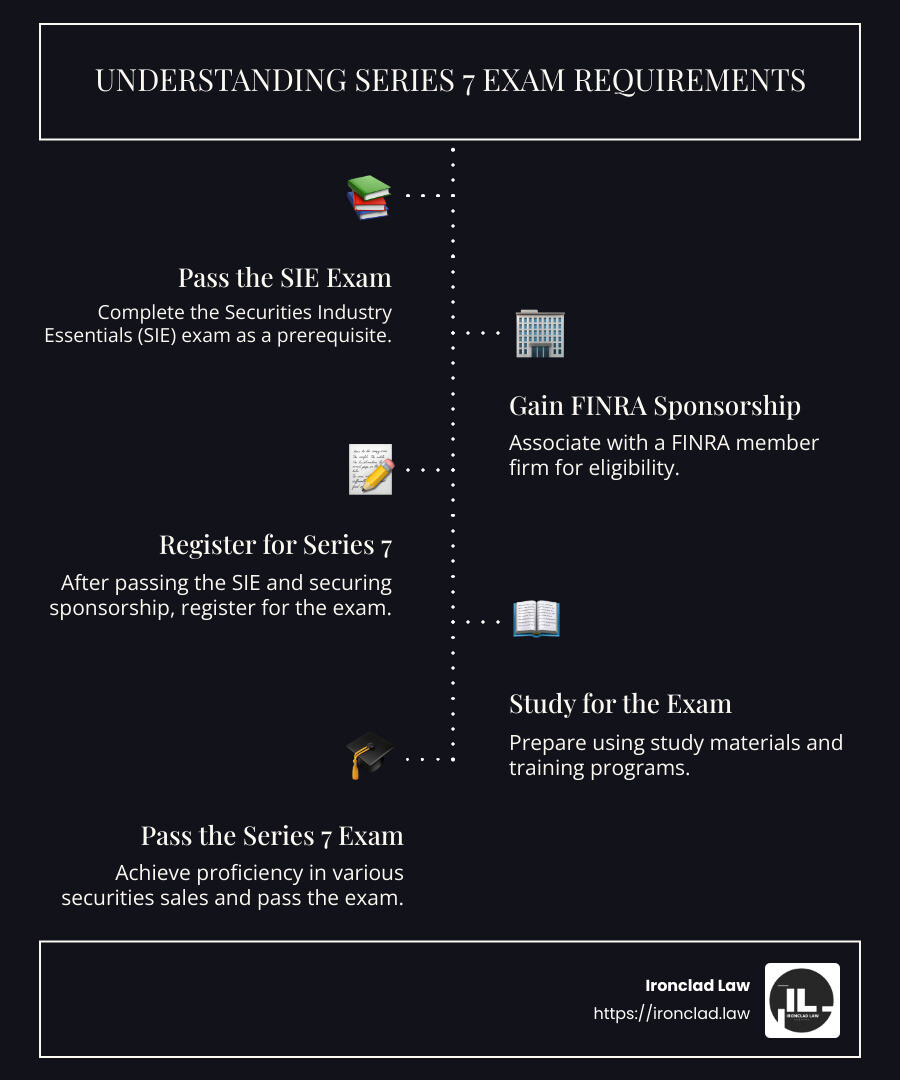
- Pass the SIE Exam: Before tackling the Series 7 exam, candidates must complete the Securities Industry Essentials (SIE) exam.
- Sponsorship by a FINRA Member Firm: Candidates must be associated with a Financial Industry Regulatory Authority (FINRA) member firm.
- Series 7 Registration: Only after passing the SIE and being sponsored, can candidates take the Series 7 exam.
- Comprehensive Knowledge: The exam evaluates proficiency in sales of various securities, including corporate, municipal, and government securities.
The Series 7 exam is a robust qualification process for those entering the securities industry. It’s designed and administered by FINRA to ensure candidates exhibit the necessary competency in handling a range of financial products. Successfully passing this exam grants you the right to engage in the trading and sales of diverse securities, except for commodities and futures.
My name is Michael Hurckes, and I am an expert in understanding and navigating the series 7 exam requirements. With years of experience in financial services and regulatory compliance, my insights can help you comprehend the intricacies of these requirements.
Understanding the Series 7 Exam Requirements
To start on the journey of becoming a General Securities Representative, you must first steer the series 7 exam requirements. Let’s break it down into manageable steps:
1. Pass the SIE Exam
The Securities Industry Essentials (SIE) exam is your first milestone. It’s an introductory exam that covers basic securities industry knowledge. Think of it as the foundation upon which you’ll build your career in finance.
-
What does the SIE cover? Topics include product types, market structure, regulatory agencies, and prohibited practices.
-
Who can take the SIE? Anyone over 18 can take the exam, even if you’re still in school. You don’t need to be sponsored by a firm to take the SIE.
-
Why is it important? Passing the SIE demonstrates your understanding of the basics needed for more advanced exams like the Series 7.
2. Secure FINRA Sponsorship
Before you can register for the Series 7 exam, you need a sponsor. This sponsor must be a FINRA member firm or a self-regulatory organization (SRO).
-
Why sponsorship? It ensures that candidates have a practical context for their knowledge, working within a firm that adheres to regulatory standards.
-
How to get sponsored? Apply for roles at brokerage firms or financial institutions. They typically sponsor promising candidates.
3. Corequisites: SIE and Series 7
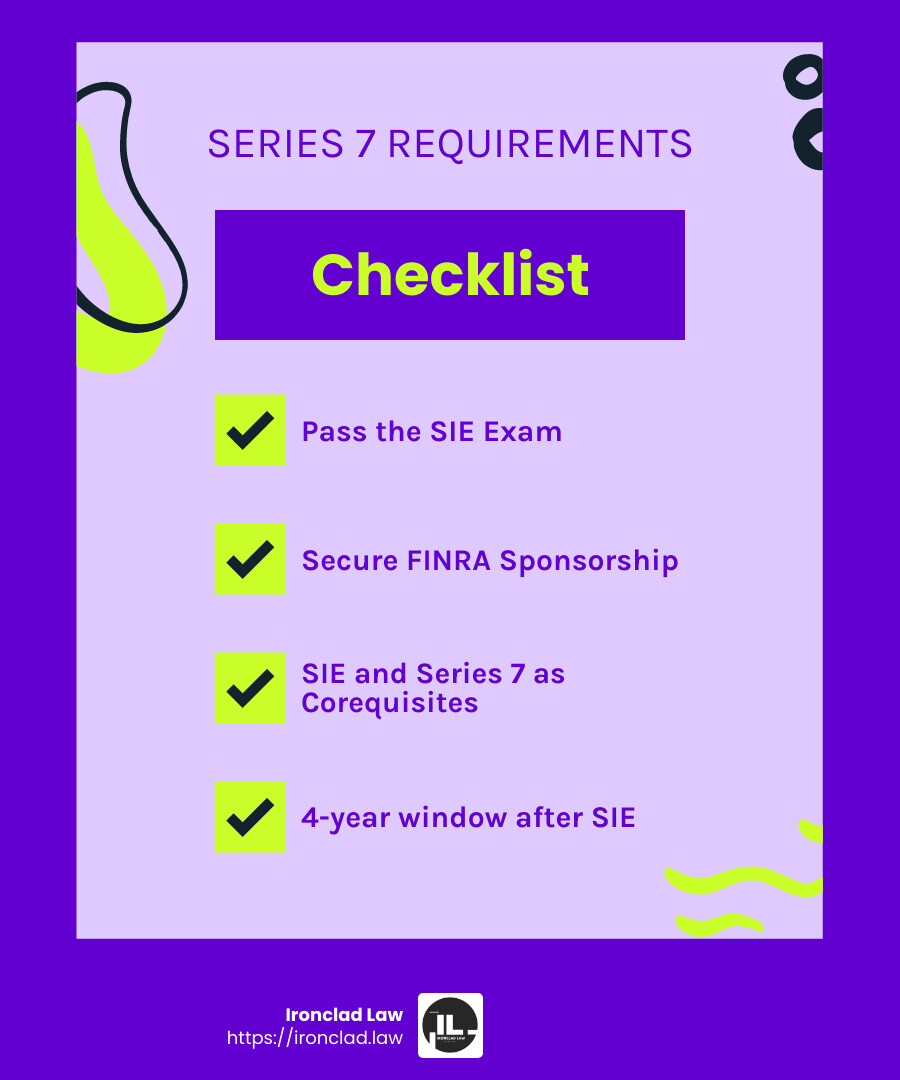
The SIE and Series 7 exams are considered corequisites. This means you must pass both to qualify for the General Securities Representative license, but not necessarily at the same time.
-
Order of exams: You can choose to take the SIE before or after the Series 7, as long as both are completed.
-
Timeframe: Once you pass the SIE, you have a four-year window to pass the Series 7.
By understanding and meeting these series 7 exam requirements, you’re setting the stage for a successful career in the securities industry. This process ensures that you not only grasp the theoretical aspects but also gain real-world insights through your association with a FINRA member firm.
Next, let’s explore the specific steps to qualify for the Series 7 exam.
Steps to Qualify for the Series 7 Exam
So, you’re ready to dive into securities with the Series 7 exam. Here’s a simple guide to get you started on meeting the series 7 exam requirements.
1. Pass the SIE Exam
First up is the Securities Industry Essentials (SIE) exam. Think of it as your gateway into the securities industry. This exam tests your understanding of fundamental concepts like product types, market structures, and the roles of regulatory agencies.
-
Who can take it? Anyone over 18, even if you’re still in school. No sponsorship needed here.
-
Why take it? It’s a prerequisite for the Series 7 exam and shows you have the foundational knowledge needed.
2. Secure a Sponsorship
To take the Series 7 exam, you need a sponsor. This must be a FINRA member firm or a self-regulatory organization (SRO).
-
Why do you need a sponsor? It provides a real-world context for your knowledge. You’ll be working within a firm that follows regulatory standards, which is crucial for your growth and compliance in the industry.
-
How to get one? Apply for entry-level roles at brokerage firms or financial institutions. These firms often sponsor candidates who show promise and potential.
3. Complete Form U4
Once you’ve secured sponsorship, the next step is to complete the Uniform Application for Securities Industry Registration or Transfer, commonly known as Form U4.
-
What is Form U4? It’s an application that your sponsoring firm submits to FINRA. It registers you for the Series 7 exam and logs your employment history, disclosures, and other pertinent information.
-
What’s the process? Your sponsoring firm will guide you through filling out Form U4. Make sure all information is accurate and complete to avoid delays.
4. Tackling Corequisites
The SIE and Series 7 exams are corequisites. You need to pass both to get your license, but you can take them in any order.
- Timing: After passing the SIE, you have four years to pass the Series 7 exam. Plan your study schedule accordingly.
By following these steps, you’ll be well on your way to qualifying for the Series 7 exam. This path ensures that you are not just theoretically prepared but also practically equipped to excel in the securities industry.
Next, let’s dig into the content and structure of the Series 7 exam to better prepare you for what lies ahead.
Series 7 Exam Content and Structure
Now that you’re set up to take the Series 7 exam, let’s explore what you’ll face on test day. Knowing the series 7 exam requirements is crucial, but understanding the exam’s content and structure is equally important.
Exam Format
The Series 7 exam is a multiple-choice test with 125 questions. You have 225 minutes to complete it, and you need a score of 72% to pass. This exam is designed to assess your ability to perform the critical functions of a general securities representative.
- Duration: 225 minutes
- Questions: 125 multiple-choice
- Passing Score: 72%
Major Job Functions
The exam measures your competency across four major job functions. These functions reflect real-world tasks you’ll perform as a securities representative:
-
Seeks Business for the Broker-Dealer from Customers and Potential Customers: This section includes 9 questions. It’s about finding and engaging potential clients.
-
Opens Accounts after Obtaining and Evaluating Customers’ Financial Profile and Investment Objectives: Here, you’ll tackle 11 questions. This part tests your ability to understand and evaluate client needs before opening accounts.
-
Provides Customers with Information about Investments, Makes Suitable Recommendations, Transfers Assets, and Maintains Appropriate Records: With 91 questions, this is the largest section. It focuses on advising clients, making recommendations, and managing records.
-
Obtains and Verifies Customers’ Purchase and Sales Instructions and Agreements; Processes, Completes, and Confirms Transactions: This final section has 14 questions, covering transaction processing and confirmation.
Multiple-Choice Questions
Each question on the Series 7 exam is multiple-choice, designed to test your knowledge and decision-making skills. These questions evaluate your understanding of investment risks, taxation, equity and debt instruments, and more.
- Tip: Practice with sample questions to get familiar with the format and improve your test-taking strategy.
By understanding the exam’s structure and content, you’ll be better prepared to tackle the Series 7 exam confidently. Next, we’ll explore how to effectively prepare for the exam to boost your chances of success.
Preparing for the Series 7 Exam
Preparing for the Series 7 exam can feel overwhelming, but with the right tools and strategies, you can boost your chances of success. Here’s what you need to know about study materials, training programs, and the passing score.
Study Materials
To conquer the Series 7 exam, you’ll need comprehensive study materials. These resources are designed to help you understand complex topics in a simple way.
-
Textbooks and Guides: Look for detailed guides that explain financial terms and concepts. These will help you grasp the core topics covered in the exam.
-
Practice Exams: Taking practice exams is crucial. They help you get used to the format and timing of the real test. Plus, they highlight areas where you need more study.
-
Flashcards: Use flashcards to memorize key terms and definitions. They’re handy for quick reviews and can be used anywhere.
Training Programs
Consider enrolling in a training program for structured learning. These programs offer expert guidance and support.
-
Online Courses: Many companies offer online courses with video lessons and interactive quizzes. These are great if you prefer learning at your own pace.
-
In-Person Classes: If you thrive in a classroom setting, look for in-person courses. These often provide direct access to instructors for questions and discussions.
-
Ironclad Law Resources: Ironclad Law provides a variety of resources tailored to help candidates succeed in their exams. These include expert consultations and study groups to enhance your preparation.
Passing Score
The passing score for the Series 7 exam is 72%. This means you need to answer at least 90 out of 125 questions correctly.
- Tip: Focus on the sections with the most questions, like providing investment information and making recommendations. These areas carry the most weight.
By using the right study materials and enrolling in effective training programs, you’ll be well on your way to achieving that 72% passing score. Next, we’ll address some common questions about the Series 7 exam requirements.
Frequently Asked Questions about Series 7 Exam Requirements
What is the passing score for the Series 7 exam?
The Series 7 exam requires a passing score of 72%. This means you need to correctly answer at least 90 out of the 125 multiple-choice questions. It’s important to focus on the sections with the most questions to maximize your chances of hitting this target.
Can I take the Series 7 exam without a finance background?
You don’t need a finance background to take the Series 7 exam, but you do need sponsorship from a FINRA member firm. This sponsorship is crucial as it allows you to register for the exam. While a finance background can be helpful, many candidates from diverse fields succeed by using comprehensive study materials and training programs.
How many attempts are allowed for the Series 7 exam?
FINRA rules allow you to take the Series 7 exam multiple times, but there are some restrictions. If you fail, you must wait 30 days before your next attempt. After three consecutive failures, the waiting period increases to 180 days. It’s important to prepare thoroughly to avoid these delays and meet the Series 7 exam requirements efficiently.
Conclusion
At Ironclad Law, we understand the complexities involved in navigating the Series 7 exam requirements. Our team is dedicated to providing comprehensive legal services that go beyond the standard advisory role. We pride ourselves on our assertive approach, especially when it comes to challenging cases and legal matters related to securities licensing.
Whether you’re just starting your journey in the financial services industry or looking to expand your qualifications, our expertise can guide you through the process. From securing the necessary sponsorship to understanding and preparing for the exam, we offer custom support to help you succeed.
Our services are not just about meeting the minimum requirements. We aim to empower our clients with the knowledge and tools they need to excel. With our strategic guidance, you can confidently tackle the Series 7 exam and advance your career as a registered representative.
To learn more about how Ironclad Law can assist you with securities licensing and other legal needs, visit our Securities Licensing page. Let us help you achieve your professional goals with our assertive and comprehensive approach.