
You have 0 items in your cart

Why Series 7 and 66 Licenses Are Your Gateway to Financial Success

Series 7 and series 66 licenses open doors to the most lucrative careers in financial services – but knowing which path to take can make or break your professional journey.
Quick Answer:
– Series 7: General securities license allowing sale of stocks, bonds, options, mutual funds ($300 exam, 125 questions, 72% passing score)
– Series 66: Combined state law exam for investment advisory services ($177 exam, 100 questions, 73% passing score)
– Key Requirement: Series 7 must be passed before Series 66
– Career Impact: Dual licensing enables both commission-based trading AND fee-based advisory services
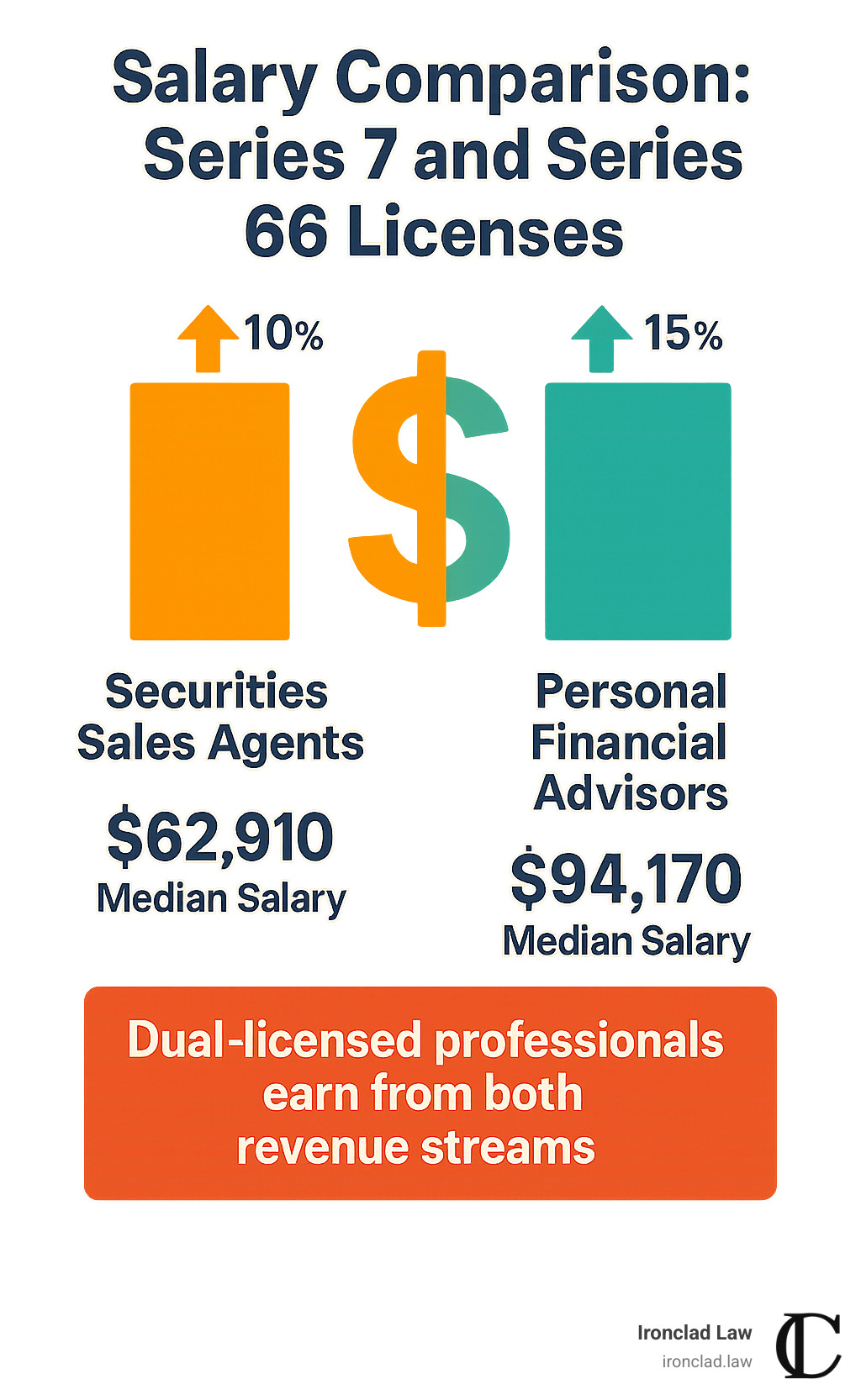
The financial services industry offers clear earning potential. Securities sales agents earn a median salary of $62,910, while personal financial advisors command $94,170 annually. Both sectors are projected to grow 10-15% through 2031 – faster than most other professions.
Having both licenses gives you maximum flexibility. You can execute trades for clients and charge advisory fees for financial planning. This dual capability separates top earners from those limited to just one service model.
I’m Michael Hurckes, Managing Partner at Ironclad Law, where I’ve spent years helping financial professionals steer FINRA regulations, broker-dealer compliance, and securities licensing requirements.
Series 7 and series 66 licenses vocab explained:
– series 7 license
– series 65 license requirements
– securities license exam
1. Why You Need Series 7 and 66 Licenses
Picture this: you’re sitting across from a client who wants to buy growth stocks and needs retirement planning advice. With just one license, you’d have to refer half that business to someone else. That’s money walking out the door.
Series 7 and series 66 licenses give you the power to handle both sides of that conversation – and keep all the revenue for yourself.
Clients don’t want to work with three different people for their financial needs anymore. They want one trusted advisor who can execute trades, provide investment advice, and create comprehensive financial plans. Without dual registration, you’re essentially telling potential clients “I can only help you halfway.”
Benefit #1 – Open up the Full Product Menu
Your Series 7 license is like getting the master key to the securities world. Once you pass that exam, you can sell virtually every investment product your clients might need.
We’re talking about stocks and bonds for building wealth, options for sophisticated strategies, mutual funds for instant diversification, and variable contracts like variable annuities. You’ll also have access to unit investment trusts and most municipal securities.
When a client asks about a specific investment strategy, you never have to say “Sorry, I can’t help with that.” You can recommend the right products and actually execute the transactions. That builds trust and keeps your clients from shopping around.
Benefit #2 – Combine Brokerage & Advisory Services
Your Series 66 license opens up an entirely different revenue stream that many advisors overlook.
While your Series 7 lets you earn commissions on trades, the Series 66 allows you to charge advisory fees for ongoing financial planning services. You can act under the fiduciary standard when providing investment advice, offer holistic planning that goes beyond just selling products, and provide ongoing portfolio management.
Instead of just earning a one-time commission when someone buys a mutual fund, you can also charge an annual advisory fee for managing their entire portfolio. That’s recurring revenue that compounds over time.
Benefit #3 – Competitive Edge & Salary Growth
Securities sales agents earn a median of $62,910 annually with 10% projected growth through 2031. Personal financial advisors do even better at $94,170 median salary with 15% growth projections.
Advisors with both licenses typically blow past these median numbers. They’re capturing revenue from commission-based trades and fee-based advisory services from the same client relationships.
This dual capability also gives you incredible job security. Professionals who can provide both brokerage and advisory services remain in high demand. You’re not just another salesperson or just another advisor – you’re a complete financial professional.
2. Series 7 vs Series 66: What They Cover and How They Differ
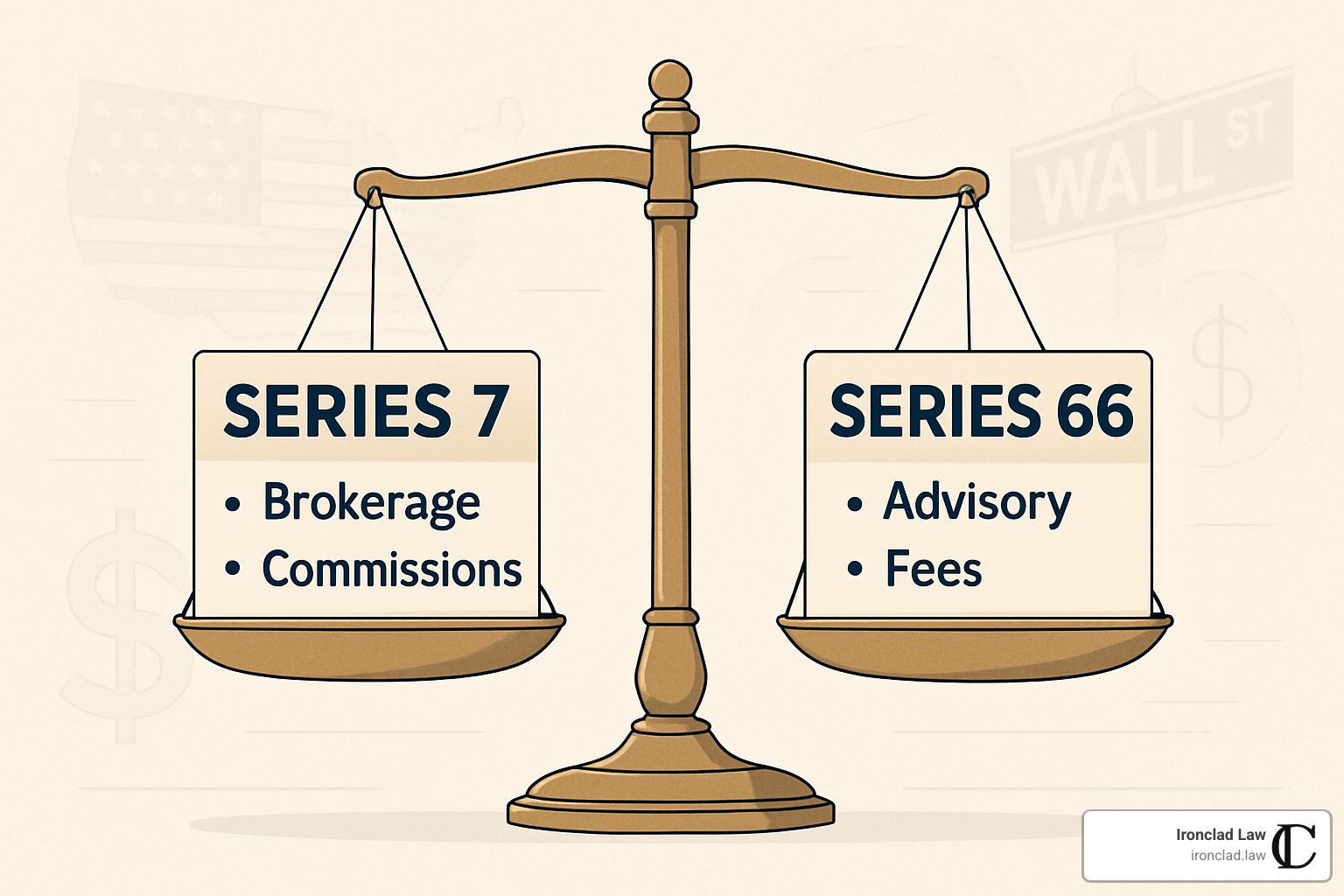
Think of series 7 and series 66 licenses like two keys that open up different doors in the financial services world. The Series 7 is your FINRA license – it’s all about selling securities and earning commissions. The Series 66 is administered by NASAA and focuses on providing investment advice for fees.
You must have your Series 7 before you can even sit for the Series 66. FINRA requires the Series 7 as a prerequisite, along with the SIE exam.
Series 7 and Series 66 Licenses at a Glance
The Series 7 exam is the longer of the two – 125 questions spread across 3 hours and 45 minutes. You’ll need to get 72% correct to pass, and it’ll cost you $300.
The Series 66 exam is more compact – 100 scored questions over 2 hours and 30 minutes. The passing score is slightly higher at 73%, but the exam fee is lower at $177.
| Feature | Series 7 | Series 66 |
|---|---|---|
| Questions | 125 multiple choice | 100 scored + 10 unscored |
| Time Limit | 3 hours 45 minutes | 2 hours 30 minutes |
| Passing Score | 72% (90 correct answers) | 73% (73 correct answers) |
| Exam Fee | $300 | $177 |
| Administrator | FINRA | NASAA (via FINRA) |
| Prerequisites | SIE Exam | Series 7 + SIE |
| Sponsorship Required | Yes (FINRA member firm) | No |
One major difference: you need a FINRA member firm to sponsor you for the Series 7, but you can self-enroll for the Series 66. This makes the Series 66 more accessible if you’re planning to work for an RIA or start your own advisory practice.
For comprehensive details about licensing requirements, check out our Securities Licensing page. You can also find official exam information on FINRA’s Series 7 page.
Key Differences From Series 63 & 65
The Series 66 is essentially a combo meal that replaces two other exams: the Series 63 and Series 65.
The Series 63 is your basic state securities agent license. Most states require it alongside your Series 7 to actually sell securities within their borders.
The Series 65 is the traditional investment advisor representative exam. It allows you to charge fees for investment advice, but unlike the Series 66, it doesn’t require you to hold a Series 7 first.
The Series 66 combines both the Series 63 and Series 65 content into one exam, but you must already have your Series 7. This makes the Series 66 route more efficient if you’re planning to do both brokerage and advisory work.
Instead of taking three separate exams (Series 7 + Series 63 + Series 65), you can achieve the same dual registration with just two exams (Series 7 + Series 66). That’s fewer test dates, less stress, and lower total costs.
3. Exam Details: Prerequisites, Format, Costs, Registration
Planning your path to series 7 and series 66 licenses requires understanding some important bureaucratic details. The two exams have completely different registration requirements.
Eligibility & Sponsorship Rules
The Series 7 requires “firm sponsorship” – you need a job offer or current employment with a FINRA member firm before you can even register. Your employer has to file Form U4 on your behalf and pay the $300 exam fee.
The Series 66 works completely differently. Once you have your Series 7, you can register yourself through FINRA’s Test Enrollment Services (TESS) system. No employer permission needed. You pay your own $177 fee and schedule when it works for you.
Both exams require you to pass the Securities Industry Essentials (SIE) exam first. The SIE costs $80 and covers basic securities industry concepts.
Registration & Scheduling Steps
The registration process follows a 120-day window rule for both exams. Once you’re eligible, you have 120 days to actually take the test.
For the Series 7, your employer initiates everything by filing Form U4 and paying fees. You’ll receive notification when you’re eligible to schedule, then book your appointment through Prometric testing centers.
The Series 66 puts you in the driver’s seat. Log into FINRA’s TESS system, pay your fee, and schedule directly with Prometric.
Both exams are administered at Prometric centers nationwide. The testing experience includes an additional 30 minutes beyond the actual exam time for tutorials and post-exam surveys.
Cancellation fees apply if you need to reschedule, so plan carefully. Testing accommodations are available for disabilities and limited English proficiency, but require advance approval and documentation.
For detailed requirements and current procedures, visit our Series 7 Exam Requirements page. FINRA also maintains comprehensive information at their Series 66 details page.
Retake & Validity Periods
Both series 7 and series 66 licenses follow identical retake policies.
If you don’t pass on your first or second attempt, you wait 30 days before trying again. After a third failure within two years, the waiting period jumps to 180 days. There’s no limit on total attempts.
The two-year rule is crucial for career planning. Once you pass an exam, you have two years to get registered with a firm and start working. Miss that deadline, and you’ll need to retake the exam.
Once you’re actively registered and working, your licenses stay valid indefinitely. Leave the industry? You have two years to return and reactivate without retaking exams.
Recent regulatory developments include FINRA’s Maintaining Qualifications Program (MQP) and NASAA’s Exam Validity Extension Program (EVEP), which may extend validity periods in certain situations.
4. Pass Rates & Preparation: How to Ace the Tests
The truth about series 7 and series 66 licenses preparation? Most people underestimate what it takes to pass these exams. But with the right strategy and realistic expectations, you can join the ranks of successful financial professionals who’ve earned both credentials.

The Series 66 has an estimated pass rate around 65-70%, while the Series 7 presents similar challenges. These aren’t impossible odds, but they demand respect and proper preparation.
Proven Study Strategies
Plan for 80-100 hours of focused study for the Series 7 and 75-85 hours for the Series 66. Trying to shortcut this process usually leads to retakes – which cost more time and money in the long run.
The Series 7 covers an enormous range of securities products and regulations. The Series 66 takes a different approach, focusing heavily on state investment advisory laws and fiduciary responsibilities.
Start with the official content outlines from FINRA and NASAA. These documents show exactly what topics appear on each exam and how many questions to expect from each area.
Spaced repetition beats cramming every time. Instead of marathon study sessions right before your exam date, spread your preparation over several months. Review previously covered material regularly, even as you learn new concepts.
Practice with realistic questions that mirror the actual exam format. The Series 7 gives you about 1.8 minutes per question, while the Series 66 allows roughly 1.5 minutes each. Get comfortable with this pacing during your practice sessions.
Quality study packages typically include customizable study plans, comprehensive manuals with graphics and exercises, question banks with hundreds of practice problems, full-length practice exams, video libraries for complex concepts, and instructor access when you need clarification.
Exam-Day Best Practices
Arrive early at your testing center – plan for 30 minutes before your scheduled appointment. Bring government-issued photo identification and nothing else. These testing centers have strict security protocols.
During the Series 7 exam, you’ll have 3 hours and 45 minutes to answer 125 questions. The Series 66 gives you 2 hours and 30 minutes for 100 scored questions. You’ll use only the electronic calculator and dry-erase board provided by the testing center.
Read each question carefully. Many wrong answers result from misreading the question rather than not knowing the material. If you’re unsure about an answer, eliminate obviously incorrect choices first.
Stress management becomes crucial during these lengthy exams. Take deep breaths, stay hydrated, and remember that some nervousness is normal.
For additional preparation resources and detailed exam strategies, visit our Securities License Exam page where we break down specific study approaches for different learning styles.
5. Careers, Renewal & License Maintenance
Once you’ve earned your series 7 and series 66 licenses, you’re entering a world of exciting career possibilities – but these licenses also come with ongoing responsibilities that keep you sharp and compliant.
Continuing Education & Compliance
Continuing education isn’t optional. Both Series 7 and Series 66 registrations require ongoing training to stay active, and the requirements are designed to keep you current with an industry that changes rapidly.
The Regulatory Element is your main ongoing requirement. This computer-based training covers current regulations and industry developments, and you’ll need to complete it within 120 days of your second registration anniversary, then every three years after that. Miss this deadline, and your registration becomes inactive.
Your employer handles the Firm Element – training on company-specific policies and procedures. This happens annually and covers everything from your firm’s particular way of doing business to updates on internal compliance procedures.
Staying current with these requirements actually protects your career. FINRA’s Maintaining Qualifications Program (MQP) may help you maintain your qualifications during employment gaps, and being up-to-date shows clients and employers that you’re serious about your profession.
Long-Term Career Pathways with Series 7 and 66 Licenses
The beauty of having both licenses is the career flexibility they create. You’re not locked into one type of role or one way of serving clients.
Starting out, most people begin as registered representatives or client associates. These roles let you learn the business while working under experienced professionals.
As you gain experience, doors open to wealth advisor and portfolio manager positions. This is where dual licensing really shines – you can manage comprehensive client relationships that include both commission-based transactions and fee-based advisory services.
For the entrepreneurially minded, series 7 and series 66 licenses provide the foundation for ultimate independence. You can become a branch manager overseeing other licensed professionals, or even start your own registered investment advisory firm. RIA ownership represents the pinnacle of independence in this industry.
Some professionals pivot into specialized roles like compliance officers, where your licensing background gives you credibility when ensuring firm adherence to securities regulations. Others become product specialists, focusing their expertise on particular investment vehicles or market niches.
Professionals with both licenses have more options throughout their careers. When market conditions change or personal priorities shift, dual licensing provides the flexibility to adapt without starting over.
For ongoing compliance support and regulatory guidance as your career develops, our FINRA Compliance services can help ensure your practice remains in good standing while you focus on serving clients and growing your business.
Frequently Asked Questions about the Series 7 and Series 66 Licenses
Let’s tackle the most common questions I hear from professionals pursuing series 7 and series 66 licenses. These concerns come up repeatedly in my practice at Ironclad Law, so you’re definitely not alone in wondering about these details.
What happens if I fail—how soon can I retake?
Nobody likes to think about failing, but it’s smart to know the rules upfront. The good news is that FINRA doesn’t limit how many times you can attempt either exam – you just need to wait between attempts.
The waiting periods are straightforward and apply to both exams equally. After your first or second failure, you’ll wait 30 days before you can retake the exam. This gives you time to identify weak areas and do focused studying without the pressure of an immediate deadline.
After a third failure within two years, the waiting period extends to 180 days. This longer break is designed to encourage more thorough preparation before your next attempt.
Here’s something important to remember: these waiting periods apply to each exam individually. If you pass your Series 7 but fail the Series 66, the Series 66 waiting period doesn’t affect your ability to take other exams like the Series 63 or Series 65.
Do professional designations waive the Series 66?
This question involves a bit of regulatory nuance that trips up a lot of people. Professional designations can waive the Series 65 requirement, but they don’t directly waive the Series 66 exam itself.
The accepted designations include some heavy hitters in the financial planning world: CFP (Certified Financial Planner), CFA (Chartered Financial Analyst), ChFC (Chartered Financial Consultant), MSFS (Master of Science in Financial Services), PFS (Personal Financial Specialist), and CIMA (Certified Investment Management Analyst).
But here’s where it gets interesting. If you hold one of these designations, you might actually choose to take the Series 63 instead of the Series 66. Since the Series 65 portion would be waived, you’d only need the Series 63 to achieve the same state registration capability.
The decision depends on your specific career goals and which states you plan to work in. Some states have different requirements, so it’s worth checking with your state regulator or consulting with a securities attorney before making this choice.
How long do the licenses stay active if I leave the industry?
Life happens, and sometimes financial professionals need to step away from the industry temporarily. The two-year rule provides some breathing room for these situations.
Your exam results remain valid for two years after you leave the securities industry. During this period, you can re-enter and reactivate your series 7 and series 66 licenses without retaking the exams. This is particularly helpful for professionals who take time off for family reasons, pursue additional education, or explore other career opportunities.
After two years pass, you’ll need to retake the exams to regain your licenses. There’s no way around this – the clock runs out, and you start fresh.
Recent developments have added some flexibility to these rules. FINRA’s Maintaining Qualifications Program (MQP) and NASAA’s Exam Validity Extension Program (EVEP) may extend validity periods under certain circumstances. However, state adoption of these programs varies significantly, so you can’t count on them being available everywhere.
The key is to check with your specific state regulator before making any assumptions about extended validity periods. What works in one state might not apply in another, and the last thing you want is to find you need to retake exams when you’re ready to return to the industry.
Conclusion
Your journey to earning series 7 and series 66 licenses isn’t just about passing two exams – it’s about positioning yourself for a thriving career in financial services where you can truly make a difference in people’s financial lives.
While your competitors are limited to either selling products or providing advice, you’ll have the flexibility to do both. That’s not just a competitive advantage – it’s becoming essential in today’s market where clients expect comprehensive service from their financial professionals.
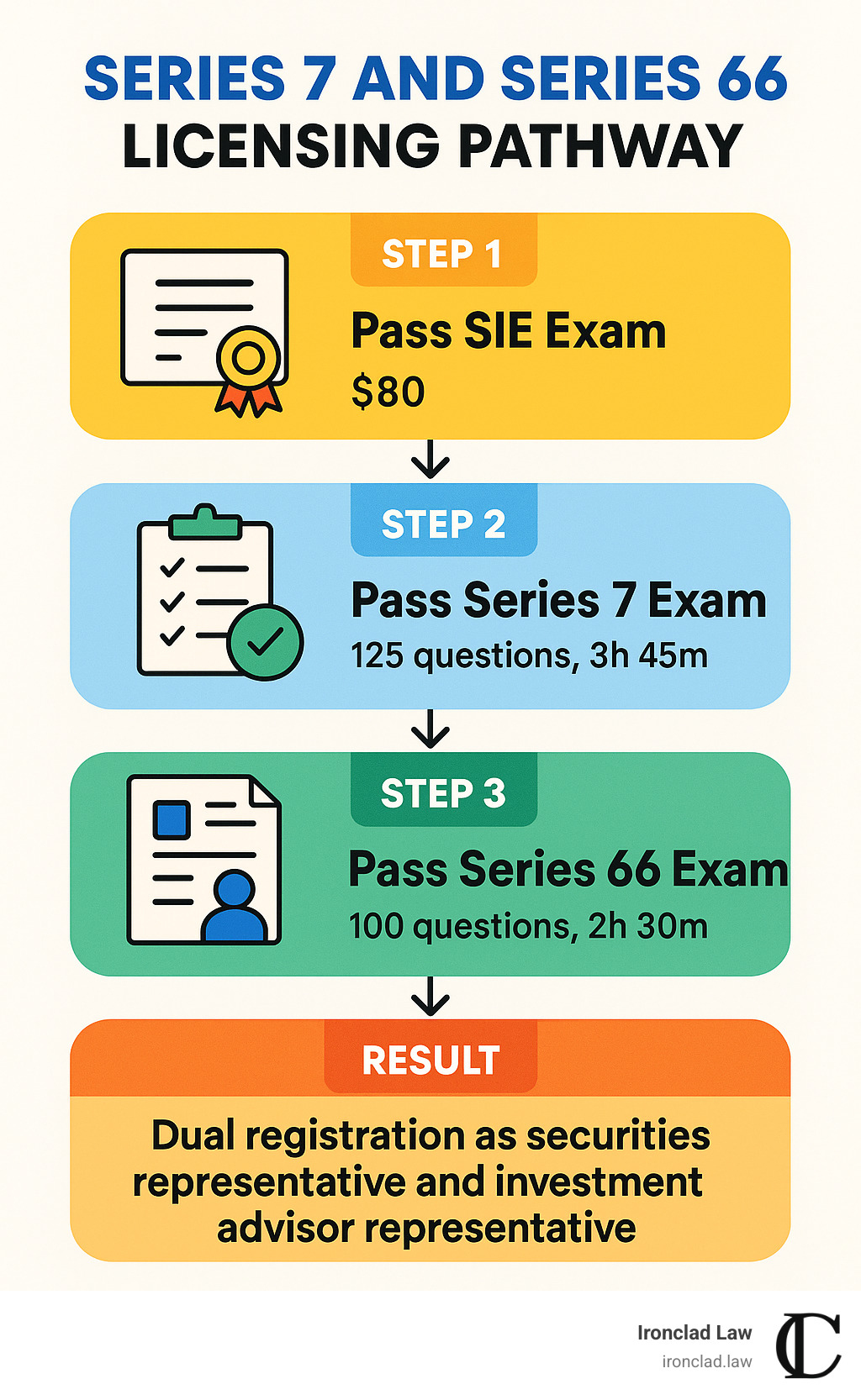
Here’s what your licensing roadmap looks like: Start with the SIE exam ($80) to build your foundation. Once you pass that, tackle the Series 7 ($300) to open up your ability to sell securities. Finally, complete the Series 66 ($177) to add investment advisory capabilities to your toolkit.
Yes, it’s a commitment. You’re looking at 155-185 hours of total study time and $557 in exam fees. But consider this: securities sales agents earn a median of $62,910 annually, while personal financial advisors command $94,170. With both licenses, you’re not choosing between these paths – you’re combining them.
The ongoing requirements aren’t burdensome either. Continuing education keeps your licenses active and ensures you stay current with industry changes. Many professionals find this ongoing learning actually helps them serve clients better and spot new opportunities.
At Ironclad Law, we’ve watched countless financial professionals transform their careers through proper licensing. Our assertive approach to legal guidance means we don’t just help you understand the rules – we help you leverage them strategically to build a successful practice.
The financial services industry rewards those who can serve clients comprehensively. Whether you’re helping a young family start investing or guiding retirees through complex portfolio decisions, having series 7 and series 66 licenses means you’re never limited in how you can help.
Ready to take the next step? Our team at Ironclad Law provides the regulatory guidance and compliance support you need to build a practice that’s both profitable and compliant. Visit our Securities Licensing page to learn how we can support your success in the financial services industry.
Your clients deserve comprehensive service. Your career deserves maximum flexibility. These licenses deliver both.